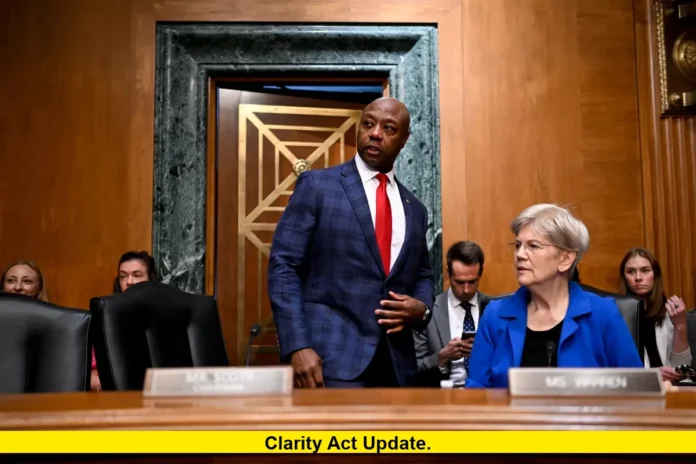

The CLARITY Act update this week confirms that the U.S. Senate will not vote on the landmark crypto market structure bill before lawmakers leave Washington for their August recess. The decision closes the door on 2026 passage before September and leaves the digital asset industry waiting for the next legislative window.
Senate Majority Leader John Thune had signaled as recently as August 3 that a floor vote would happen before recess. That did not materialize. Multiple people tracking the legislation confirmed no cloture motion was filed on the bill, formally known as the Digital Asset Market Clarity Act or H.R. 3633.
What Just Happened With the CLARITY Act
Friday, August 7, marked the Senate’s last scheduled workday before its summer break. Lawmakers needed a cloture motion filed with enough lead time to hold a procedural vote before departing. That motion never came.
Industry sources following the bill say Thune could still file for cloture when the Senate returns. If he does so immediately upon return, the first procedural vote could happen as early as September 15. A later filing pushes the earliest possible vote to September 16.
The Senate returns to Washington on September 14 and will have roughly three weeks to work on the bill alongside other pending priorities before breaking again for the final stretch of midterm campaigning.
Why the Vote Stalled
Three disputes kept the bill from reaching the floor. Senators from both parties said they had unresolved concerns heading into the deadline.
- Ethics provisions: Democrats pushed for restrictions on federal officials and their families engaging in crypto dealings. A draft included a temporary ban on senior officials issuing or sponsoring digital assets through 2029, but the White House had not signed off on it.
- Illicit finance language: Lawmakers disagreed over how the bill addresses money laundering and sanctions evasion risks tied to digital assets.
- Stablecoin yield: A provision restricting passive yield on stablecoins remained contested. Coinbase had publicly withdrawn support earlier in the year over this exact issue, citing its own revenue tied to stablecoin arrangements.
Senate Democrats reportedly reached internal agreement that they would block cloture unless Republicans showed visible movement on all three fronts. Republicans hold 53 Senate seats, meaning they needed at least seven Democratic votes to reach the 60-vote threshold required to end debate.
The Legislative Timeline So Far
The bill’s path through Congress has been long, and this latest delay is just the newest chapter. Here is how it has moved:
| Date | Milestone |
|---|---|
| July 17, 2025 | Passed the House, 294–134, with 78 Democrats in favor |
| January 2026 | Cleared Senate Agriculture Committee, 12–11 |
| May 14, 2026 | Cleared Senate Banking Committee, 15–9, with two Democrats joining |
| June 1, 2026 | Placed under General Orders, formally eligible for a Senate floor vote |
| July 22, 2026 | New Republican draft released to try to resolve outstanding disputes |
| August 7, 2026 | Senate recess begins with no cloture vote held |
| September 14, 2026 | Senate returns to Washington, D.C. |
The House passage in July 2025 remains the strongest bipartisan congressional endorsement of crypto legislation in U.S. history. Getting a companion result out of the Senate has proven far harder.
What This Means for Crypto Regulation Right Now
Without a statute, crypto oversight continues to run through agency guidance rather than permanent law. The Securities and Exchange Commission and the Commodity Futures Trading Commission issued joint interpretive guidance on March 17, 2026, classifying 16 digital assets under a five-category taxonomy. That guidance can be reversed by a future administration without a congressional vote, since only a statute survives a change in leadership intact.
The CFTC has been especially active in the absence of legislation. Acting Chairman Caroline Pham launched a 12-month “Crypto Sprint” in August 2025 that led to the first listed spot crypto trading on CFTC-regulated exchanges. The SEC’s own 2026 regulatory agenda includes a rulemaking package nicknamed “Regulation Crypto,” covering registration exemptions for token launches and custody rules for broker-dealers.
Prediction markets have reacted to the stalled vote. Odds tracked on platforms like Kalshi and Polymarket for CLARITY Act passage in 2026 dropped sharply in the days leading up to the recess, with some contracts pricing 2026 passage well below 30%.
Industry Reaction
Crypto trade groups, including the Digital Chamber and the Crypto Council for Innovation, issued statements following the Senate’s decision not to vote. Industry advocates have argued that continued reliance on agency guidance rather than statute leaves companies without durable rules, since guidance can shift with each new administration.
Supporters of the bill also point to the Supreme Court’s June 29, 2026, ruling in Trump v. Slaughter, which allowed the president to remove independent agency commissioners at will. That decision added a further layer of uncertainty to any regulatory framework that rests on agency action instead of a congressional statute.
What Happens Next
The bill is not dead, but its path forward now runs through September and into the heart of election-year politics. Once the Senate reconvenes on September 14, it faces a compressed calendar shared with other must-pass items, including spending legislation.
If the three-week September window closes without a deal, the CLARITY Act’s next realistic opportunity would come after the November midterms, when the composition and priorities of Congress could shift depending on election outcomes. Analysts tracking the bill describe the odds of eventual passage as close to a coin flip, with the missed August deadline making the timeline considerably tighter.
For now, crypto exchanges, stablecoin issuers, and token projects continue to operate under a mix of SEC and CFTC guidance rather than a single federal framework. That leaves the core question the CLARITY Act was designed to answer, whether a given digital asset falls under securities law or commodities oversight, unresolved at the federal level heading into the fall.
What’s your take on the Senate missing this deadline? Drop your thoughts in the comments below.