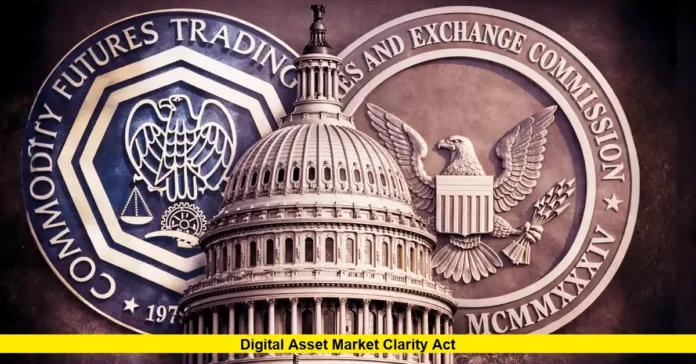
: Latest Updates, Key Provisions, SEC vs. CFTC & Impact)
The Digital Asset Market CLARITY Act is one of the most important cryptocurrency bills considered by the U.S. Congress. Designed to establish a comprehensive federal framework for digital asset markets, the legislation seeks to clarify which federal agencies regulate cryptocurrencies, blockchain businesses, and digital asset trading platforms.
For years, the U.S. cryptocurrency industry has operated under an uncertain regulatory environment. Questions over whether certain digital assets should be treated as securities or commodities have resulted in lawsuits, enforcement actions, and inconsistent regulatory guidance. The CLARITY Act aims to address those issues by creating clearer legal definitions, assigning responsibilities to federal regulators, and establishing rules for digital asset businesses.
As of August 2026, the legislation remains under consideration in Congress. While it has cleared significant legislative hurdles, it has not yet become law. Nevertheless, the bill has become a central piece of the national conversation about the future of cryptocurrency regulation in the United States. Click Here to Read More
What Is the Digital Asset Market CLARITY Act?
The Digital Asset Market CLARITY Act is proposed federal legislation that establishes a market structure framework for digital assets in the United States.
Its primary objectives include:
- Creating clear regulatory rules for digital assets
- Defining the responsibilities of the SEC and the CFTC
- Establishing registration requirements for digital asset businesses
- Improving consumer and investor protection
- Encouraging responsible blockchain innovation
- Reducing legal uncertainty for the cryptocurrency industry
Rather than relying primarily on enforcement actions to determine how cryptocurrencies should be regulated, the bill would provide statutory guidance that businesses, investors, and regulators could follow.
Latest Digital Asset Market CLARITY Act Update (August 2026)
The CLARITY Act continues to move through the legislative process but has not yet completed every step required to become federal law.
Recent developments include:
- The House of Representatives previously approved the legislation.
- Senate committees have released updated legislative text with revisions and additional provisions.
- Lawmakers continue negotiating bipartisan support before a full Senate vote.
- If the Senate approves a version that differs from the House bill, both chambers must agree on a final text before it can be sent to the President.
Until that process is complete, existing federal securities, commodities, banking, and anti-money laundering laws continue to govern the digital asset industry.
Why Was the CLARITY Act Introduced?
Congress introduced the CLARITY Act because the rapid growth of cryptocurrencies exposed gaps in the existing regulatory framework.
For more than a decade, blockchain technology developed faster than federal law. As thousands of cryptocurrencies entered the market, businesses frequently struggled to determine which agency regulated their products.
The legislation seeks to solve several long-standing challenges.
Regulatory Uncertainty
One of the biggest concerns has been uncertainty surrounding the legal classification of digital assets. Different regulators have sometimes reached different conclusions regarding similar blockchain projects.
Market Growth
The digital asset market has expanded into a multitrillion-dollar global industry involving cryptocurrency exchanges, decentralized finance platforms, token issuers, institutional investors, payment providers, and blockchain developers.
Many lawmakers believe federal regulation should evolve to reflect that growth.
Investor Protection
Congress also wants to strengthen safeguards for consumers by improving disclosures, increasing transparency, and establishing clearer compliance standards for companies operating in digital asset markets.
Legislative History of the CLARITY Act
The Digital Asset Market CLARITY Act builds on several years of congressional efforts to establish federal cryptocurrency legislation.
Introduction
Members of Congress introduced the bill to create a comprehensive market structure framework after years of debate over digital asset regulation.
Committee Review
The legislation underwent hearings, amendments, and committee consideration before advancing through Congress.
During this process, lawmakers revised several provisions involving market oversight, registration requirements, disclosure obligations, and agency responsibilities.
House Approval
The House passed the CLARITY Act with bipartisan support, marking one of the most significant congressional votes on cryptocurrency regulation.
Senate Consideration
After arriving in the Senate, lawmakers released updated legislative text incorporating additional provisions related to ethics, consumer protections, market oversight, and digital commodity regulation.
The Senate continues to debate the proposal before any final vote.
Why the Digital Asset Market CLARITY Act Matters
The CLARITY Act could reshape how cryptocurrencies are regulated in the United States.
If enacted, the legislation would affect nearly every part of the digital asset ecosystem, including:
- Cryptocurrency exchanges
- Digital asset brokers
- Dealers
- Custodians
- Token issuers
- Blockchain developers
- Institutional investors
- Retail investors
Instead of relying on years of litigation to determine regulatory authority, the bill seeks to establish clearer statutory rules that define how different digital assets should be regulated.
Supporters believe this approach would provide greater certainty while encouraging responsible innovation. Critics, however, argue that implementation details and future rulemaking will ultimately determine how effective the legislation becomes.
Main Goals of the CLARITY Act
The legislation is built around several core objectives.
Create Regulatory Clarity
The bill attempts to eliminate confusion regarding which federal laws apply to different categories of digital assets.
Define Agency Responsibilities
It establishes a clearer division of responsibilities between the Securities and Exchange Commission (SEC) and the Commodity Futures Trading Commission (CFTC).
Protect Consumers
The legislation introduces additional disclosure, registration, operational, and compliance requirements intended to strengthen investor confidence and reduce fraud.
Encourage Innovation
Lawmakers supporting the bill argue that predictable regulations can encourage blockchain companies to build products within the United States while maintaining appropriate consumer safeguards.
Strengthen U.S. Competitiveness
Many policymakers believe a comprehensive regulatory framework will help the United States remain competitive as other countries continue adopting dedicated cryptocurrency legislation.
Key Provisions of the Digital Asset Market CLARITY Act
The Digital Asset Market CLARITY Act contains numerous provisions intended to establish a modern regulatory framework for digital assets. Rather than introducing a single rule for every cryptocurrency, the legislation creates a comprehensive system that addresses market participants, regulatory authority, disclosures, consumer protection, and compliance obligations.
The bill focuses on bringing greater certainty to an industry that has operated under overlapping federal and state regulations for years.
SEC vs. CFTC Under the CLARITY Act
One of the most closely watched features of the CLARITY Act is how it divides regulatory authority between the Securities and Exchange Commission (SEC) and the Commodity Futures Trading Commission (CFTC).
For years, uncertainty over whether cryptocurrencies should be regulated as securities or commodities has created legal disputes and inconsistent enforcement. The CLARITY Act attempts to establish a clearer framework by defining when each agency has jurisdiction.
The SEC’s Role

The SEC would continue overseeing digital assets that qualify as securities under federal securities laws.
Its responsibilities generally include:
- Digital asset securities
- Investment contract assets during applicable stages
- Securities offerings involving digital assets
- Public disclosure requirements
- Anti-fraud enforcement
- Investor protection rules
The legislation does not remove the SEC from cryptocurrency regulation. Instead, it clarifies the circumstances in which securities laws continue to apply.
The CFTC’s Role
The CLARITY Act would significantly expand the CFTC’s role in supervising digital commodity markets.
The agency would oversee many spot-market activities involving qualifying digital commodities, including registered market participants.
Its responsibilities could include oversight of:
- Digital commodity exchanges
- Digital commodity brokers
- Digital commodity dealers
- Trading platforms
- Market integrity
- Customer protection standards
- Anti-manipulation enforcement
- Registration and compliance requirements
Supporters believe this clearer division of authority would reduce regulatory uncertainty and provide businesses with more predictable compliance expectations.
How Digital Assets Could Be Classified
The legislation proposes statutory definitions for several categories of blockchain-based assets.
Instead of assuming every cryptocurrency falls into the same legal category, the bill recognizes that different digital assets may serve different purposes and therefore require different regulatory treatment.
Among the categories addressed are:
- Digital assets
- Digital commodities
- Digital asset securities
- Investment contract assets
- Ancillary assets
These definitions are intended to help regulators determine which legal framework applies to particular digital assets based on their characteristics and use.
Registration Requirements for Digital Asset Businesses
The CLARITY Act creates federal registration pathways for many businesses operating within digital asset markets.
Depending on the services they provide, companies may need to register with the SEC, the CFTC, or another appropriate regulator.
Businesses potentially covered include:
- Cryptocurrency exchanges
- Trading platforms
- Brokers
- Dealers
- Custodians
- Certain digital asset intermediaries
Registration would generally require compliance with federal operational standards, reporting obligations, financial requirements, examinations, and recordkeeping rules.
Disclosure Requirements for Token Issuers
Transparency is another major objective of the legislation.
The bill establishes disclosure obligations intended to provide investors with important information before purchasing qualifying digital assets.
Potential disclosures include information regarding:
- Network governance
- Blockchain protocol
- Token supply
- Token distribution
- Insider ownership
- Material risks
- Development roadmap
- Significant protocol changes
Supporters argue that these disclosures would improve investor understanding while recognizing that blockchain projects often differ from traditional public companies.
Rules for Cryptocurrency Exchanges
Cryptocurrency exchanges are among the businesses most directly affected by the CLARITY Act.
The legislation creates operational standards intended to strengthen oversight of trading platforms serving U.S. customers.
Areas addressed include:
Customer Asset Protection
Exchanges would be expected to maintain safeguards designed to protect customer assets and reduce operational risk.
Market Surveillance
Registered platforms would be required to implement systems that help identify suspicious trading activity, fraud, and potential market manipulation.
Operational Compliance
Digital asset exchanges would need compliance programs covering recordkeeping, internal controls, supervisory procedures, and regulatory reporting.
Conflict-of-Interest Policies
The legislation also encourages policies designed to reduce conflicts involving exchange operations, customer transactions, and affiliated activities.
Consumer Protection Measures
Protecting consumers represents one of the legislation’s primary goals.
The CLARITY Act introduces several measures intended to improve confidence in digital asset markets.
Improved Transparency
Registered firms would provide more standardized disclosures regarding products, services, fees, and associated risks.
Fraud Prevention
Federal regulators would retain authority to investigate and pursue fraudulent conduct involving regulated digital asset activities.
Market Integrity
The legislation seeks to reduce practices that may undermine fair and orderly markets, including certain forms of market manipulation and deceptive trading.
Regulatory Oversight
Clearer registration requirements would give federal agencies more defined supervisory authority over regulated market participants.
How the CLARITY Act Could Affect Cryptocurrency Exchanges
If enacted, cryptocurrency exchanges may experience some of the most significant regulatory changes.
Potential impacts include:
- New federal registration obligations
- Expanded compliance programs
- Additional reporting requirements
- Enhanced cybersecurity expectations
- Stronger customer protection standards
- Greater operational oversight
- Increased regulatory examinations
Although compliance costs could rise, supporters argue that clearer federal rules may encourage greater institutional participation and strengthen confidence in regulated trading platforms.
Impact on Crypto Brokers and Dealers
Digital asset brokers and dealers would also face new federal requirements under the proposed legislation.
These businesses may need to:
- Register with the appropriate regulator
- Maintain compliance policies
- Meet operational standards
- Preserve transaction records
- Cooperate with regulatory examinations
- Protect customer assets
- Comply with applicable reporting requirements
The goal is to create consistent national standards across the digital asset marketplace instead of relying on a patchwork of differing regulatory approaches.
How the CLARITY Act Could Affect Investors
Retail and institutional investors may experience several potential benefits if the legislation becomes law.
These include:
- Greater transparency before purchasing digital assets
- Improved oversight of regulated exchanges
- Stronger consumer safeguards
- Clearer regulatory standards
- Increased confidence in market participants
- Better access to information about digital asset projects
At the same time, some market participants could face higher compliance costs, which may influence how certain products and services are offered within the U.S. cryptocurrency market.
Why Regulatory Clarity Matters
For many years, uncertainty surrounding cryptocurrency regulation has been viewed as one of the industry’s biggest challenges.
Companies have often struggled to determine:
- Which federal agency oversees their activities
- Which registration requirements apply
- Which disclosure obligations must be followed
- How new blockchain projects should be structured
The CLARITY Act attempts to answer many of these questions through legislation rather than relying primarily on court decisions or regulatory enforcement actions.
Supporters believe that clearer statutory rules could encourage responsible innovation while maintaining strong consumer protections and improving the long-term stability of U.S. digital asset markets.
How the CLARITY Act Addresses Decentralized Finance (DeFi)
Decentralized finance, commonly known as DeFi, is one of the most complex areas of cryptocurrency regulation. Unlike traditional financial institutions, many DeFi protocols operate through smart contracts and decentralized blockchain networks rather than centralized companies.
The CLARITY Act recognizes that decentralized technologies require a different regulatory approach from traditional financial services. Instead of applying identical rules to every blockchain project, the legislation seeks to distinguish between centralized intermediaries and decentralized networks when determining regulatory obligations.
However, DeFi remains an evolving area of law. If the CLARITY Act becomes law, federal agencies would likely issue additional regulations and guidance explaining how specific provisions apply to decentralized protocols, developers, governance participants, and service providers.
Stablecoins and the CLARITY Act
Although the CLARITY Act is primarily a market structure bill, it also has implications for stablecoins because these digital assets are widely traded on cryptocurrency exchanges and other digital asset platforms.
The legislation does not create a complete regulatory framework for payment stablecoins. Congress has considered separate legislation focused specifically on stablecoin issuance, reserve requirements, and supervision.
Instead, the CLARITY Act complements those efforts by establishing broader rules for digital asset markets. Businesses dealing with stablecoins may still be subject to registration, compliance, disclosure, and consumer protection requirements if they operate within the framework established by the legislation.
Anti-Money Laundering and Compliance Requirements
The CLARITY Act does not replace existing anti-money laundering (AML) or Bank Secrecy Act (BSA) requirements. Instead, digital asset businesses would continue complying with applicable federal financial crime laws while also meeting any new obligations created by the legislation.
Compliance programs may include:
- Customer identification procedures
- Know Your Customer (KYC) policies
- Suspicious Activity Report (SAR) requirements
- Recordkeeping obligations
- Internal compliance controls
- Cooperation with law enforcement agencies
These requirements are intended to help prevent money laundering, terrorist financing, fraud, and other illicit financial activities involving digital assets.
Ethics Provisions in the Senate Proposal
One of the notable additions in the Senate version of the CLARITY Act is a set of ethics provisions.
These measures are designed to address concerns about conflicts of interest involving certain federal officials and their participation in digital asset activities.
The ethics provisions seek to strengthen public confidence by establishing standards that limit certain digital asset-related financial interests while individuals serve in specified government positions.
Although the exact language could change during the legislative process, the inclusion of ethics provisions reflects lawmakers’ efforts to improve transparency and accountability.
Supporters of the CLARITY Act
The legislation has received support from many participants in the digital asset industry, financial technology companies, and policymakers who believe the United States needs a modern regulatory framework.
Supporters argue that the bill would:
- Reduce regulatory uncertainty
- Encourage responsible blockchain innovation
- Strengthen consumer protections
- Improve transparency
- Promote investment in the United States
- Increase institutional participation in digital asset markets
- Help the U.S. remain competitive with other countries that have adopted comprehensive crypto regulations
Many industry organizations also believe that clearer rules would reduce litigation and provide businesses with greater confidence when developing blockchain products and services.
Criticism of the CLARITY Act
Despite significant support, the legislation has also generated debate.
Critics have raised several concerns, including:
Investor Protection
Some consumer advocates argue that the legislation should include stronger investor safeguards and more detailed disclosure requirements.
Regulatory Complexity
Although the bill seeks to simplify digital asset regulation, some experts believe that determining how specific cryptocurrencies should be classified could still present challenges.
Future Technology
Blockchain technology continues to evolve rapidly. Critics caution that additional legislation may eventually be necessary to address future innovations not specifically covered by the current proposal.
Implementation
Much of the legislation’s practical impact would depend on future rulemaking by federal agencies after the bill becomes law.
Potential Impact on the U.S. Cryptocurrency Industry
If enacted, the Digital Asset Market CLARITY Act could reshape the cryptocurrency industry in several important ways.
Greater Regulatory Certainty
Businesses would have clearer guidance regarding registration, compliance, and operational requirements.
Increased Institutional Adoption
Banks, investment firms, and other financial institutions may be more willing to participate in digital asset markets if a comprehensive regulatory framework is established.
Consumer Confidence
Improved transparency and stronger oversight could increase confidence among retail investors.
Business Investment
Many blockchain companies argue that clearer federal rules would encourage investment, job creation, and technological development within the United States.
International Competitiveness
Supporters believe the legislation would help the United States compete with jurisdictions such as the European Union, the United Kingdom, Singapore, and other countries that have introduced dedicated digital asset regulations.
What Happens Next?
As of August 2026, the Digital Asset Market CLARITY Act has not become law.
Before the legislation can take effect, several important steps remain:
- The Senate must approve the bill.
- Any differences between the House and Senate versions must be reconciled.
- Both chambers of Congress must pass the same final version.
- The legislation must then be signed by the President or become law through another constitutional process.
Even after enactment, federal agencies would likely require additional time to develop detailed regulations implementing many of the bill’s provisions.
Frequently Asked Questions
What is the Digital Asset Market CLARITY Act?
The Digital Asset Market CLARITY Act is proposed U.S. legislation that establishes a comprehensive regulatory framework for digital assets and clarifies the responsibilities of federal financial regulators.
Has the CLARITY Act passed?
The legislation has advanced through important stages in Congress but has not yet become law as of August 2026.
Why is the CLARITY Act important?
The bill aims to provide regulatory clarity, strengthen consumer protection, establish registration requirements for digital asset businesses, and encourage responsible innovation within the cryptocurrency industry.
Will the CLARITY Act affect Bitcoin?
If enacted, the legislation would affect the regulatory framework governing digital asset markets, including businesses involved in trading, custody, and other services related to Bitcoin and other cryptocurrencies.
Which agency regulates cryptocurrencies under the CLARITY Act?
The proposed framework generally divides responsibilities between the Securities and Exchange Commission (SEC) and the Commodity Futures Trading Commission (CFTC), depending on the nature of the digital asset and the regulated activity.
Conclusion
The Digital Asset Market CLARITY Act represents one of the most significant efforts by Congress to modernize the regulation of cryptocurrencies and blockchain technology in the United States.
By establishing clearer rules for digital assets, defining the responsibilities of the SEC and CFTC, introducing registration and disclosure requirements, and strengthening consumer protections, the legislation seeks to replace years of regulatory uncertainty with a more predictable legal framework.
Although the bill has made substantial progress, it has not yet been enacted into law. The remaining legislative process, along with future regulatory implementation, will determine how the proposed framework ultimately shapes the U.S. digital asset market.
For investors, cryptocurrency businesses, developers, and policymakers, the CLARITY Act remains one of the most closely watched pieces of financial legislation. Whether enacted in its current form or amended through future negotiations, it is likely to influence the direction of U.S. cryptocurrency regulation for years to come.
Stay tuned for future updates as Congress continues considering the Digital Asset Market CLARITY Act and other major cryptocurrency legislation.