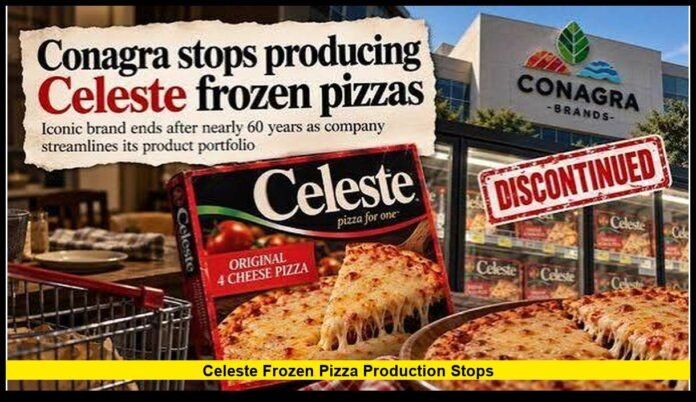

The celeste frozen pizza production stop is bringing an end to a familiar name in America’s frozen-food aisle. The longtime pizza brand has officially ceased production, leaving customers with only the inventory already moving through stores and distribution channels. The decision reflects a shift in business priorities, as the manufacturer looks to concentrate resources on products with stronger financial potential.
For shoppers, the change means a convenient, budget-conscious meal option will gradually become harder to find. For the food industry, it offers another example of how manufacturers are reassessing established brands amid changing business conditions.
Production Ends as Remaining Supplies Sell Through
Celeste frozen pizzas are no longer being manufactured. Existing packages may still appear in supermarkets, but availability will depend on how quickly retailers sell their remaining stock.
Some stores may run out before others. Customers who regularly purchased the product could notice empty freezer spaces or fewer varieties before the brand disappears completely from their local stores.
There is no single confirmed date for the final retail sale nationwide. Inventory levels differ among retailers, and the remaining supply may last longer in some locations than in others.
Shoppers should not confuse temporary availability with a return to normal production. Finding a package today does not mean additional shipments will continue indefinitely.
Why the Manufacturer Made the Decision
The decision forms part of a broader effort to simplify the manufacturer’s product lineup and direct investment toward more promising business opportunities.
Food companies must consider more than brand recognition when deciding which products to retain. Manufacturing expenses, packaging requirements, distribution costs, sales volumes, and profit margins all influence those decisions.
A product can have loyal customers and a long history while still delivering limited financial returns.
In this case, the company identified Celeste as a smaller, lower-profit business that no longer justified continued investment under its current strategy.
The manufacturer expects the exit to support profitability over time. Although discontinuing a product removes its future sales, it can also reduce costs and free up resources for other parts of the business.
The move does not indicate that all frozen pizzas are being discontinued. It specifically concerns the Celeste brand.
A Business Decision With Financial Consequences
Removing a product from a large food portfolio involves balancing immediate revenue against longer-term efficiency.
Celeste’s departure had a modest negative effect on the manufacturer’s reported first-quarter net sales, reducing them by approximately 15 basis points, or 0.15 percentage points.
However, management expects the decision to improve margins going forward.
This approach reflects a common challenge for major food manufacturers. Maintaining a wide selection of products can create additional operational demands, particularly when individual brands require separate production runs, specialized packaging, and dedicated distribution arrangements.
Reducing the number of products can help companies focus on their strongest categories.
The strategy does not guarantee higher profits on its own. Its success depends on whether the savings and redirected investments outweigh the revenue lost from discontinued products.
How Celeste Earned Its Place in American Kitchens
Celeste’s roots reach back to the early 1960s, when Celeste Lizio and her family developed a frozen-pizza business connected to their Italian food tradition.
The brand expanded nationally after Quaker Oats acquired it in 1969. That transition helped introduce the product to shoppers far beyond its original market.
Over the following decades, Celeste became a recognizable option for consumers seeking individual frozen pizzas without the cost or preparation time associated with a larger meal.
Its appeal rested on a simple idea: keep a pizza in the freezer and prepare it whenever hunger strikes.
The product suited people living alone, students, busy households, and anyone looking for a straightforward meal without extensive preparation.
The brand’s longevity also gave it a place in family routines. Consumers who purchased it as children could continue recognizing the packaging years later, even as supermarkets introduced new competitors.
Why Longtime Customers Are Taking Notice
Food products often develop emotional value that extends beyond their ingredients or price.
For some customers, Celeste recalls after-school snacks, quick dinners, late-night meals, or trips to the grocery store with family members. Others remember choosing it because it offered an inexpensive alternative to takeout.
These experiences help explain why the end of production has attracted attention from people who may not have purchased the pizza recently.
A familiar product can become part of a household’s routine without anyone giving it much thought. Its disappearance makes that routine more noticeable.
Still, nostalgia and commercial demand are not the same thing. A brand can remain memorable while attracting too few purchases to support its place in a manufacturer’s portfolio.
That tension is central to the story of Celeste: consumers can value a product’s history even when the business case for continued production weakens.
What Shoppers Can Expect at Supermarkets
The immediate impact will vary by location. Retailers that still have inventory may continue selling Celeste pizzas, while other stores may already have exhausted their supply.
Customers looking for remaining packages can check local supermarket websites or contact stores directly. Online inventory listings may not always reflect the exact number of products available on the shelf.
Once the existing supply is exhausted, shoppers will need to choose another frozen pizza or a different quick-meal option.
Those who liked Celeste for its portion size should compare individual-serving products rather than automatically switching to a family-size pizza. Customers focused on affordability may also want to compare prices per serving.
No competing product should be assumed to offer an identical recipe, texture, size, or price.
Could the Brand Return in the Future?
There is currently no confirmed relaunch plan or announced return date for Celeste frozen pizza.
Food brands can sometimes return under new ownership or through licensing agreements, but such possibilities should not be mistaken for an actual business announcement.
For now, the production shutdown means consumers should expect supplies to decline rather than anticipate a routine restocking cycle.
A future revival would require a separate decision and confirmation. Until then, shoppers should base expectations on the current discontinuation.
What the Shutdown Says About the Frozen-Food Industry
The end of Celeste illustrates the pressure facing established grocery brands as manufacturers review their product portfolios.
Companies must continually decide where to invest, which products to promote, and how to balance customer loyalty with operating costs. Limited shelf space and competition also make it difficult for every product to maintain a permanent position in stores.
Manufacturers increasingly have to weigh the value of keeping a recognizable legacy brand against the potential returns from investing elsewhere.
For consumers, these decisions can mean losing familiar products even when those products remain popular in personal memories.
The disappearance of Celeste does not signal the end of frozen pizza. Instead, it shows how the market continues to evolve, with manufacturers prioritizing products they believe can deliver sustainable financial results.
Final Update for Celeste Pizza Fans
The celeste frozen pizza production stop closes a chapter in the history of a product that served American shoppers for generations. Production has ended, remaining inventory may still be available, and no confirmed comeback has been announced.
Customers who enjoyed the brand can check local stores while supplies last. Its departure also highlights a broader reality of the grocery business: even familiar names can disappear when commercial priorities change.
Did Celeste have a place in your freezer growing up? Share your memories and tell us which frozen pizza you will choose next.