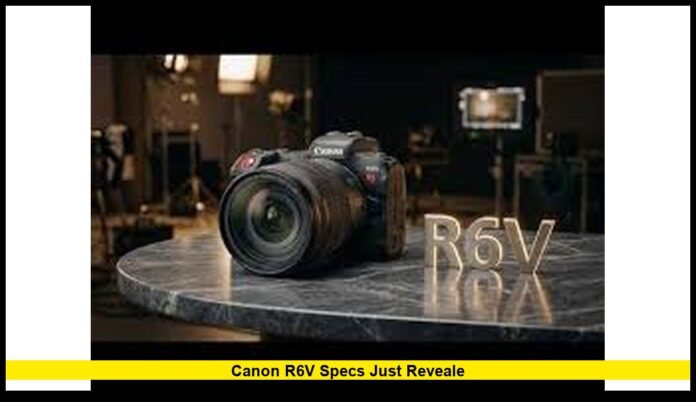

Canon is making a major move in the creator camera space with the launch of its newest full-frame mirrorless model, and the latest canon r6v specs reveal a serious push toward professional video production, livestreaming, and cinematic content creation. The EOS R6 V arrives as Canon’s first dedicated V-series full-frame camera, combining advanced video tools, compact portability, and creator-focused workflow upgrades in a body designed specifically for modern filmmakers and digital creators.
The camera introduces internal 7K RAW recording, open gate capture, advanced autofocus, active cooling, and professional monitoring tools while removing several photography-first design elements found in traditional mirrorless cameras. Canon clearly built this model for creators who prioritize filmmaking, vertical content, streaming, and social media production over conventional still photography.
The EOS R6 V enters one of the most competitive segments in the camera industry as brands race to attract creators, YouTubers, wedding filmmakers, documentary producers, and livestreamers seeking high-end video performance without stepping into bulky cinema camera systems.
Canon’s newest release also arrives alongside a new RF power zoom lens and several creator-focused accessories that strengthen the company’s growing focus on video-first workflows.
Camera enthusiasts and creators looking for the next evolution in compact filmmaking tools now have one of Canon’s most ambitious launches in years to examine closely.
If you enjoy following major camera launches, filmmaking gear, and creator technology trends, stay connected for more updates and in-depth coverage throughout the year.
Canon Introduces a New Direction for the EOS Lineup
The EOS R6 V represents more than just another camera launch. It signals a noticeable shift in Canon’s strategy for the mirrorless market.
For years, Canon separated its professional cinema lineup from its consumer and hybrid mirrorless cameras. The EOS R6 V now begins bridging that gap by bringing cinema-style features into a much smaller and more affordable package.
The camera drops the electronic viewfinder entirely, a decision that immediately separates it from traditional photography-oriented EOS models. Canon instead optimized the body for handheld video shooting, gimbal use, livestreaming, and mobile production setups.
The result is a smaller, flatter, and more creator-focused design that looks very different from the company’s photography-first cameras.
Canon also added several design features aimed directly at solo creators, including:
- Front-facing record button
- Tally lamps
- Vertical tripod mount
- Rotating user interface for vertical shooting
- Full-size HDMI port
- Dedicated video controls
These additions may seem small individually, but together they create a workflow designed around real-world creator needs rather than traditional camera operation.
32.5MP Full-Frame Sensor Delivers High-End Video Performance
At the center of the EOS R6 V is a newly developed 32.5-megapixel full-frame CMOS sensor paired with Canon’s DIGIC X processor.
The sensor supports advanced video capture formats that place the camera firmly in professional creator territory.
Canon says the camera can deliver more than 15 stops of dynamic range when recording in Canon Log 2, providing filmmakers with greater flexibility during post-production color grading.
The EOS R6 V supports:
- 7K RAW internal recording
- 7K open gate video
- Oversampled 4K video at up to 60p
- Uncropped 4K recording up to 120p
- Full HD recording up to 180p
These specifications immediately position the camera among the most advanced creator-focused full-frame mirrorless systems currently available.
Oversampled 4K footage generated from the 7K sensor readout should provide noticeably sharper detail and cleaner image quality compared to standard line-skipped recording systems.
High-frame-rate recording also gives creators more flexibility for cinematic slow-motion footage, sports content, documentary work, and commercial production.
Open Gate Recording Expands Editing Flexibility
One of the most discussed features in the canon r6v specs announcement is the inclusion of open gate recording.
Open gate capture uses the entire sensor area rather than cropping footage into a standard widescreen format during recording.
This gives editors much greater flexibility later in post-production.
Creators can shoot a single clip and later crop it into:
- Vertical social media videos
- Traditional widescreen YouTube content
- Cinematic aspect ratios
- Square-format social clips
As more creators publish across multiple platforms simultaneously, open gate recording has become one of the most valuable tools in modern hybrid filmmaking.
Canon’s decision to include the feature shows the company is paying close attention to how digital creators actually work today.
Active Cooling Tackles Overheating Concerns
Thermal management remains one of the biggest challenges for compact mirrorless video cameras.
Canon directly addresses this issue by integrating active cooling into the EOS R6 V body.
The built-in cooling fan is designed to extend recording times during demanding 7K and 4K capture sessions while reducing overheating interruptions.
This could become one of the camera’s biggest real-world advantages for creators who film:
- Long interviews
- Weddings
- Podcasts
- Events
- Livestreams
- Documentaries
- Commercial shoots
Canon reportedly includes multiple fan modes so users can balance cooling performance with operational noise levels depending on their shooting environment.
The addition of active cooling moves the EOS R6 V closer to professional cinema systems while preserving the portability creators expect from mirrorless cameras.
Professional Monitoring Tools Built Into the Camera
Canon loaded the EOS R6 V with advanced exposure and monitoring tools usually associated with higher-end cinema equipment.
The camera includes:
- Waveform monitoring
- False color exposure tools
- Zebra guides
- Focus peaking
- LUT support
- Canon Log 2
- Canon Log 3
- HDR recording options
These tools help creators achieve more accurate exposure and color management directly in-camera.
Professional videographers often rely heavily on waveform monitoring and false color during commercial production and documentary filmmaking because these tools provide more accurate exposure information than standard histogram displays.
Canon’s decision to include these features further highlights the company’s creator-first direction for the EOS R6 V.
Autofocus Designed for Modern Content Creation
Canon continues using its highly regarded Dual Pixel CMOS Autofocus II system in the EOS R6 V.
The autofocus system supports intelligent subject detection for:
- Humans
- Animals
- Vehicles
The camera can track faces and eyes while maintaining focus during movement, helping solo creators and small production teams capture more reliable footage without dedicated focus pullers.
Autofocus performance has become one of the most important buying factors in the creator camera market, particularly for vloggers, livestreamers, and handheld shooters working alone.
Canon’s autofocus systems already maintain a strong reputation across the video industry, and the EOS R6 V aims to strengthen that position further.
Strong Stabilization for Handheld Shooting
Handheld content creation continues growing rapidly across social media, travel filmmaking, and documentary production.
Canon equipped the EOS R6 V with in-body image stabilization capable of delivering up to 8.5 stops of correction in supported conditions.
The stabilization system can work together with lens stabilization and digital stabilization to improve handheld footage smoothness.
For creators shooting without heavy rigs or stabilizers, this feature could significantly improve workflow flexibility.
The stabilization system should especially benefit:
- Travel creators
- Documentary filmmakers
- Wedding videographers
- Vloggers
- Run-and-gun productions
Smooth handheld footage remains essential for modern creator content, and stabilization performance often determines whether creators need additional gimbal equipment.
Vertical Video Creation Becomes a Priority
The EOS R6 V clearly targets the growing vertical-video market.
Canon redesigned portions of the interface specifically for portrait-oriented recording, allowing menus and recording data to rotate automatically during vertical shooting.
The vertical tripod socket also simplifies mounting setups for TikTok, Instagram Reels, YouTube Shorts, and mobile-first production.
This reflects a major shift happening across the camera industry.
Brands no longer treat vertical content as a secondary feature. Instead, companies increasingly design products specifically for creators publishing on mobile-focused platforms.
Canon’s approach with the EOS R6 V demonstrates how seriously the company now views creator-driven media production.
New RF Power Zoom Lens Targets Video Professionals
Canon launched the RF 20-50mm f/4 L IS USM PZ lens alongside the EOS R6 V.
This lens represents Canon’s first professional-grade full-frame RF power zoom lens.
Unlike traditional photography zoom lenses, power zoom systems provide smoother, more controlled zoom transitions during video recording.
The lens includes:
- Constant f/4 aperture
- Internal zoom mechanism
- Internal focusing
- Reduced focus breathing
- Optical stabilization
- Remote zoom control support
The internal zoom system helps maintain balance during gimbal use and handheld operation.
Focus breathing reduction also improves cinematic consistency during focus transitions, which is especially important for professional filmmaking.
Canon appears to be building an ecosystem specifically designed around video creators rather than simply adapting photography equipment for video use.
Streaming and Remote Production Features
The rise of livestreaming has transformed creator workflows across entertainment, gaming, education, and business production.
Canon equipped the EOS R6 V with UVC and UAC support, allowing creators to use the camera directly for livestreaming through USB connections.
This simplifies setup processes for creators who previously needed separate capture hardware.
Combined with advanced autofocus, active cooling, and high-quality video output, the EOS R6 V could become attractive for:
- Podcast studios
- Streaming creators
- Online educators
- Corporate productions
- Gaming broadcasters
Remote zoom functionality with the new RF power zoom lens also improves studio production flexibility.
Compact Design With Cinema-Level Ambitions
One of the most important aspects of the EOS R6 V launch is how Canon blends cinema-style performance with compact mirrorless portability.
Traditional cinema cameras often deliver stronger video tools but come with larger bodies, heavier rigs, and more complicated workflows.
Mirrorless cameras offer portability but sometimes sacrifice thermal reliability or professional production tools.
Canon appears to be targeting the middle ground.
The EOS R6 V attempts to combine:
- Compact size
- Cinema-style recording tools
- Long recording reliability
- Professional monitoring features
- Advanced autofocus
- High-end stabilization
This balance may appeal strongly to creators who need professional results without carrying full cinema setups.
Pricing Positions the Camera Aggressively
Canon announced the EOS R6 V body at approximately $2,499 in the United States.
The RF 20-50mm f/4 L IS USM PZ lens will sell separately for around $1,399.
That pricing places the camera in direct competition with several high-end hybrid video systems already targeting creators and filmmakers.
However, Canon’s combination of:
- 7K RAW recording
- Open gate capture
- Active cooling
- Professional monitoring tools
- Advanced stabilization
- Creator-focused ergonomics
could make the pricing highly attractive for users seeking cinema-oriented features without entering significantly more expensive production ecosystems.
Why the EOS R6 V Could Matter for the Industry
The EOS R6 V reflects broader changes across the entire camera market.
Content creation now drives product development at nearly every major camera brand.
Manufacturers increasingly prioritize:
- Vertical content workflows
- Streaming integration
- Open gate recording
- Thermal performance
- Lightweight production
- Solo creator operation
Canon’s latest release may become one of the clearest examples yet of a major manufacturer building a camera specifically around modern creator behavior instead of adapting older photography concepts.
The EOS R6 V does not simply add video features to a photography camera. It restructures the camera around video production from the ground up.
That distinction could make the launch especially important for the future direction of mirrorless camera development.
Early Industry Interest Continues Growing
The EOS R6 V has already generated major attention among creators, filmmakers, and camera enthusiasts following its official reveal.
Much of the discussion centers around Canon’s aggressive move into creator-focused filmmaking tools and the inclusion of features previously limited to larger cinema systems.
The combination of compact design, advanced recording options, and professional workflow tools may help the EOS R6 V stand out in an increasingly crowded market.
As hands-on testing and real-world production reviews continue emerging, creators will likely examine how the camera performs under demanding shooting conditions.
For now, Canon’s newest launch clearly signals that the competition for creator-focused full-frame cameras is becoming even more intense in 2026.