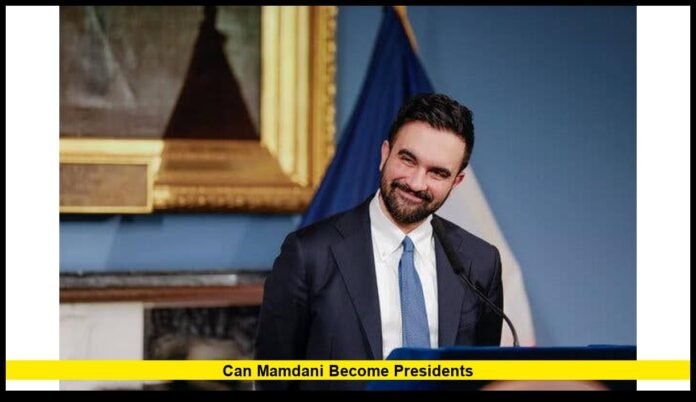

The question can Mamdani become president has taken on greater significance as Zohran Mamdani’s political influence has grown beyond New York City. The Queens-born politician’s rise to City Hall has placed him among the most closely watched figures in progressive American politics, prompting renewed discussion about whether his political ambitions could eventually extend to the White House.
Mamdani’s Birthplace Is the Central Issue
The biggest obstacle is not Mamdani’s age, political experience, or American citizenship. It is where he was born.
Mamdani was born in Kampala, Uganda, in 1991. He moved to the United States with his family as a child and eventually became a naturalized American citizen.
That distinction matters because the Constitution establishes a special citizenship requirement for anyone seeking the presidency.
A presidential candidate must be a natural-born U.S. citizen, at least 35 years old, and have lived in the United States for at least 14 years.
Mamdani now satisfies the age requirement. His long residence in the United States also addresses the residency requirement. His citizenship, however, was obtained through naturalization rather than being held from birth.
Why Naturalization Does Not Resolve the Issue
U.S. citizenship and presidential eligibility are not identical concepts.
Naturalized citizens can vote, hold many elected offices, work in government, and participate fully in American political life. The presidency is different because the Constitution imposes an additional citizenship-at-birth requirement.
That means becoming an American citizen later in life does not automatically provide eligibility for the White House.
Mamdani’s political career illustrates the distinction. His naturalized citizenship did not prevent him from serving in the New York State Assembly or eventually becoming mayor of New York City. But those offices do not carry the same constitutional requirements as the presidency.
His Age Is No Longer the Main Question
When Mamdani first emerged as a major political figure, his age was another reason presidential speculation faced an obvious limitation.
The Constitution requires a president to be at least 35. Mamdani was born in 1991, so he has now crossed that threshold.
That removes one potential obstacle, but it does not change the citizenship requirement.
The result is a situation in which Mamdani satisfies the age requirement while remaining unable to satisfy the natural-born-citizen requirement under the current constitutional framework.
His Rise to New York City Hall
Mamdani’s political trajectory has been unusually rapid.
He first gained attention as a progressive member of the New York State Assembly before winning the New York City mayoral race. He assumed office as mayor on January 1, 2026.
His campaign helped elevate issues such as housing affordability, transportation costs, child care and household expenses into central parts of the city’s political conversation.
The mayoralty has also given Mamdani a much larger national platform.
New York is the country’s largest city, and its mayor regularly receives attention from voters, political organizations and national media across the United States. For Mamdani, that visibility has created opportunities to shape debates well beyond municipal government.
Could He Run for President Anyway?
Political ambitions and constitutional eligibility are two different matters.
A politician can discuss national issues, campaign for other candidates and develop a nationwide following without being eligible to appear as a presidential candidate.
For Mamdani, the constitutional limitation would remain in place even if his national popularity continued to increase.
This is why the question of can Mamdani become president is ultimately a constitutional question rather than simply a political one.
Popularity, fundraising ability, public support and experience in elected office cannot by themselves remove the natural-born-citizen requirement.
What Would Have to Change?
The rules could theoretically change, but doing so would require a constitutional amendment.
The presidential eligibility requirements are contained in the Constitution, meaning Congress could not simply pass an ordinary law allowing naturalized citizens to become president.
Changing the requirement would require the formal amendment process, which demands substantial support at both the federal and state levels.
Such a change would also represent a major alteration to one of the country’s longstanding presidential qualifications.
There is no current constitutional amendment removing the natural-born-citizen requirement.
Mamdani’s Own Position Matters
Mamdani has been asked about his eligibility and the constitutional restriction.
Rather than campaigning for a change that would make him eligible for the presidency, he has indicated that he does not believe the Constitution needs to be changed for that purpose.
That position makes speculation about a future Mamdani presidential campaign even more complicated.
His national influence can grow considerably without requiring him to pursue the presidency. His current political platform gives him several ways to remain involved in national debates while continuing to focus on New York City.
The Vice Presidency Has the Same Problem
The constitutional issue does not stop with the presidency.
The 12th Amendment establishes that a person who is constitutionally ineligible to serve as president cannot serve as vice president either.
Consequently, Mamdani’s foreign birth would present essentially the same constitutional barrier if he were considered for the vice presidency.
This limits the range of federal executive positions that could become realistic options for him under the existing constitutional rules.
A National Political Future Is Still Possible
Presidential eligibility should not be confused with national political influence.
Mamdani can remain a major figure in American politics even if he can never occupy the Oval Office. As mayor of New York City, he has a platform capable of influencing discussions about Democratic strategy, progressive policy and urban government.
His views on affordability, housing and public services can also contribute to national policy debates.
The mayor’s office may therefore become an important launching point for influence rather than a direct route to the presidency.
Could the Rules Ever Be Different?
Theoretically, yes.
If the Constitution were amended in the future, the eligibility calculation could change. But there is no indication that such a change is imminent, and constitutional amendments are deliberately difficult to enact.
For now, the legal position is straightforward: a naturalized citizen who was born outside the United States does not meet the existing constitutional qualification for president.
Mamdani’s future political success could therefore take many forms, but a presidential campaign would face a constitutional barrier that cannot be overcome through an ordinary election.
What This Means for Mamdani’s Future
Mamdani’s rise demonstrates that naturalized Americans can reach highly influential positions in U.S. government. His path from immigrant childhood to New York City mayor has already made him a nationally recognized political figure.
But the presidency has a unique constitutional standard.
Unless that standard changes, Mamdani can build a powerful political career without being eligible to become president. His influence over national politics may continue to expand, but the constitutional boundary remains clear.
For voters following his career, the more relevant question may not be whether he can eventually occupy the White House, but how much influence he can exert from City Hall and within the broader Democratic movement.
As of the latest update, the answer to the presidential eligibility question remains unchanged: Mamdani is not constitutionally eligible to become president under the current rules.
Key Points Summary
╔════════════════════════════════════════════════════════════════════╗
║ – Zohran Mamdani is currently ineligible to become president under the U.S. Constitution. ║
║ – He was born in Uganda in 1991 and later became a naturalized U.S. citizen. ║
║ – Mamdani has reached the Constitution’s minimum presidential age of 35. ║
║ – His naturalized citizenship, rather than his age or political experience, is the central constitutional obstacle. ║
║ – Changing the presidential citizenship requirement would require a constitutional amendment. ║
╚════════════════════════════════════════════════════════════════════╝