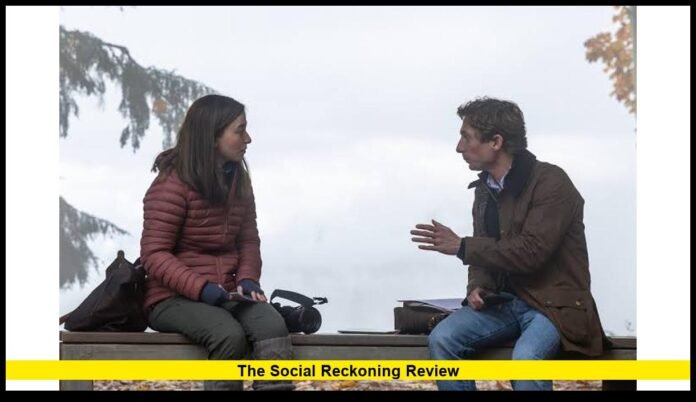

The social reckoning review conversation has intensified ahead of the film’s U.S. theatrical release on October 9, 2026, with early critics offering a sharply divided response to Aaron Sorkin’s return to the world of Facebook. The movie centers on whistleblower Frances Haugen and journalist Jeff Horwitz as they investigate the technology giant’s internal practices and the consequences of its pursuit of user engagement.
The film reunites Sorkin with the subject matter that inspired his Oscar-winning screenplay for The Social Network, but the creative setup is substantially different this time. Sorkin is not only the writer but also the director, while a new cast takes on the principal roles.
The result is a contemporary technology drama that trades Facebook’s origin story for a much darker examination of what happened after the platform became a dominant force in everyday life.
A New Chapter in Facebook’s Story
The movie is set around the events that brought Haugen into the public spotlight in 2021.
Mikey Madison portrays Haugen, a Facebook employee who becomes increasingly troubled by decisions surrounding the platform’s systems and their potential consequences. Jeremy Allen White plays Horwitz, the investigative journalist who works with her as confidential information begins reaching the public.
Their collaboration provides the film with its central dramatic engine.
Rather than concentrating on corporate expansion or Silicon Valley ambition, the story follows the difficult process of uncovering information, verifying it and deciding whether exposing it is worth the personal consequences.
That gives the film the structure of an investigative thriller while allowing Sorkin to explore questions about technology, corporate responsibility and the power of journalism.
Mikey Madison Leads the Cast
Madison is one of the strongest elements of the movie.
Following her Academy Award-winning performance in Anora, she takes on a considerably different character. Haugen is intelligent and determined, but the role depends more on controlled reactions and quiet tension than explosive emotion.
The performance requires Madison to carry scenes involving technical discussions and complicated corporate issues without making the character feel like a walking explanation of Facebook’s problems.
Early reviews have frequently identified her work as a major strength.
Her portrayal also gives the movie an emotional center. The audience experiences the growing pressure surrounding Haugen largely through Madison’s restrained performance, particularly as the risks associated with revealing confidential information become more serious.
Jeremy Allen White Brings a Different Energy
Jeremy Allen White plays Horwitz, whose role places him at the intersection of journalism and Haugen’s whistleblowing campaign.
White approaches the character without turning him into a stereotypical cinematic reporter. Horwitz is presented primarily as a methodical investigator whose job is to understand complicated information and determine how it can be responsibly reported.
That makes his scenes with Madison especially important.
Their partnership is based on professional trust, and the film uses their conversations to move between technical details and the larger human consequences of Facebook’s decisions.
White has also received positive attention from early reviewers, although some have argued that the dialogue occasionally overwhelms the individuality of the characters.
Jeremy Strong Takes on Mark Zuckerberg
Jeremy Strong assumes the role of Mark Zuckerberg, giving audiences a markedly different interpretation from Jesse Eisenberg’s performance in The Social Network.
Strong does not attempt to recreate Eisenberg’s rapid-fire portrayal. His version is more subdued, controlled and deliberately strange.
Zuckerberg is not the primary character in this story. The focus remains on Haugen and the investigation surrounding Facebook, meaning the company’s founder often operates from the edges of the central narrative.
That approach has produced mixed reactions.
Some critics have found Strong’s interpretation fascinating, while others believe the character is too simplified. The role nevertheless adds another layer to a film that is less interested in Facebook’s creation than in the consequences of its enormous influence.
Why the Fincher Comparison Matters
The biggest challenge facing the film may be unavoidable.
The Social Network became one of the defining movies about Silicon Valley because David Fincher’s direction, Sorkin’s screenplay and the performances worked together to create a distinctive cinematic identity.
This film has Sorkin behind the camera instead.
That difference can be felt throughout the movie. The new production relies heavily on dialogue, information and investigative momentum. It is less interested in the sleek visual atmosphere associated with Fincher’s work.
Some reviewers have considered that change a weakness. Others have argued that the film succeeds when treated as its own investigative drama rather than as a direct attempt to duplicate the earlier movie.
That distinction is important because the two stories are separated by more than a decade and examine completely different periods of Facebook’s development.
A Story Built Around Whistleblowing
At the heart of the film is the question of what happens when an employee decides that remaining silent is no longer acceptable.
Haugen’s story gives Sorkin an opportunity to examine the personal cost of challenging a powerful technology company.
The film portrays confidential information as something that can change the balance between an individual employee and a global corporation. Once the material begins moving outside Facebook, the stakes expand beyond Haugen herself.
The investigation becomes a larger discussion about what technology companies know about the effects of their products and how much responsibility they should bear for those effects.
Sorkin’s Dialogue Remains Front and Center
Fans of Sorkin’s writing style will recognize his familiar rhythm.
Characters frequently exchange information at high speed, debate complicated subjects and challenge one another through tightly constructed conversations.
That approach works well when the story needs to explain technical or institutional issues quickly.
However, it has also become one of the main points of criticism. Several reviews argue that the characters can sometimes sound too similar, with the distinctive voices of individual people becoming secondary to the writer’s recognizable dialogue style.
For some viewers, that will be part of the appeal. For others, it could create emotional distance.
The Movie’s Biggest Strengths
The subject remains highly relevant.
Social-media platforms continue to influence political communication, news consumption, advertising, online communities and everyday relationships. The questions raised by Haugen’s disclosures have therefore not disappeared simply because the events occurred several years ago.
The cast also gives the movie considerable weight.
Madison provides the emotional foundation, White supplies the investigative perspective and Strong offers a provocative interpretation of one of the most recognizable figures in modern technology.
The film also benefits from a straightforward narrative objective: uncover what happened and make the information public.
That clarity helps keep the story moving even when the dialogue becomes dense.
Where Critics Have Raised Concerns
The principal criticism is that the movie does not consistently generate the same cinematic electricity associated with The Social Network.
Some reviewers have described the film as overly direct, arguing that Sorkin’s message sometimes becomes more prominent than subtle characterization.
Another concern is timing.
The central issues surrounding Facebook’s algorithms, misinformation and content moderation have already been widely discussed. The movie therefore has to provide more than information to create a lasting dramatic effect.
Critics have disagreed over whether it achieves that balance.
Is the Film Worth Seeing?
The latest the social reckoning review discussion suggests that viewers should approach the movie as a serious investigative drama rather than expect another Silicon Valley origin story.
Audiences interested in whistleblowers, journalism and the social consequences of technology are likely to find plenty to discuss.
Those primarily seeking the style, visual intensity and character-driven tension of The Social Network may have more reservations.
The film’s October 9 theatrical release will also provide a much clearer indication of how general audiences respond once the movie moves beyond the critic screening cycle.
Final Verdict
The Social Reckoning arrives with a difficult assignment: revisit one of the most recognizable technology stories in modern cinema while examining a completely different stage of Facebook’s history.
Sorkin has chosen a compelling real-world subject and surrounded it with a strong cast. Madison’s performance gives the story its human focus, White provides a grounded journalistic presence, and Strong makes Zuckerberg an intentionally unsettling figure.
The movie’s weaknesses largely come from the same creative choice that gives it its identity. Sorkin’s unmistakable dialogue drives the narrative, but it can sometimes leave less room for subtle characterization or visual storytelling.
Ultimately, the film stands on its own as a drama about whistleblowing, journalism and the enormous influence of social-media companies. Whether audiences consider it a worthy companion to The Social Network will depend largely on how much they value its contemporary subject matter over the distinctive filmmaking style that defined the 2010 classic.