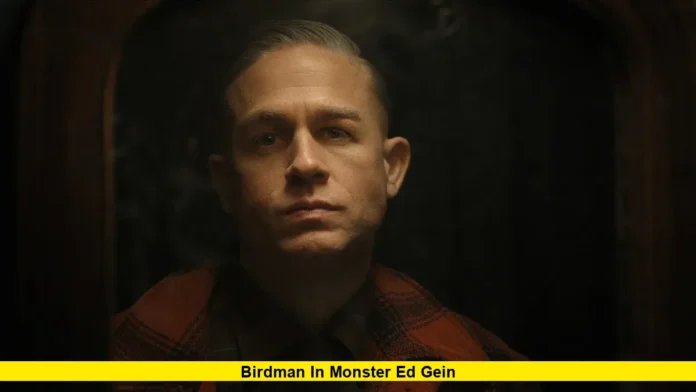

The Birdman in Monster: Ed Gein is one of the most intriguing figures introduced in Netflix’s true-crime drama. While the series blends historical events with fictional storytelling, Birdman is not an invented symbolic figure. Instead, the character is based on Richard Speck, a real-life American mass murderer whose appearance in the show’s final episode serves a larger purpose. Rather than focusing solely on Ed Gein’s crimes, the series uses Birdman to explore Gein’s lasting influence on crime, popular culture, and the mythology surrounding notorious killers.
For many viewers, Birdman’s brief appearance raised several questions. Is he a real person? Did he actually know Ed Gein? Why does the series include him at all? Understanding the answers requires looking at both historical facts and the creative decisions behind Netflix’s adaptation.
Who Is Birdman in Monster: Ed Gein?
Birdman appears during the closing chapter of Monster: The Ed Gein Story as Richard Speck, portrayed by Tobias Jelinek. In the series, Speck is shown as one of several infamous criminals whose lives intersect symbolically with Ed Gein’s legacy.
Although the nickname “Birdman” may initially sound fictional, it refers to Richard Speck’s prison reputation. Speck became known by the nickname after reportedly caring for a sparrow while incarcerated before eventually killing the bird, an incident that became part of his prison lore.
The show’s inclusion of Birdman is meant to connect Gein’s story with later generations of violent offenders and to illustrate how notorious criminals can become part of a disturbing cultural mythology.
Is Birdman Based on a Real Person?
Yes. Birdman is based on Richard Speck, one of America’s most infamous mass murderers.
Speck gained national attention after murdering eight student nurses in Chicago in 1966, one of the most shocking crimes in American history. A ninth victim survived by hiding during the attack and later helped investigators identify Speck, leading to his arrest. He was initially sentenced to death, but his sentence was later commuted after changes to U.S. death penalty law. He ultimately spent the rest of his life in prison, where he died in 1991.
Because both Gein and Speck became notorious figures in American criminal history, the series uses their fictional interaction to emphasize how different generations of criminals became linked in the public imagination.
Did Richard Speck and Ed Gein Actually Know Each Other?
There is no historical evidence that Richard Speck and Ed Gein ever exchanged letters, communicated, or developed any relationship.
In Monster: The Ed Gein Story, Birdman is portrayed writing fan letters to Gein, but this is a dramatic invention rather than a documented historical event. The sequence functions as a storytelling device rather than a factual recreation.
Ryan Murphy’s Monster anthology frequently combines verified historical events with imagined conversations, dream sequences, and symbolic encounters to explore broader themes rather than present a documentary-style account.
Why Does the Series Introduce Birdman?
Birdman’s appearance serves several narrative purposes.
Showing Ed Gein’s Lasting Influence
Although Ed Gein committed relatively few confirmed murders compared with many later serial killers, his crimes had an enormous cultural impact. His disturbing acts inspired fictional characters such as Norman Bates in Psycho, Leatherface in The Texas Chain Saw Massacre, and Buffalo Bill in The Silence of the Lambs.
By introducing Birdman near the end of the series, the show argues that Gein’s legacy extended beyond his own crimes and became part of the mythology surrounding American violence.
Exploring Society’s Fascination with Killers
The Monster anthology repeatedly questions why notorious murderers become cultural icons.
Birdman’s admiration for Gein represents this uncomfortable fascination. Instead of portraying Gein simply as an isolated criminal, the series suggests that society, the media, and later criminals all contributed to turning him into a legendary figure.
This theme becomes central during the final episode, where the narrative shifts from Gein’s personal story to his influence on American culture.
Connecting Different Eras of Crime
Richard Speck belonged to a later generation of notorious killers.
By placing him alongside Gein, the series creates a symbolic bridge between the crimes of the 1950s and those that followed during the 1960s and beyond. The connection is thematic rather than historical.
Is Birdman Meant to Be Symbolic?
Yes, even though Birdman is based on a real individual, his role functions symbolically.
He represents several ideas:
- The way infamous killers become legends.
- Society’s obsession with violent crime.
- The influence of earlier criminals on later cultural narratives.
- The continuing commercialization of true crime.
Rather than focusing exclusively on historical accuracy, Birdman’s scenes encourage viewers to think about why certain murderers continue to receive public attention decades after their deaths.
How Birdman Connects to Ed Gein’s Psychology
Throughout Monster: The Ed Gein Story, Ed Gein is portrayed as a deeply disturbed individual shaped by isolation, trauma, and an unhealthy relationship with his mother.
Birdman’s appearance shifts the focus from Gein’s internal struggles to the external consequences of his notoriety.
Instead of examining Gein’s crimes alone, the series asks another question:
What happens when society turns violent offenders into enduring public figures?
Birdman becomes part of that discussion by illustrating how Gein’s reputation extends beyond his lifetime and influences the stories told about crime.
What Have the Creators Said About the Character?
Ryan Murphy and Ian Brennan have explained that the series intentionally examines not only Ed Gein himself but also the broader cultural impact of his crimes.
According to the creators, one of the central themes of the season is how media, films, public fascination, and storytelling helped shape Gein’s lasting legacy. Rather than presenting a straightforward biography, the series explores the relationship between real crimes and the way those crimes become embedded in popular culture.
This creative approach explains why the series includes historical figures, fictional horror characters, filmmakers, and later criminals alongside Gein.
Historical Accuracy vs. Dramatic Storytelling
Like previous installments of Netflix’s Monster anthology, The Ed Gein Story blends fact with fiction.
Historically accurate elements include:
- Ed Gein’s crimes in Plainfield, Wisconsin.
- Richard Speck’s identity as a real mass murderer.
- Gein’s enormous influence on horror fiction.
Dramatized elements include:
- The correspondence between Speck and Gein.
- Many imagined conversations.
- Symbolic meetings between historical figures who never interacted.
- Several dreamlike sequences designed to explore themes instead of documented events.
Recognizing these creative liberties helps viewers separate historical fact from narrative symbolism.
Why Birdman Has Become a Talking Point
Birdman has attracted attention because his appearance lasts only a short time yet introduces one of the series’ biggest themes.
Many viewers initially assumed Birdman was either a fictional hallucination or a metaphor created specifically for the show. Learning that he is actually Richard Speck has prompted renewed interest in both Speck’s crimes and the broader message of the series.
His role also highlights how Monster differs from a traditional true-crime dramatization. Rather than simply recreating historical events, the anthology examines the cultural afterlife of infamous criminals and the stories society continues to tell about them.
Final Thoughts
The Birdman in Monster: Ed Gein is much more than a brief supporting character. He is Netflix’s dramatized version of Richard Speck, a real-life mass murderer whose appearance underscores the show’s exploration of notoriety, media fascination, and the enduring legacy of Ed Gein. While there is no evidence that Speck and Gein ever communicated in real life, the fictional connection allows the series to examine how one notorious criminal’s influence can echo across decades of American crime and popular culture.
For viewers seeking historical accuracy, Birdman’s storyline should be understood as a symbolic storytelling device rather than a factual account. His inclusion ultimately reinforces one of the season’s central questions: how do notorious criminals become lasting figures in the public imagination, and what role does society play in keeping their stories alive?