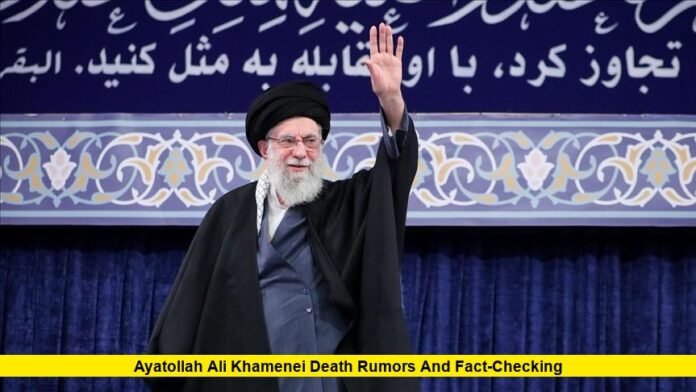

As of March 1, 2026, the world is grappling with rapidly evolving news regarding Ayatollah Ali Khamenei’s status after intense military activity in Iran. Conflicting reports and social media rumors have circulated widely online, but today’s verified sources paint a clearer factual picture. This long-form report breaks down what is confirmed, what is contested, and what remains unverified — strictly based on credible, real-time updates from major news organizations and official sources.
Confirmed Reports: Supreme Leader Ayatollah Ali Khamenei Is Dead
After days of uncertainty and speculation, Iranian state media and official authorities have confirmed that Ayatollah Ali Khamenei — the Supreme Leader of Iran — has died. Multiple major news outlets report this confirmation:
- Iranian state television announced that Khamenei was killed on Saturday (February 28) during a wave of U.S.-Israeli military strikes on Iran, declaring a 40-day period of mourning.
- Reuters confirms that Khamenei’s death was acknowledged by Iranian authorities following a joint United States and Israeli assault, which targeted key Iranian infrastructure and leadership compounds.
- Associated Press reports detail that Khamenei, 86, led Iran since 1989 and was confirmed dead by Iranian state media after the strikes, reporting on his decades-long leadership and global diplomatic impact.
These confirmations come after initial rumors and denials circulated, underscoring how volatile the flow of information has been in the early stages of the conflict.
Timeline: From Rumors to Official Confirmation
Initial Phase: Conflicting Early Reports
Immediately following the military strikes, several rumors and unverified claims emerged online and in early press reports:
- Some Israeli officials initially stated there were “many signs” that the Supreme Leader was killed in the strikes, but no independent confirmation was immediately available at that stage.
- Iran’s Foreign Minister at one point suggested that Khamenei and other top officials were still alive “as far as I know.”
- Social media posts and regional outlets circulated mixed information about his whereabouts and condition.
This phase — rife with speculation — demonstrates how quickly unverified claims can spread in high-tension geopolitics.
Final Confirmation
As the crisis unfolded, Iranian state media and official bodies acknowledged Khamenei’s death, corroborated by multiple reputable international news agencies. Key elements reported include:
- Confirmation of Khamenei’s death in Tehran during joint U.S.-Israeli military strikes late February.
- Declaration of 40 days of official mourning and a week-long public holiday across Iran.
- References to the death of family members alongside him, according to Iran’s Fars News Agency, which is tied to the Islamic Revolutionary Guard Corps.
These elements represent the most recent, verified facts available as of today.
Understanding the Rumors: Why Confusion Spread Quickly
The propagation of death rumors without confirmation is a common phenomenon in major geopolitical crises. In this case, several factors contributed:
Rapid Escalation of Military Operations
The joint U.S. and Israeli military campaign — reportedly codenamed “Operation Epic Fury” — involved hundreds of airstrikes targeting Iranian military facilities, missile sites, and command centers. Early reports of explosions near Khamenei’s compound fueled speculation.
Conflicting Statements from Officials
At times, Iranian officials and external sources communicated opposing claims, with some denying reports and others suggesting possible harm, creating room for rumor amplification.
Social Media and Unverified Narratives
Platforms such as X and other social media channels saw a proliferation of posts, videos, and commentary that were not verified by established news agencies, making it difficult for audiences to distinguish fact from speculation.
Who Was Ayatollah Ali Khamenei? A Brief Background
To understand the seriousness of these developments, it helps to know who Khamenei was:
- Supreme Leader Since 1989: Khamenei became Iran’s second Supreme Leader after the death of Ayatollah Ruhollah Khomeini, wielding ultimate authority over Iran’s political, military, and religious institutions for nearly four decades.
- Architect of Modern Iranian Policy: His tenure saw expansion of Iran’s regional influence, controversial nuclear development programs, and a history of internal repression — including crackdowns on protests.
- Symbol of Authority: Within Iran’s political system, the Supreme Leader holds power above all elected positions, shaping foreign policy, defense strategy, and domestic governance.
His confirmed passing marks a historic turning point for Iran and the broader Middle East.
Immediate Aftermath: Reactions and Unfolding Consequences
Public Response in Iran
Following the announcement of Khamenei’s death:
- Crowds in Iran displayed mixed and emotionally charged reactions, with some celebrating and others supporting the regime, reflecting deep divisions within Iranian society.
- Street reactions ranged from jubilant outbursts to solemn gatherings, illustrating the complex public sentiment toward the clerical establishment.
Regional and Global Implications
Khamenei’s death underscores the potentially explosive future of Middle East geopolitics:
- With Iran’s leadership structure now in flux, regional powers and global actors are closely monitoring how authority will transfer and what this means for international diplomacy.
- Global markets, particularly energy prices, may respond to rising instability, given Iran’s strategic position in global oil production.
Fact-Checking Checklist: What Is Verified vs. Unverified
To clear up common misconceptions:
Verified Facts
✔ Khamenei is reported dead, as confirmed by Iranian state media and widely cited by major news outlets.
✔ He had served as Iran’s Supreme Leader since 1989.
✔ Iran declared official mourning after the announcement.
Unverified or Early Speculative Claims
✖ Early social media posts claiming his death before official statements.
✖ Some third-party reports suggesting contradictory survival without subsequent confirmation.
What Comes Next: Succession and Stability Questions
With Khamenei gone, Iran faces an uncertain leadership transition. According to current reports:
- A succession process is likely underway, involving the Assembly of Experts and other senior religious bodies.
- Political stability within Iran may be tested, as various factions vie for influence in the post-Khamenei era.
These developments will be closely watched by governments and analysts worldwide.
Your thoughts on the global impact of Ayatollah Ali Khamenei’s confirmed death are important — share your perspective and stay engaged with the ongoing developments.