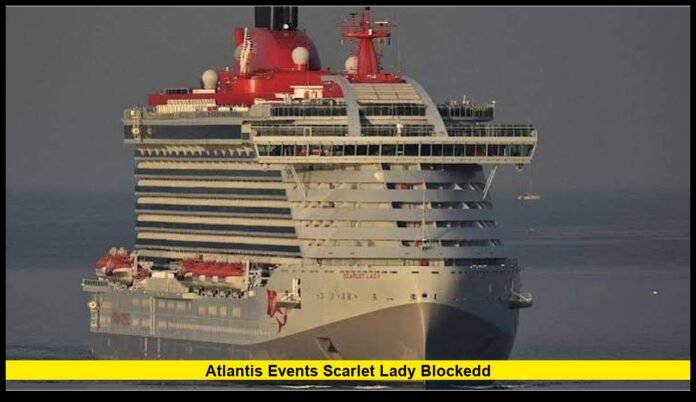

The Atlantis Events Scarlet Lady blocked incident quickly became one of the most talked-about travel stories of 2026, drawing global attention to the intersection of international tourism, cruise operations, government policy, and LGBTQ+ rights. What was planned as a luxury Mediterranean vacation aboard Virgin Voyages’ Scarlet Lady unexpectedly turned into a major international news event after two countries refused to allow the ship to dock during its scheduled itinerary.
Thousands of passengers boarded the voyage expecting to visit some of the Mediterranean’s most iconic destinations, including Istanbul, Kuşadası, and Alexandria. Instead, they witnessed a series of last-minute itinerary changes that sparked widespread debate across the cruise industry and among travelers worldwide.
What Was the Atlantis Events Mediterranean Cruise?
Atlantis Events is one of the world’s best-known organizers of LGBTQ+ vacations and themed cruises. For more than three decades, the company has chartered cruise ships around the globe, offering entertainment, parties, cultural excursions, and luxury travel experiences designed primarily for LGBTQ+ travelers and their friends.
In July 2026, Atlantis chartered Virgin Voyages’ Scarlet Lady for a week-long Mediterranean cruise departing from Athens, Greece.
The itinerary originally included several popular destinations across Southern Europe and the eastern Mediterranean, including:
- Athens, Greece
- Mykonos, Greece
- Santorini, Greece
- Kuşadası, Turkey
- Istanbul, Turkey
- Dubrovnik, Croatia
- Additional stops before concluding the voyage in Italy
Passengers had booked shore excursions months in advance, especially for famous historical sites such as Ephesus near Kuşadası and the cultural landmarks of Istanbul.
Everything appeared to be proceeding normally until the ship approached Turkish waters.
Turkey Refuses Entry
Only days before Scarlet Lady was scheduled to dock, Turkish authorities announced that the vessel would not be allowed to enter either Kuşadası or Istanbul.
The announcement surprised both passengers and cruise organizers because Turkey has welcomed numerous international cruise ships over the years, including previous Atlantis-chartered voyages.
Officials stated that concerns had been raised regarding the nature of the charter and indicated that allowing the visit would not align with what they described as the country’s social and moral values.
As a result, both Turkish port visits were officially canceled.
The decision immediately attracted worldwide media attention because it involved one of the largest LGBTQ+ charter cruises operating in the Mediterranean.
Why Was the Decision So Significant?
The refusal was notable for several reasons.
First, Atlantis Events has operated cruises for more than 35 years without facing a comparable government decision based specifically on the identity of its passengers.
Second, Turkey remains one of the Mediterranean’s most popular cruise destinations.
Cities like Istanbul attract millions of visitors annually thanks to landmarks including:
- Hagia Sophia
- Blue Mosque
- Grand Bazaar
- Topkapi Palace
- Bosphorus waterfront
Likewise, Kuşadası serves as the primary cruise gateway to the ancient city of Ephesus, one of the world’s best-preserved archaeological sites.
Passengers had anticipated visiting these famous attractions, making the cancellations particularly disappointing.
A Broader Political Context
Although homosexuality is legal in Turkey, public discussion surrounding LGBTQ+ issues has changed considerably over the past decade.
Several Pride events have been restricted or canceled in recent years, while public officials have increasingly taken conservative positions on LGBTQ+ matters.
Supporters of the government’s decision argued that each country has the sovereign right to determine which events it wishes to host.
Critics, meanwhile, viewed the refusal as discriminatory toward LGBTQ+ travelers.
The differing perspectives quickly fueled debate across international news outlets and social media platforms.
Atlantis Events Responds
Atlantis Events expressed disappointment after learning that the ship would not be permitted to dock.
Company leadership noted that the organization had previously visited Turkey on multiple occasions without incident.
Executives emphasized that Atlantis cruises are tourism-focused vacations rather than political demonstrations.
According to the company, passengers simply planned to:
- Visit museums
- Shop in local markets
- Enjoy restaurants
- Explore historical attractions
- Participate in organized sightseeing excursions
Organizers stressed that the cruise had been planned as a celebration of travel and community.
How Many Travelers Were Affected?
Nearly 2,000 passengers were aboard Scarlet Lady during the voyage.
Travelers represented dozens of countries, including:
- United States
- Canada
- United Kingdom
- Australia
- Germany
- France
- Brazil
- Spain
- Other international markets
Many guests had purchased premium shore excursions that were canceled once Turkish authorities denied entry.
Despite the disappointment, passengers remained onboard while alternative destinations were arranged.
Entertainment Continued Onboard
One aspect of the voyage that remained unchanged was its entertainment schedule.
Scarlet Lady featured live performances, themed parties, comedy acts, DJs, and celebrity appearances throughout the cruise.
Among the most recognized performers was Broadway icon Patti LuPone, whose scheduled performances continued despite the itinerary disruptions.
Passengers praised both the entertainers and the ship’s crew for maintaining a positive atmosphere while replacement ports were being organized.
Egypt Brings Another Surprise
Following Turkey’s decision, organizers worked quickly to redesign the itinerary.
Alexandria, Egypt, was selected as one of the replacement destinations.
Initially, passengers welcomed the change because Alexandria offers access to centuries of history and serves as a gateway to some of Egypt’s cultural treasures.
However, shortly before arrival, Egyptian authorities also declined permission for Scarlet Lady to dock.
Unlike Turkey, Egyptian officials did not publicly release a detailed explanation for the decision.
The unexpected development marked the second time during the same voyage that government authorities prevented the ship from making a scheduled port call.
How Did the Cruise Continue?
Despite losing multiple destinations, the voyage itself never faced operational problems.
Scarlet Lady continued sailing safely through the Mediterranean while cruise planners introduced alternative ports.
Additional time was spent at destinations that remained available, allowing passengers to continue enjoying shore excursions elsewhere.
Cruise itineraries occasionally change because of weather, labor disputes, mechanical issues, or geopolitical developments.
However, two separate government denials during a single voyage made this sailing particularly unusual.
Virgin Voyages’ Role
Virgin Voyages owned and operated Scarlet Lady throughout the voyage.
Because Atlantis Events had chartered the entire ship, the vacation experience—including entertainment, activities, and guest programming—was managed by Atlantis.
Virgin Voyages remained responsible for navigation, safety, hospitality, and ship operations.
There were no reports of mechanical failures, onboard security issues, or passenger safety concerns.
The disruptions resulted entirely from external governmental decisions affecting port access.
Passenger Reactions
Passengers responded with a mixture of disappointment and resilience.
Many had dreamed of visiting Istanbul for years.
Others had specifically chosen the itinerary because of Ephesus, one of the best-preserved ancient cities in the world.
Still, numerous guests praised Atlantis Events for communicating frequently throughout the situation.
The company kept travelers informed about itinerary updates while arranging replacement destinations as quickly as possible.
Passengers also complimented Scarlet Lady’s crew for maintaining excellent service despite the unexpected changes.
Photos and videos shared online showed guests continuing to enjoy pools, restaurants, live performances, and themed celebrations throughout the voyage.
Impact on the Cruise Industry
The incident generated discussion far beyond one sailing.
Cruise companies constantly evaluate political developments when designing future itineraries.
Port access depends upon agreements between cruise operators and local governments.
When governments change tourism policies or adopt new restrictions, cruise lines may need to revise routes months or even years in advance.
Industry analysts believe this event may encourage charter companies to conduct additional assessments before scheduling voyages in destinations where political or cultural sensitivities could affect operations.
What It Means for LGBTQ+ Tourism
The cruise also highlighted the varying approaches countries take toward LGBTQ+ visitors.
Many destinations actively market themselves as welcoming locations for LGBTQ+ travelers.
Others maintain more conservative social policies despite relying heavily on international tourism.
For travelers, the incident served as a reminder that local laws, government decisions, and cultural attitudes can influence international travel experiences, even when passengers are visiting purely as tourists.
Travel advisors may increasingly encourage clients to remain flexible when booking international cruises that involve multiple jurisdictions.
Economic Questions Raised
The cancellations also prompted discussion about tourism economics.
Cruise passengers typically spend money on:
- Restaurants
- Local transportation
- Souvenirs
- Museums
- Guided tours
- Historic attractions
- Hotels before and after cruises
When ships skip scheduled ports, local businesses often lose anticipated tourism revenue.
Although one canceled visit is unlikely to create a lasting economic impact, repeated itinerary changes involving major cruise destinations could influence future scheduling decisions by cruise operators.
Social Media Attention
The story spread rapidly across social media platforms.
Passengers documented itinerary changes in real time while posting photos from aboard Scarlet Lady.
Travel bloggers, cruise enthusiasts, and tourism analysts debated the broader implications of the government’s decisions.
The incident remained among the most discussed cruise-related stories throughout July 2026.
Could Similar Situations Happen Again?
International cruise travel has always depended on cooperation between governments, port authorities, and cruise operators.
Most voyages proceed exactly as scheduled.
However, political developments, diplomatic issues, security concerns, weather conditions, or public health emergencies can occasionally result in itinerary modifications.
The events involving Scarlet Lady demonstrate that government decisions may sometimes affect travel plans with little advance notice.
Experienced cruise travelers generally understand that itineraries remain subject to change throughout every voyage.
What’s Next for Atlantis Events?
The company has not indicated whether it will immediately return to the same Turkish or Egyptian ports for future cruises.
Instead, future itineraries will likely be planned after carefully evaluating local regulations, governmental policies, and operational considerations.
Atlantis Events continues to organize cruises across numerous destinations worldwide, and industry observers expect the company to review future Mediterranean schedules carefully following the events of July 2026.
Final Thoughts
The Atlantis Events Scarlet Lady blocked story became far more than a simple cruise itinerary change. It evolved into an international discussion about tourism, government authority, LGBTQ+ travel, and the complexities of operating global cruise vacations. Although passengers ultimately completed their Mediterranean voyage safely, the unexpected denial of access to multiple ports ensured that this sailing would be remembered as one of the most extraordinary cruise stories of 2026. The episode also serves as a reminder that international travel can sometimes be shaped as much by political decisions as by weather or logistics, making flexibility an essential part of any overseas journey.