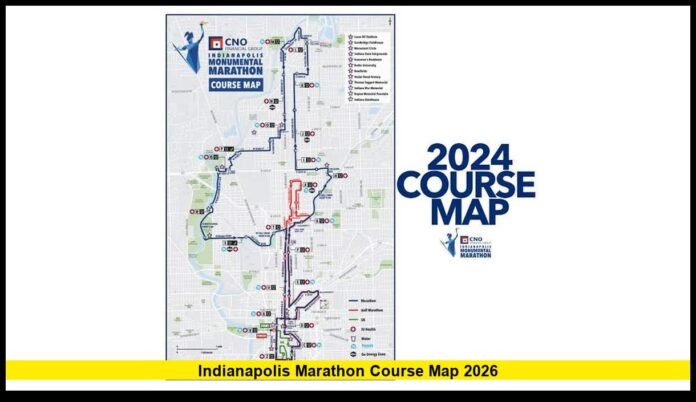

The Indianapolis marathon course map 2026 is an important resource for athletes, spectators, and visitors preparing for the CNO Financial Indianapolis Monumental Marathon. Taking place on Saturday, November 7, 2026, the annual running event brings together participants for three major race distances: the full marathon, half marathon, and 5K. Understanding the course layout can help runners prepare for the miles ahead while allowing spectators to plan where they want to watch the competition.
Indianapolis is known for hosting a marathon that combines a downtown race atmosphere with a route through several recognizable parts of the city. The event is particularly appealing to runners seeking a relatively flat course and an opportunity to pursue personal records. Its central starting and finishing locations also make downtown Indianapolis an important gathering point throughout race day.
The 2026 course information is useful for understanding the race distances, route divisions, aid stations, cutoff requirements, and spectator arrangements. Participants should review the current event maps rather than relying on older editions, as individual course details and traffic arrangements may change between years.
Indianapolis Monumental Marathon 2026: Event Details
The CNO Financial Indianapolis Monumental Marathon is an annual road-running event that attracts participants with different levels of experience. Some runners enter with specific performance goals, while others participate to complete their first marathon or support charitable causes.
The 2026 event features three principal races, each offering a different distance and experience.
| Race information | Details |
|---|---|
| Event | CNO Financial Indianapolis Monumental Marathon |
| Date | Saturday, November 7, 2026 |
| Full marathon | 26.2 miles |
| Half marathon | 13.1 miles |
| 5K | Approximately 3.1 miles |
| Marathon start | 8:00 a.m. ET |
| Half marathon start | 8:00 a.m. ET |
| 5K start | 8:40 a.m. ET |
| Location | Indianapolis, Indiana |
| Start and finish | Downtown Indianapolis |
| Scheduled course closure | 3:30 p.m. ET |
The full marathon is the event’s longest competition, requiring participants to cover 26.2 miles. The half marathon provides a shorter endurance challenge, while the 5K welcomes runners and walkers interested in participating in a shorter event.
Although the races are part of the same festival, they do not follow identical routes. Participants should select the correct course map according to their registered distance.
Indianapolis Marathon Course Map 2026: What Runners Should Know
The Indianapolis marathon course map 2026 provides an overview of the roads and areas included in the event. It helps runners understand the relationship between the starting location, course sections, support stations, and finishing area.
The full marathon extends beyond the downtown district and covers several sections of Indianapolis. This gives participants an opportunity to experience more of the city while completing the standard marathon distance.
One of the course’s major attractions is its relatively flat profile. Compared with routes featuring repeated steep climbs, a flatter course may allow participants to maintain a more consistent rhythm.
However, runners should not assume that a favorable elevation profile guarantees an easy race. Completing 26.2 miles still requires endurance, preparation, and careful management of energy.
The most important information to examine on the map includes:
- Starting-line location and designated entrances.
- Full marathon and half marathon route divisions.
- Mile markers and course direction.
- Aid stations and available refreshments.
- Medical support points.
- The final section leading toward the finish.
- Areas where spectators may be able to watch participants.
Reviewing these details before race morning can help participants avoid unnecessary confusion.
Where Does the Indianapolis Marathon 2026 Start?
The 2026 Indianapolis Monumental Marathon starts in downtown Indianapolis, with the starting arrangements centered around West Street and South Missouri Street.
Published race-day information identifies South Missouri Street near South West Street as the starting-line area. Participants should consult the official race-morning map to confirm the exact entrance and location assigned to their starting wave.
The full marathon and half marathon are scheduled to begin at 8:00 a.m. Eastern Time.
Runners should arrive with sufficient time to complete their preparations, organize personal belongings, use available facilities, and reach the appropriate starting area.
The early morning schedule also means participants should plan their transportation before leaving their accommodation. Downtown traffic restrictions may affect the routes available to vehicles and pedestrians.
For first-time marathon participants, becoming familiar with the starting area in advance can make the experience more manageable.
Where Is the Indianapolis Marathon Finish Line?
The finish area is situated in downtown Indianapolis, near Monument Circle and the Indiana Statehouse on East Maryland Street.
This central location provides a recognizable destination for runners and spectators. It also places participants close to several downtown facilities after completing their races.
For marathon runners, reaching the finish line marks the conclusion of a demanding endurance challenge. After crossing the line, participants should allow time for recovery, hydration, and collecting their belongings.
Spectators should arrange a meeting location before the event begins. Trying to locate someone immediately after the race can be difficult when thousands of participants and visitors are moving through the downtown area.
A clearly identified meeting point can make post-race arrangements considerably easier.
Major Landmarks Along the Indianapolis Marathon Route
The Indianapolis Monumental Marathon provides participants with an opportunity to experience different parts of the city. Several well-known locations serve as useful geographic references when studying the route.
The current official course map should be used to establish the precise roads and mile markers associated with each location.
Downtown Indianapolis
Downtown Indianapolis is the center of the event’s race-day activities. It contains the general start and finish areas and provides access to hotels, restaurants, parking facilities, and other city attractions.
Because runners and spectators gather here throughout the morning and afternoon, downtown is likely to experience significant activity during the event.
Participants staying nearby may find walking to the race area convenient, although temporary pedestrian restrictions should still be considered.
Monument Circle
Monument Circle is one of the most recognizable locations in Indianapolis.
Its proximity to the finish area makes it an important reference point for visitors planning to meet runners after the competition. The surrounding streets also provide a central orientation point for people unfamiliar with the city.
Spectators should remember that the area may be crowded and that normal vehicle access may be restricted during the race.
Indiana Statehouse
The Indiana Statehouse is another recognizable landmark near the downtown finishing area.
Its location makes it useful for understanding the final part of the event and identifying nearby streets. Visitors can use the building as a geographic reference when organizing post-race meetings.
However, the actual pedestrian routes and access arrangements should be checked against the race-day instructions.
Broad Ripple
Broad Ripple is a popular neighborhood in northern Indianapolis and an important geographic reference for understanding the marathon’s wider route.
The full marathon extends beyond the downtown area, allowing participants to experience sections of the city that are not covered by the shorter races.
For spectators, understanding the neighborhood’s location can help when planning to watch runners away from the central event area.
Butler University and Newfields
Butler University and Newfields are additional landmarks associated with the northern sections of the marathon’s geographic coverage.
These locations help participants visualize the route beyond downtown Indianapolis.
Runners should distinguish between a landmark appearing in general course information and the exact road traveled by the race. The official map determines the route, including the specific streets and mile markers.
Riverside Park
Riverside Park is an important option for spectators interested in watching marathon participants during the later stages of the race.
The event’s spectator guidance identifies this location as a possible viewing point around mile 20.
This provides friends and family with an opportunity to encourage runners as they approach the final portion of the 26.2-mile challenge.
Visitors should plan their transportation carefully because traveling between Riverside Park and downtown may take additional time during race-day restrictions.
Full Marathon, Half Marathon, and 5K: Understanding the Different Routes
The Indianapolis Monumental Marathon offers three distances, allowing participants to select an event that matches their experience and preparation.
Full Marathon: 26.2 Miles
The full marathon is the longest race and the primary attraction for many competitive runners.
Participants begin in downtown Indianapolis before traveling through the wider course area. The route includes sections beyond the city center before returning toward the downtown finish.
Runners should review the complete map to understand the route’s direction, support facilities, and important cutoff points.
The full marathon requires substantial physical preparation. Participants should establish a realistic pace and follow a nutrition and hydration strategy practiced during training.
Half Marathon: 13.1 Miles
The half marathon covers 13.1 miles and provides a shorter endurance challenge.
The half marathon shares approximately the first 7.2 miles with the full marathon before the two courses separate.
This arrangement means participants may initially run alongside athletes registered for the longer event. Once the routes divide, runners must follow the appropriate markings for their distance.
Understanding this separation is particularly important for anyone unfamiliar with the event.
5K: Approximately 3.1 Miles
The 5K is the shortest of the three races.
It offers an opportunity for participants who prefer a shorter distance or want to experience the atmosphere of the Indianapolis Monumental Marathon.
The 5K has its own scheduled starting time of 8:40 a.m. Eastern Time.
Participants should review the separate 5K map rather than assuming that its route follows the same streets as the full marathon or half marathon.
Is the Indianapolis Monumental Marathon a Flat Course?
The Indianapolis Monumental Marathon is promoted as a fast and relatively flat race.
This is an important feature for runners interested in achieving personal records or maintaining a steady pace over the marathon distance.
A course without repeated major climbs may help participants manage their energy more consistently. It can also make pacing strategies easier to plan for runners who have trained for a particular finishing time.
Nevertheless, the course profile is only one factor affecting performance.
Weather, wind, road surfaces, training quality, nutrition, and individual fitness can influence the final result. Even experienced runners may encounter difficult moments during the later miles.
For participants preparing for the 2026 event, useful training priorities include:
- Completing regular long-distance training sessions.
- Practicing the intended race pace.
- Testing nutrition and hydration plans before race day.
- Developing endurance for the final miles.
- Studying the route and important course divisions.
- Avoiding an overly aggressive starting pace.
A flat course can provide favorable conditions, but preparation remains essential.
Indianapolis Marathon 2026 Aid Stations and Runner Services
Aid stations play an important role in supporting participants throughout the event.
The course materials identify designated support points and use symbols to show the services available along the route.
Runners should review the map legend to understand which services are offered at particular locations.
Water and Hydration
Water availability is important for participants covering long distances.
Runners should understand the locations of the designated water stations and prepare a hydration strategy based on their individual needs.
Hydration requirements can differ depending on temperature, pace, body size, and personal sweat rate.
Participants should follow the approach they have practiced during training rather than introducing an unfamiliar strategy on race day.
Electrolyte Drinks
Electrolyte support is another consideration for marathon participants.
These drinks may help replace minerals lost through sweating. The current course materials should be checked for the locations where electrolyte products are available.
Runners who regularly use sports drinks during training should confirm the products offered at the event before relying on them.
Energy Gels
Energy gels are commonly used by distance runners as part of their fueling strategies.
The event materials identify energy-gel support along the course. However, runners should review the current aid-station details to determine where these products are offered.
Participants should avoid experimenting with unfamiliar nutrition products during the competition.
Medical Assistance
Medical support is an important safety feature of a major running event.
The course map identifies medical assistance locations through designated symbols. Participants should familiarize themselves with these markings before starting.
Anyone experiencing concerning symptoms should seek help from race personnel or medical staff rather than continuing without assistance.
Indianapolis Marathon 2026 Cutoff Times and Course Rules
Understanding the cutoff requirements is particularly important for participants completing the full marathon.
The marathon and half marathon share approximately 7.2 miles before their routes separate. The designated division point is therefore an important part of the course layout.
According to the published 2026 race rules, full marathon participants must reach the marathon-half marathon split between miles 7 and 8 by 10:25 a.m. Eastern Time to continue on the marathon route.
The full marathon has a seven-hour time limit, with the scheduled course closure at 3:30 p.m.
The published rules also establish a minimum pace of 16 minutes per mile for marathon participants to finish within the permitted time. The half marathon has a 16-minute-per-mile minimum pace requirement for its first 10 miles.
These requirements should be considered when developing a race strategy.
Participants should review the complete rules for their registered event and follow any instructions issued by race officials.
How to Track Indianapolis Marathon Runners in 2026
Spectators who cannot remain along the course throughout the event can use participant-tracking services to follow available race updates.
The 2026 event information includes real-time tracking through the official race app.
This feature can help family members and friends monitor a participant’s progress and make better decisions about where to watch.
Steps for Following a Participant
The general process involves:
- Open the official Indianapolis Monumental Marathon event app.
- Select the 2026 race.
- Find the participant-tracking section.
- Search for the runner using the available name or bib-number option.
- Review the progress information displayed by the tracking system.
Tracking information may update at designated timing points rather than showing a continuous GPS location.
Spectators should therefore use the information as a guide rather than assuming it always represents the runner’s exact current position.
Checking Official Race Results
The event provides designated results resources for the full marathon, half marathon, and 5K.
Participants can use the results service to review their recorded performances once the timing information becomes available.
Official results should be used to confirm finishing times and placements. Estimates calculated from an earlier checkpoint should not be treated as final results.
Best Places for Spectators to Watch the Indianapolis Marathon
Choosing a suitable viewing location can make the event more enjoyable for family members and friends.
Spectators should consider the runner’s expected pace, transportation arrangements, road restrictions, and the time needed to reach each viewing point.
Downtown Indianapolis Start Area
The starting area is an excellent option for spectators who want to watch participants prepare for the event and begin their races.
The atmosphere around the starting line can be particularly exciting as runners gather before the scheduled start.
Access may be restricted in certain areas, so visitors should follow event instructions and use designated spectator locations.
Downtown Finish Area
The finish area is a natural gathering point for people welcoming runners after their events.
Monument Circle and the surrounding downtown area provide useful geographic references for planning a meeting location.
Spectators should avoid standing in restricted sections of the finish area and should allow participants time to recover after crossing the line.
Riverside Park
Riverside Park offers another option for spectators, particularly those who want to watch marathon participants around mile 20.
This point allows family members and friends to provide encouragement during a challenging stage of the race.
Visitors should check available access routes and allow sufficient time for travel between the park and downtown.
Indianapolis Marathon Road Closures and Parking Information
Road closures are among the most important logistical considerations for the 2026 event.
The marathon affects several streets in downtown Indianapolis and surrounding areas. Temporary restrictions may influence driving routes, parking access, and pedestrian movement.
Published race information identifies the following major restrictions:
- West Street and South Missouri Street near the start area are scheduled to close from 5:00 a.m. to 10:00 a.m.
- West Washington Street and North Capitol Avenue near the finish area are scheduled to close from 5:00 a.m. until 5:30 p.m.
- Additional restrictions affect sections of the marathon route.
These restrictions make it important for visitors to plan transportation before arriving downtown.
Parking Preparation
Runners and spectators should not assume that their usual downtown parking route will remain available during the event.
Before race day, consider the following:
- Identify a parking facility outside restricted areas.
- Check the garage’s entrance and exit arrangements.
- Allow additional time to walk to the event.
- Review hotel transportation options.
- Keep an alternative parking location in mind.
Public Transportation and Pedestrian Access
Public transportation and walking may be useful alternatives to driving, especially for visitors staying near the city center.
However, temporary pedestrian barriers and street restrictions may affect access.
Travelers should check the latest transportation information before leaving their accommodation.
Latest Indianapolis Marathon Course Map 2026 Information
The 2026 Indianapolis Monumental Marathon is scheduled for November 7, with the event offering a full marathon, half marathon, and 5K.
The published race information identifies the following important details:
- The full marathon and half marathon begin at 8:00 a.m. ET.
- The 5K begins at 8:40 a.m. ET.
- The full marathon covers 26.2 miles.
- The half marathon covers 13.1 miles.
- The 5K covers approximately 3.1 miles.
- The marathon and half marathon share approximately 7.2 miles before separating.
- The full marathon course is scheduled to close at 3:30 p.m.
The precise starting arrangements should be checked using the race-morning map. Published information identifies the downtown starting area around South Missouri Street and South West Street.
Participants should also distinguish between the course map, the race-morning map, and the traffic-restriction map. Each serves a different purpose.
The course map explains the running route, the race-morning map provides information about event access and starting arrangements, and the traffic map helps visitors understand road closures.
Any revised instructions issued by race organizers should take priority over earlier information.
How to Prepare for Race Day Using the Course Map
Studying the Indianapolis marathon course map 2026 before the event can help runners and spectators avoid unnecessary problems.
The first step is to understand the starting and finishing locations. Participants should know how to reach their assigned starting area and where they will meet family members after completing the race.
The next step is reviewing the route division. Full marathon runners should understand where their course separates from the half marathon.
Aid stations also deserve attention. Participants should examine the available support information and consider how it fits their hydration and fueling strategies.
Spectators should approach the map from a different perspective. Their main priorities are identifying suitable viewing locations, checking road closures, and estimating how much time is needed to move between different sections of the course.
Finally, all participants should check for updated event instructions before traveling to Indianapolis.
Being familiar with the course can help make race morning more organized and allow runners to focus on their performance.
Frequently Asked Questions About Indianapolis Marathon Course Map 2026
Where can I find the Indianapolis Marathon Course Map 2026?
The official 2026 course map is available through the Indianapolis Monumental Marathon’s event information and participant resources. Separate maps are provided for the full marathon, half marathon, and 5K.
When is the Indianapolis Monumental Marathon 2026?
The event is scheduled for Saturday, November 7, 2026, in Indianapolis, Indiana.
What time does the full marathon start?
The full marathon is scheduled to begin at 8:00 a.m. Eastern Time. The half marathon also has an 8:00 a.m. start, while the 5K begins at 8:40 a.m.
Where is the starting line located?
The starting area is in downtown Indianapolis, around South Missouri Street and South West Street. Participants should check the race-morning map for their precise entrance and starting-wave arrangements.
Where is the finish line located?
The finish area is in downtown Indianapolis near Monument Circle and the Indiana Statehouse on East Maryland Street.
How long is the Indianapolis Monumental Marathon?
The full marathon covers 26.2 miles. The half marathon is 13.1 miles, and the 5K covers approximately 3.1 miles.
Is the Indianapolis Marathon course flat?
Yes. The event is promoted as a relatively flat and fast course, making it attractive to runners interested in maintaining a consistent pace or pursuing personal records.
Do the full marathon and half marathon share a route?
Yes. The two events share approximately the first 7.2 miles before their routes separate.
Can spectators track runners online?
The event provides participant-tracking resources through its official race app. Spectators can use the available search and tracking features to follow runners during the event.
What time does the Indianapolis Marathon course close?
The published 2026 schedule lists 3:30 p.m. Eastern Time as the course-closing time.
Where can spectators watch runners around mile 20?
Riverside Park is identified in the event’s spectator information as an option for watching marathon participants around mile 20.
Will there be road closures during the marathon?
Yes. Temporary closures affect streets around the downtown start and finish areas, along with sections of the race route. Visitors should review the current traffic information before traveling.
Can I use an older Indianapolis Marathon course map?
Older maps may help with general geographic orientation, but they should not be treated as confirmation of the 2026 route. Participants should use the current official map for accurate course information.
Final Thoughts
The Indianapolis marathon course map 2026 is an essential planning resource for participants and spectators attending the CNO Financial Indianapolis Monumental Marathon. From the downtown starting area to the final miles, understanding the route can help runners prepare for the distance and make informed decisions about pacing, hydration, and race-day logistics.
The event’s three race distances provide opportunities for participants with different running backgrounds. Its relatively flat profile, recognizable city locations, and downtown finish make it an appealing destination for the running community.
Spectators can also benefit from reviewing the course layout, identifying viewing locations, and understanding temporary transportation restrictions. Checking participant tracking and official race results can make following the event easier.
As the 2026 race takes place, the latest official course and race-day instructions remain the most reliable resources for participants.
Are you running the Indianapolis Monumental Marathon 2026 or following someone participating? Share your race-day experience in the comments and keep checking for the latest Indianapolis Marathon updates!