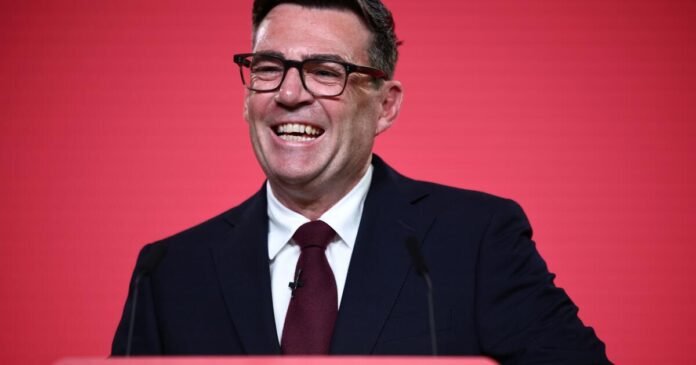

As Andy Burnham prepares to lead Britain, public curiosity about his personal background has grown sharply, and one of the most searched questions surrounding him is Andy Burnham religion. Now confirmed as the new leader of the Labour Party and Britain’s incoming prime minister, Burnham has never hidden the fact that he was raised Catholic, and his faith background has become a genuine talking point as he steps into Number 10. While he does not describe himself as a strictly observant churchgoer today, his Catholic upbringing has clearly left a lasting imprint on his values, his political style, and the way he talks about compassion, community, and fairness.
This article looks at what is actually known about Andy Burnham’s religious background, how it has influenced his political journey, and why it matters now that he is taking over as the country’s most powerful elected figure.
Who Is Andy Burnham
Andy Burnham was born in Aintree, Liverpool, and grew up in a working-class, Irish-Catholic household in the north-west of England. He was educated at Catholic schools, including a Catholic primary school and a Roman Catholic high school, before studying English at Cambridge University. He entered Parliament in 2001 as the MP for Leigh and went on to serve in several senior ministerial roles under Prime Ministers Tony Blair and Gordon Brown, including as Culture Secretary and Health Secretary.
After losing two separate Labour leadership contests, Burnham stepped away from Westminster in 2017 to become the first directly elected Mayor of Greater Manchester, a role he held for eight years and used to build a reputation as a plain-speaking regional leader. His public clashes with the government over COVID-19 support for the north of England earned him the nickname “King of the North,” and his popularity with the public and with Labour members never really faded, even while he was outside Parliament.
Andy Burnham Religion: A Catholic Upbringing
When people search for Andy Burnham religion, what they typically find is that he was raised in a devout Irish-Catholic family, and Catholicism, alongside Everton Football Club and the Labour Party, is one of three things he has repeatedly said shaped who he is. He has often summarised his own identity by saying he was made by “Everton Football Club, the Labour Party and the Catholic Church,” in that order, a line he has used for years and one that continues to circulate as he takes on Britain’s top job.
Burnham was an altar boy as a child and has spoken about how the Catholic parishes of the north-west, shaped heavily by Irish immigration, formed the backdrop of his early life. He took Michael as his confirmation name and has described a “direct read-across” between what he learned at church and school and the values he later found in the Labour movement. He has credited the Catholic emphasis on compassion, equality, and care for the poor as being closely aligned with Labour’s founding principles.
However, Burnham has also been open about drifting from regular religious practice as an adult. He has previously said he is “Catholic by upbringing” but “not particularly religious” today, and he has spoken candidly in the past about becoming disillusioned with aspects of Church teaching, particularly around issues of sexuality, which he found difficult to reconcile with his own support for gay rights and equality. This mix of cultural attachment and personal distance from formal religious practice is sometimes described by commentators as “cultural Catholicism,” meaning the identity and moral framework remain important even though regular Mass attendance does not.
How His Faith Has Shaped His Politics
Even though Burnham does not present himself as a strict practising Catholic, observers and religious commentators have repeatedly pointed to the influence his upbringing has had on his political instincts. He has spoken about admiring Pope Francis’s focus on the poor and marginalised, and he has drawn parallels between that outlook and his own commitment to tackling homelessness, a cause he prioritised heavily during his time as Mayor of Greater Manchester, including donating part of his salary toward the issue.
At the same time, Burnham’s policy positions do not always align with official Catholic Church teaching. He supports same-sex marriage, has voted against restrictive amendments on abortion rights, and has expressed sympathy for assisted dying, while also stressing that better palliative and hospice care needs to be in place first. He has also spoken in favour of a ban on conversion therapy. Political analysts have described this approach as an “à la carte” style of Catholicism, one that embraces the social justice and equality strands of Catholic teaching while departing from its more socially conservative positions.
Burnham has said he was raised with a “live and let live” approach at home, something he credits with shaping his generally tolerant, non-judgemental style of politics. His children have attended a Catholic school named after St Edmund Arrowsmith, a 17th-century Catholic martyr, underlining that Catholic identity still runs through his family life even if it does not translate into strict religious observance.
Career Path Back to Westminster and Onward to Number 10
Burnham’s route back to national leadership has been closely watched throughout 2026. After years of speculation about a possible leadership challenge to Sir Keir Starmer, Josh Simons, the sitting Labour MP for Makerfield, resigned his seat in May 2026 specifically to allow Burnham to stand in the resulting by-election and re-enter the House of Commons, a step required under Labour’s own rules for anyone wanting to contest the party leadership.
Burnham won the Makerfield by-election on 18 June 2026 with around 55 percent of the vote, defeating Reform UK’s candidate by more than nine thousand votes and outperforming pre-election polling. Days later, Sir Keir Starmer announced his resignation as Labour leader amid mounting pressure from within the party following poor local election results. Burnham quickly emerged as the frontrunner, gathering support from over 200 Labour MPs, and was ultimately confirmed as the sole candidate in the leadership contest.
On 17 July 2026, Andy Burnham was officially declared the new leader of the Labour Party at a special party conference in London. With Starmer’s formal resignation and King Charles III set to invite Burnham to form a government, Burnham prepares to lead Britain as its next prime minister, becoming the seventh person to hold the office since 2016. In his first speech as leader, he pledged to bring “hope” back to a country worn down by economic pressures, a cost-of-living squeeze, and strained public services.
Public Interest in Andy Burnham’s Background
The surge in searches around Andy Burnham religion reflects a broader pattern that tends to follow any new prime minister: the public wants to understand the personal values and background of the person now leading the country. Burnham would be the first practising or culturally identifying Catholic to begin a term as UK prime minister, which has prompted renewed attention to a rarely discussed constitutional detail. Under the Roman Catholic Relief Act 1829, also known as the Catholic Emancipation Act, Catholics are permitted to sit in Parliament and hold most public offices, but a Catholic prime minister is barred from formally advising the monarch on Church of England episcopal appointments. Legal and political experts have noted that how this specific provision would work in modern practice remains a point of debate, though it is not expected to have any significant practical impact on how Burnham governs day to day.
Beyond the constitutional curiosity, much of the public interest centres on Burnham’s personal story: his working-class Liverpool roots, his Catholic school education, his long-standing devotion to Everton Football Club, and his reputation as one of Labour’s more relatable and emotionally open communicators. Supporters have pointed to his 2021 mayoral re-election victory speech, during which he became visibly emotional thanking his family, as an example of the personal warmth that has made him popular with voters well beyond his home region.
Latest Updates
As of his confirmation as Labour leader on 17 July 2026, Burnham is expected to formally take office as prime minister within days, following Starmer’s resignation being tendered to the King. Burnham has said relatively little in detail about his specific policy agenda so far, and he will arrive in Downing Street largely unfamiliar to voters outside Greater Manchester, despite his high profile within the party. Trade unions have welcomed his early focus on living standards, while business groups have cautiously welcomed his emphasis on economic growth, though they have also stressed that execution will be the real test of his premiership. There is no official confirmation at this stage of any specific announcement regarding a general election date, and Burnham will retain the discretion, as prime minister, to decide when or whether to call one before the next election is legally required by 2029.
Final Thoughts
Andy Burnham religion is best understood not as a story of strict religious devotion, but as a story of cultural and moral inheritance. His Catholic upbringing in Irish-Catholic Liverpool shaped his early worldview, his instinct for social justice, and his belief in equality and compassion for the vulnerable, even as his personal practice of the faith has loosened over the years and his policy positions have diverged from official Church doctrine on several social issues. As Andy Burnham prepares to lead Britain, that blend of working-class Catholic roots and progressive social politics is likely to remain part of how both supporters and critics interpret his leadership style in the months ahead.
What do you think Andy Burnham’s Catholic upbringing will mean for his leadership style as prime minister? Share your thoughts in the comments, and stay tuned for more updates as his government takes shape.