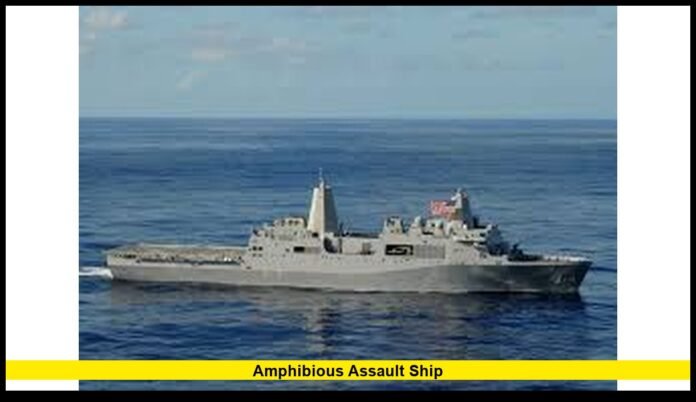

The amphibious assault ship has become one of the most strategically important assets in the modern U.S. Navy, reflecting how American military power adapts to global instability, regional competition, and fast-moving crises. In 2026, these ships are not only operationally active but increasingly central to U.S. defense planning, maritime presence, and expeditionary warfare.
As geopolitical tensions evolve and naval competition intensifies, amphibious assault ships provide the United States with a rare combination of mobility, flexibility, and sustained power projection. Their ability to operate across combat, deterrence, and humanitarian missions makes them uniquely suited for today’s security environment.
Defining the Amphibious Assault Ship
An amphibious assault ship is a large naval vessel designed to deploy Marine Corps forces from the sea to land using aircraft and surface landing craft. Unlike traditional warships with a single mission focus, these ships support a wide range of operations from a single floating platform.
They are built to carry:
- Marine expeditionary units
- Fixed-wing and rotary aircraft
- Command and control centers
- Medical facilities
- Logistics and sustainment assets
This design allows amphibious assault ships to function as mobile bases, capable of sustaining operations for extended periods without reliance on foreign ports or airfields.
Why These Ships Matter More Than Ever
Modern conflicts rarely follow predictable patterns. Threats can emerge suddenly, shift locations, or combine military, political, and humanitarian challenges. Amphibious assault ships give U.S. leaders options that do not require permanent basing or immediate escalation.
Their presence offshore provides:
- Rapid response capability
- Visible deterrence
- Strategic flexibility
- Reduced political risk
This makes them especially valuable in regions where access ashore is uncertain or contested.
U.S. Amphibious Assault Ship Classes
The U.S. Navy operates two main classes of amphibious assault ships, each serving a distinct role while sharing core capabilities.
America-Class Ships
America-class ships emphasize aviation operations and rapid air-based force deployment. They support Marine Corps concepts that prioritize speed, reach, and flexibility.
Key characteristics include:
- Expanded flight deck operations
- Support for fifth-generation aircraft
- Enhanced command and control spaces
- Optimized air assault capability
New ships entering this class strengthen the Navy’s ability to sustain aviation-heavy expeditionary missions.
Wasp-Class Ships
Wasp-class ships combine aviation capability with a full well deck for surface landings. This allows them to deploy landing craft, amphibious vehicles, and heavy equipment directly onto shore.
Their dual-role design supports:
- Traditional amphibious landings
- Aviation-based assaults
- Logistics movement
- Crisis response operations
Despite their age, these ships remain operationally relevant through modernization and sustained maintenance.
Operational Reality in 2026
Amphibious assault ships are not theoretical assets. They are actively deployed and supporting real-world missions across multiple regions.
Caribbean Operations
In the Caribbean, U.S. amphibious assault ships have supported sustained naval presence tied to enforcement operations, security missions, and contingency planning. Their ability to host command staff, aviation assets, and Marines makes them ideal platforms for complex maritime operations near unstable regions.
These deployments highlight how amphibious assault ships function as both deterrent tools and operational headquarters, allowing U.S. forces to manage evolving situations without establishing land bases.
Indo-Pacific Forward Presence
The Indo-Pacific remains a central focus of U.S. naval strategy. Amphibious assault ships forward-deployed in this region support joint exercises, alliance commitments, and deterrence missions.
Their presence reassures partners, strengthens interoperability, and reinforces freedom of navigation. Unlike aircraft carriers, amphibious assault ships offer a less escalatory but still powerful signal of U.S. commitment.
Strategic Value in Great Power Competition
As naval competition intensifies, amphibious assault ships occupy a critical space between diplomacy and high-end combat.
Their strategic advantages include:
- Persistent presence without permanent basing
- Multi-mission adaptability
- Reduced reliance on vulnerable infrastructure
- Enhanced operational reach
Other nations are expanding their own amphibious capabilities, reflecting a global recognition of the value these platforms provide. The U.S. Navy’s continued investment ensures it retains an operational and technological edge.
Supporting the Marine Corps Transformation
The U.S. Marine Corps is undergoing a fundamental transformation in how it organizes, deploys, and conducts operations. This shift emphasizes distributed forces, increased mobility, and the ability to respond rapidly across wide geographic areas. Amphibious assault ships play a direct and essential role in enabling this new operational approach.
By providing sea-based platforms for Marine units, amphibious assault ships allow forces to operate without dependence on fixed land bases. This supports distributed operations, where smaller, highly capable units can deploy quickly, reposition as needed, and sustain themselves from the sea. The ability to move Marines and equipment dynamically aligns closely with the Corps’ evolving mission requirements.
Amphibious assault ships enable key aspects of this transformation, including:
- Sea-based force projection, allowing Marines to deploy directly from international waters
- Flexible task organization, supporting tailored unit structures for specific missions
- Rapid mission reconfiguration, enabling shifts between combat, deterrence, and support roles
- Integration with modern aviation assets, including advanced aircraft and tiltrotor platforms
This close alignment between amphibious assault ship design and Marine Corps doctrine reinforces their long-term relevance. As the Corps continues to adapt to modern threats and operating environments, amphibious assault ships provide the mobility, flexibility, and operational reach necessary to execute its evolving mission set effectively.
Humanitarian and Crisis Response Capabilities
Beyond combat roles, amphibious assault ships play a critical part in humanitarian assistance and disaster response.
Their onboard capabilities include:
- Surgical and trauma medical facilities
- Helicopter-based evacuation support
- Logistics distribution hubs
- Water and power generation
These ships can respond quickly to disasters without requiring functioning ports or airports. Their independence makes them invaluable during earthquakes, hurricanes, evacuations, and regional crises.
Humanitarian missions also strengthen U.S. relationships abroad and demonstrate leadership through action rather than rhetoric.
Fleet Modernization and Shipbuilding Outlook
The U.S. Navy is continuing a broad modernization effort to ensure its amphibious fleet remains effective against future threats and operational demands. Amphibious assault ships are a central part of this effort, with upgrades focused on improving combat effectiveness, survivability, and integration with evolving joint force concepts.
New ship construction plays a key role in shaping the next generation of amphibious capability. Modern designs emphasize aviation-centric operations, improved internal layouts, and enhanced command spaces that support complex, multi-domain missions. These ships are being built to operate more effectively in contested environments while sustaining long-duration deployments far from home ports.
Aviation integration remains a top priority. Amphibious assault ships are being optimized to support advanced aircraft, including short takeoff and vertical landing jets, tiltrotor platforms, and rotary-wing assets. Improved flight deck operations, maintenance facilities, and support systems increase sortie generation and mission flexibility.
Digital modernization is also reshaping how these ships operate. Networked command-and-control environments allow amphibious assault ships to function as operational hubs, linking naval, air, and ground forces in real time. Enhanced data sharing and communications improve decision-making speed and coordination during both combat and crisis response missions.
Key modernization priorities include:
- Enhanced survivability, with improved defensive systems and damage control
- Improved aviation support, enabling sustained air operations
- Networked command environments, supporting joint and allied operations
- Integration with emerging technologies, including unmanned systems and advanced sensors
While budget pressures and shipyard capacity influence construction timelines, amphibious capability remains a core requirement in U.S. defense planning. Continued investment reflects the Navy’s recognition that amphibious assault ships provide enduring value across the full spectrum of military operations, ensuring they remain relevant well into the future.
Operational Flexibility Without Escalation
One of the most valuable advantages of an amphibious assault ship is its ability to provide credible options short of open conflict. These vessels allow U.S. leaders to respond to emerging situations with measured force, avoiding the immediate commitment associated with permanent bases or large-scale troop deployments.
By positioning amphibious assault ships offshore, decision-makers can place military capability within reach without crossing political or strategic thresholds. This posture signals readiness and resolve while preserving room for diplomacy and de-escalation. The presence of these ships communicates capability without forcing rapid escalation.
Amphibious assault ships also allow forces to transition quickly between missions as conditions change. A ship supporting deterrence patrols can shift to humanitarian assistance, evacuation operations, or limited military action without requiring redeployment or additional infrastructure.
This operational flexibility is particularly important in politically sensitive regions, where permanent basing may be impractical or unwelcome. By offering a visible yet adaptable presence, amphibious assault ships give the United States a balanced approach to managing risk while maintaining the ability to act decisively if required.
Maintaining Global Influence
Amphibious assault ships play a direct role in sustaining U.S. global influence by enabling consistent engagement across key regions. Their forward presence allows the United States to remain actively involved with allies and partners without relying on permanent bases, reinforcing long-term strategic relationships.
Through regular joint exercises, these ships help improve interoperability with allied militaries and ensure forces can operate together effectively during real-world contingencies. Port visits and regional engagements support diplomatic objectives, strengthen military-to-military ties, and demonstrate U.S. commitment to shared security interests.
Amphibious assault ships also serve as platforms for security cooperation, providing training opportunities and operational collaboration that enhance regional stability. During crises, their ability to respond quickly reinforces confidence among allies and deters potential adversaries by showing that U.S. support can be delivered rapidly and decisively.
Key contributions to global influence include:
- Joint exercises that enhance readiness and interoperability
- Port visits that support diplomatic engagement
- Security cooperation that builds partner capacity
- Crisis response that demonstrates reliable U.S. commitment
By maintaining a visible, flexible presence at sea, amphibious assault ships strengthen alliances and uphold the credibility of U.S. commitments in an increasingly competitive international environment.
Why These Ships Remain Essential
Even as unmanned systems and long-range strike capabilities continue to advance, amphibious assault ships remain indispensable to U.S. naval operations. Technology alone cannot replace the need to move personnel, aircraft, and sustained capability directly into operational areas. These ships deliver that presence with speed, flexibility, and persistence.
Amphibious assault ships are designed to operate where access is limited or denied. They carry Marines, aviation assets, command elements, and logistics in a single platform, allowing forces to deploy and adapt without relying on host-nation infrastructure. This makes them especially valuable in contested environments and during rapidly evolving crises.
Their enduring importance is rooted in a unique combination of strengths:
- Mobility, enabling rapid repositioning across theaters
- Endurance, allowing sustained operations far from home ports
- Versatility, supporting combat, deterrence, and humanitarian missions
- Operational independence, reducing reliance on land bases and external support
Few naval platforms offer this level of adaptability across such a wide range of missions. Amphibious assault ships provide decision-makers with flexible options that remain relevant regardless of how technology or threats evolve, ensuring their continued role at the center of U.S. maritime power.
Looking Ahead
As global security challenges become more complex and less predictable, the amphibious assault ship is set to remain a core element of U.S. naval power. Its proven ability to operate across combat operations, deterrence missions, and humanitarian response gives the United States a flexible tool that few other platforms can match.
Future defense planning places increasing value on sea-based forces that can move quickly, operate independently, and sustain missions without relying on fixed infrastructure. Amphibious assault ships align closely with this approach, offering mobility, endurance, and adaptability in regions where access ashore may be limited or politically sensitive.
Continued modernization will strengthen these capabilities through improved aviation integration, enhanced command systems, and upgraded survivability features. Strategic deployment of these ships will allow the U.S. Navy to respond rapidly to crises, reinforce alliances, and maintain a steady presence in critical maritime areas.
In an era of intensifying competition, amphibious assault ships provide a balanced means of projecting power while supporting stability. Their ongoing role reflects a broader commitment to maritime readiness, alliance assurance, and the protection of U.S. interests across the world’s oceans.
How do you see amphibious assault ships shaping future U.S. military strategy? Join the discussion and stay engaged with the latest developments.