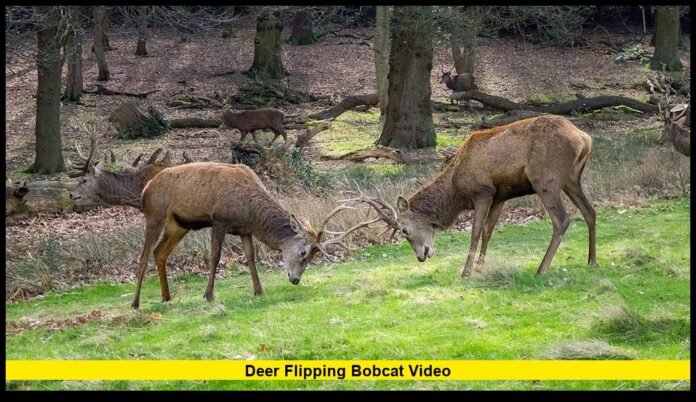

The deer flipping bobcat video has captured the attention of wildlife watchers and social media users after footage reportedly recorded in Crawfordville, Georgia, showed a mature buck charging a bobcat and sending the predator tumbling into the air. The unexpected confrontation offers a dramatic look at how quickly wildlife encounters can change when an animal that is usually considered prey decides to defend itself.
The video reportedly features a doe, a buck, and a bobcat moving through a wooded area. What begins as a seemingly ordinary wildlife sighting quickly turns into a remarkable confrontation. The buck suddenly charges the bobcat, using its antlers and powerful body to knock the predator off balance and send it airborne.
The dramatic moment has attracted attention because it reverses the usual expectations of a predator-prey encounter. Bobcats are skilled hunters, but the footage shows that a mature deer can also be a formidable opponent when threatened.
Key Points Summary
╔════════════════════════════════════════════════════════════════════╗
║ – Trail-camera footage from Crawfordville, Georgia, shows a buck confronting a bobcat in a dramatic wildlife encounter. ║
║ – The encounter reportedly began after a doe ran through the area, with the bobcat appearing to follow or pursue her. ║
║ – The buck faced the predator, charged with its antlers, and sent the bobcat into the air. ║
║ – The footage reportedly features a mature eight-point buck and was shared by wildlife video contributor Larry Poole. ║
║ – The bobcat retreated after the confrontation, although its condition afterward has not been confirmed. ║
╚════════════════════════════════════════════════════════════════════╝
A Trail Camera Captures an Unexpected Wildlife Encounter
Trail cameras are designed to capture wildlife activity without disturbing animals in their natural environment. They can record deer moving through a clearing, predators searching for food, and other interactions that happen when humans are nowhere nearby.
The Georgia footage provides an example of why these cameras continue to attract interest among wildlife enthusiasts. Instead of recording a routine animal sighting, the camera captured a confrontation that unfolded in a matter of seconds.
The video reportedly begins with a doe moving quickly across a trail or clearing. The female deer then disappears into nearby vegetation. A buck enters the scene shortly afterward, followed by a bobcat.
The timing of the animals’ movements appears to set the stage for the confrontation. The bobcat is seen near the same area where the deer have been moving, while the buck eventually turns its attention toward the predator.
Although the footage is short, it captures several distinct stages of the encounter: the arrival of the animals, a brief face-off, the buck’s sudden charge, the bobcat being thrown into the air, and the predator’s retreat.
That sequence has made the video particularly interesting to viewers who enjoy wildlife footage because it shows more than a simple animal sighting. It records a rapid change in behavior and a dramatic physical interaction.
The Doe Appears to Set the Scene for the Confrontation
One of the most discussed details in the footage is the doe’s appearance at the beginning. The female deer moves across the clearing and quickly disappears into the woods before the buck and bobcat come into view.
The sequence has led observers to believe that the bobcat may have been following the doe or attempting to approach her. The buck’s arrival and subsequent confrontation could have been connected to the predator’s proximity to the female deer.
However, the camera does not reveal every detail of what happened before the recording began. It is therefore difficult to establish with certainty whether the bobcat was actively hunting the doe, simply moving through the same habitat, or responding to another factor.
The apparent connection between the doe and the buck’s response has nevertheless become a central part of the video’s appeal.
Viewers have interpreted the buck’s actions as a defensive response, with the male deer appearing unwilling to allow the bobcat to continue approaching the area where the doe had been.
The Buck and Bobcat Face Off Before the Charge
Before the dramatic impact, the animals reportedly have a brief confrontation. The buck appears to approach the bobcat while the predator remains close to the trail.
Rather than immediately fleeing, the deer appears to face the cat and move closer. This brief moment gives the encounter a tense quality because neither animal immediately abandons the area.
The bobcat is a capable predator with sharp claws, powerful jaws, and quick reflexes. It is adapted to stalking and ambushing prey, usually relying on stealth rather than prolonged confrontations with much larger animals.
A mature white-tailed buck, meanwhile, can possess considerable body mass and a large set of antlers. When it decides to charge, the deer can generate substantial momentum.
The confrontation reaches its most dramatic point when the buck suddenly lunges toward the bobcat.
How the Buck Sends the Bobcat Flying
The moment that has attracted the greatest attention occurs when the buck charges with its antlers positioned toward the predator.
The deer appears to make contact with the bobcat, lifting or striking it in a way that sends the animal into the air. The movement happens quickly, creating the dramatic visual that has made the footage widely discussed.
The buck’s antlers are an important part of its defensive equipment. While antlers are commonly associated with fights between male deer during the breeding season, they can also be used during aggressive encounters with other animals.
The impact in the footage appears to involve a combination of the buck’s forward movement, body strength, and antlers. The bobcat is caught off balance and briefly becomes airborne.
The moment is unusual because viewers often associate bobcats with hunting and stalking behavior. Seeing one suddenly knocked into the air by a deer creates a striking reversal of the expected roles.
The encounter also demonstrates how quickly an animal that may have been approaching as a predator can become vulnerable when faced with a larger and physically powerful opponent.
The Bobcat Retreats as the Buck Continues the Pursuit
Following the impact, the footage reportedly shows the bobcat attempting to recover and move away from the buck. The deer does not immediately stop, instead continuing to pursue the predator as it retreats.
The chase appears to bring the confrontation to an end, with the bobcat leaving the immediate area and the buck remaining in control of the encounter.
The camera footage does not provide a complete view of what happened after the animals moved out of the recorded area. There is no confirmed information establishing whether the bobcat sustained an injury or whether it continued moving normally afterward.
It is important to separate the dramatic visual moment from assumptions about the animal’s condition. Being thrown into the air could potentially result in an injury, but the footage alone does not confirm that the bobcat was seriously hurt.
The available sequence indicates that the predator was driven away. Its subsequent condition remains unknown.
Why a Buck Can Be Dangerous to a Predator
White-tailed deer are commonly associated with avoiding danger. Their survival strategy often involves detecting threats early, running away, and using their speed and agility to escape predators.
However, deer are not defenseless animals.
A mature buck can use its antlers, muscular body, and powerful legs to respond to a threat. During the fall breeding season, bucks may become particularly aggressive as they compete for access to females and confront other males.
Antlers are normally associated with competition between bucks, but they can also be used during defensive encounters. A charge from a large deer can create a serious risk for a smaller animal.
The Georgia footage shows how the physical advantages of an adult deer may become important when escape is not the animal’s immediate response.
The buck’s size and antlers appear to give it a significant advantage during the confrontation. The bobcat, despite being an agile predator, is unable to maintain control of the encounter after the deer charges.
What Bobcats Usually Eat
Bobcats are adaptable predators found throughout much of North America. Their diets generally include smaller animals such as rabbits, rodents, birds, and other mammals.
They are known for their ability to stalk prey quietly and use the element of surprise. Their hunting techniques often involve waiting, moving carefully through vegetation, and striking quickly when an opportunity presents itself.
Deer can also be part of a bobcat’s diet, although they are not typically the primary food source. Bobcats may target deer under certain conditions, including when the animals are young, vulnerable, or otherwise easier to capture.
The presence of deer in a bobcat’s habitat does not mean every encounter will result in a successful hunt. Adult deer are considerably larger than bobcats, and a healthy buck can present a serious challenge.
The video illustrates this difference in physical capability. A predator may have the advantage of speed, claws, and hunting experience, but those qualities do not guarantee success when it encounters an animal capable of defending itself.
Why the Encounter Is Unusual
The most surprising aspect of the footage is the rapid reversal in the apparent roles of the animals.
Bobcats are predators, and their presence near deer can create a potential threat. Yet in this encounter, the buck appears to respond aggressively rather than retreating.
The confrontation also takes place in a setting where the animals’ movements are captured from a relatively unobstructed viewpoint. That makes it easier for viewers to follow the action and understand how the encounter develops.
Wildlife footage often becomes popular when it captures behavior that people do not frequently see. Animal interactions involving unexpected aggression, unusual movements, or dramatic physical contact tend to attract attention because they offer a glimpse into the natural world that is difficult to observe firsthand.
The Georgia video combines several elements that make it memorable: a predator, a larger prey animal, a possible defensive response, and an abrupt physical confrontation.
The Role of Trail Cameras in Wildlife Observation
Trail cameras have become valuable tools for observing wildlife. They can be placed in wooded areas, along trails, near water sources, or in locations where animals regularly travel.
Unlike a person holding a camera, a trail camera can record animals during the day or night and remain in place for extended periods. This allows wildlife observers to document activity without being physically present.
The technology has also changed the way people experience wildlife. Footage that might once have been seen only by a landowner or hunter can now be shared with a much larger audience.
A short recording can generate discussion about animal behavior, habitat, predators, prey, and the natural balance between species.
The buck-bobcat encounter is another example of the unexpected events that trail cameras can capture. It is a reminder that wildlife activity continues even when people are not watching.
Why the Deer Flipping Bobcat Video Is Trending
The deer flipping bobcat video has become a popular subject because it captures an unexpected moment that challenges the way many people imagine predator-prey interactions.
The footage shows a bobcat near a deer, followed by a buck’s aggressive response. The predator is suddenly sent into the air, and the deer continues pursuing it.
The video is short, but the action is dramatic enough to generate discussion. Viewers are interested in how the buck reacted, whether it was defending the doe, and what happened to the bobcat after it was thrown.
The apparent defensive behavior also adds another layer to the encounter. Many people have interpreted the buck’s actions as an example of a male deer protecting a female, although the precise motivation cannot be established from the recording alone.
The footage has also prompted renewed interest in the strength and defensive abilities of white-tailed deer. While deer usually avoid predators, encounters like this show that their behavior can change quickly when they perceive a threat.
Could the Buck Have Been Protecting the Doe?
The footage has led to speculation that the buck was protecting the doe from the bobcat. The sequence of events supports that possibility, but the animal’s motivation cannot be definitively determined from the camera recording.
Deer can respond aggressively when they perceive a threat nearby. A buck may react to another animal because of competition, territorial behavior, breeding activity, or a perceived danger to itself or other deer.
The doe’s appearance before the confrontation is an important detail. She runs across the clearing and disappears into the woods, while the buck and bobcat subsequently appear in the same area.
That sequence may indicate that the buck was responding to the predator’s presence near the doe. Still, wildlife behavior is complex, and the footage does not provide enough information to establish exactly why the buck chose to attack.
Regardless of its motivation, the result was clear: the buck successfully drove the bobcat away from the immediate area.
What the Footage Reveals About Wildlife Behavior
The encounter serves as a reminder that animals do not always behave according to the simplified roles people assign them.
A bobcat may be a predator, but it can also become vulnerable when confronted by a larger animal. A deer may usually be prey, but it can use its size, antlers, and strength to defend itself.
These interactions are part of the natural world, where survival depends on a combination of instinct, physical ability, timing, and environmental circumstances.
The video also highlights the importance of avoiding assumptions about animal behavior. A single recording may show what happened during a few seconds, but it cannot necessarily explain every factor that led to the encounter.
Wildlife observers can learn a great deal from such footage, especially when it is viewed as a record of natural behavior rather than as proof of a specific motivation.
Frequently Asked Questions
Where was the buck and bobcat encounter filmed?
The encounter reportedly took place in Crawfordville, Georgia, and was captured by a trail camera.
What happened in the viral wildlife video?
The footage shows a buck confronting a bobcat, charging the predator with its antlers, and sending it into the air before pursuing it.
Was the buck protecting a doe?
The footage appears to show a doe running through the area before the confrontation. The buck may have been responding to the bobcat’s presence near the female deer, but its exact motivation has not been confirmed.
How many points did the buck have?
Reports describing the footage identify the deer as a mature buck with an eight-point antler rack.
Did the bobcat get injured?
The footage shows the bobcat retreating after being struck and thrown into the air. Its condition afterward has not been publicly confirmed.
Do bobcats hunt deer?
Yes. Bobcats primarily eat smaller animals, including rabbits and rodents, but they can also prey on deer under certain circumstances.
Why are trail-camera wildlife videos popular?
Trail cameras can record wildlife behavior without human presence. They frequently capture unusual encounters, feeding activity, predator movements, and other moments that people might otherwise never see.
Final Thoughts
The dramatic Georgia wildlife encounter shows how quickly an interaction between animals can change. A bobcat appeared near a doe, a buck confronted the predator, and a sudden charge sent the cat tumbling through the air. The bobcat then retreated as the deer continued its pursuit.
While the exact circumstances behind the buck’s reaction remain uncertain, the footage offers a striking example of the strength and defensive capabilities of mature white-tailed deer. It also highlights the unpredictability of wildlife and the fascinating moments that trail cameras can capture.
Have you ever witnessed a deer standing its ground against a predator? Share your thoughts in the comments and stay tuned for more fascinating wildlife encounters and viral animal videos