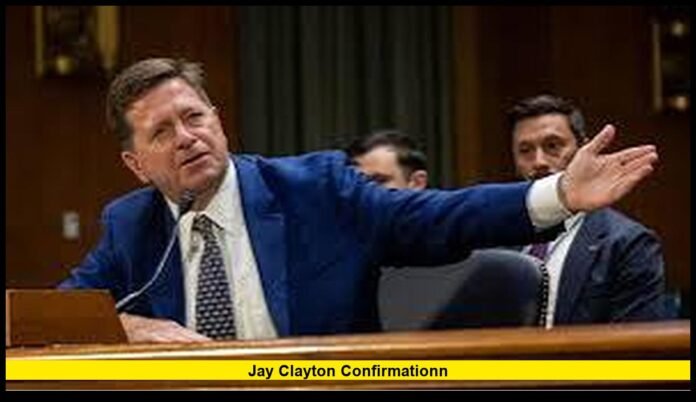

The jay clayton confirmation marked a consequential moment for the U.S. intelligence community, bringing an end to weeks of uncertainty over who would permanently oversee America’s intelligence agencies. The Senate approved President Donald Trump’s nominee, Walter “Jay” Clayton III, by a 51–47 vote on July 28, 2026, following a politically contentious confirmation process. His appointment placed a former Securities and Exchange Commission chairman and federal prosecutor in charge of coordinating intelligence operations at a time when cybersecurity, foreign interference, artificial intelligence, and national security threats are receiving growing attention.
Clayton’s selection attracted considerable interest because his professional background differs from that of many traditional intelligence officials. Rather than building his career inside an intelligence agency, he developed experience in corporate law, financial regulation, federal investigations, and national security-related prosecutions. The Trump administration viewed that combination as valuable for a position requiring coordination across multiple government organizations.
The confirmation also came after disagreements between Republicans and Democrats over Clayton’s testimony, his previous prosecutorial decisions, and the independence of intelligence agencies. With the Senate vote completed, attention has shifted from the political process to his leadership and the challenges facing the U.S. Intelligence Community.
Key Points Summary
╔════════════════════════════════════════════════════════════════════╗
║ – Jay Clayton was confirmed as Director of National Intelligence on July 28, 2026. ║
║ – The Senate approved his nomination by a 51–47 party-line vote. ║
║ – President Donald Trump announced Clayton as his nominee on June 11, 2026. ║
║ – Clayton previously served as chairman of the Securities and Exchange Commission from 2017 to 2020. ║
║ – He also led the U.S. Attorney’s Office for the Southern District of New York. ║
║ – His July 15 confirmation hearing included questions about election integrity and intelligence oversight. ║
║ – Clayton replaced the temporary leadership arrangement that followed Tulsi Gabbard’s departure. ║
║ – His latest public statements have focused on cybersecurity, technology disruptions, and emerging national security threats. ║
╚════════════════════════════════════════════════════════════════════╝
Senate Approves Jay Clayton After Divisive Confirmation Process
The Senate’s decision on July 28 ended the uncertainty surrounding Trump’s choice for the country’s top intelligence position. The final tally was 51 votes in favor and 47 against, with two Republican senators not participating.
The vote followed a confirmation hearing held by the Senate Select Committee on Intelligence on July 15. Although Clayton entered the process with substantial professional credentials, his testimony generated disagreements that made the final decision more politically difficult.
Republicans supported his nomination, emphasizing his experience in federal law enforcement, financial regulation, and leadership. They argued that his ability to manage complex organizations and oversee sensitive investigations would be useful in coordinating intelligence agencies.
Democratic senators, however, raised concerns about his responses to questions involving the 2020 presidential election and his handling of investigations while serving as a federal prosecutor.
The party-line outcome demonstrated that national security appointments can become politically contentious even when nominees have extensive government experience.
Why Did Donald Trump Choose Jay Clayton?
President Trump announced Clayton’s nomination on June 11, 2026. His selection followed the departure of Tulsi Gabbard, whose tenure as Director of National Intelligence had been marked by disagreements with congressional Democrats.
The administration needed a permanent leader who could oversee the intelligence community and provide the president with assessments of domestic and international security developments.
Clayton’s experience offered a different approach to the position.
His career included senior responsibilities in a major international law firm, leadership of the SEC, and federal prosecutorial work in one of the country’s most prominent judicial districts.
These roles exposed him to financial institutions, international business activity, criminal investigations, regulatory enforcement, and national security-related cases.
The administration’s choice reflected an interest in leadership experience and institutional management rather than relying exclusively on candidates with traditional intelligence backgrounds.
What Happened During the Senate Confirmation Hearing?
Clayton appeared before the Senate Intelligence Committee on July 15, 2026. Lawmakers used the hearing to examine his qualifications, judgment, political independence, and understanding of the intelligence director’s responsibilities.
One of the most controversial subjects was the 2020 presidential election.
Democratic senators repeatedly asked Clayton whether he would acknowledge that Joe Biden won the election. Clayton referred to Biden’s certification as the winner but did not provide the direct acknowledgment that several lawmakers wanted.
His responses became a major source of criticism and contributed to opposition from Democratic members of the committee.
Another subject involved his previous work as U.S. Attorney for the Southern District of New York.
Senators questioned his office’s use of subpoenas involving New York Times journalists and raised concerns about protecting press freedom and constitutional rights.
Clayton defended his professional conduct and discussed the importance of following legal procedures.
The hearing also addressed intelligence independence, government surveillance, congressional oversight, and the responsibility of intelligence officials to provide accurate information regardless of political considerations.
These discussions illustrated the scrutiny attached to a position that has access to highly sensitive intelligence and plays an important role in presidential decision-making.
Understanding the 51–47 Senate Vote
The confirmation vote was closely divided, with Republicans providing the support necessary to approve the nomination.
| Voting category | Result |
|---|---|
| Votes supporting Clayton | 51 |
| Votes opposing Clayton | 47 |
| Republicans not voting | 2 |
| Final decision | Confirmed |
All 51 Republicans who participated voted in favor. The 45 Democrats and two independents who caucus with Democrats voted against the nomination.
Senators Lindsey Graham and Mitch McConnell did not vote.
The result was particularly significant because the nomination had initially appeared to have the potential for broader bipartisan support. However, disagreements during the confirmation hearing changed the political atmosphere.
Once the Senate approved Clayton, the administration could move forward with permanent leadership of the intelligence community.
Jay Clayton’s Background Before Joining the Intelligence Community
Clayton’s professional history is an important part of understanding why his nomination attracted attention.
Born on July 11, 1966, in Newport News, Virginia, he pursued an education that combined engineering, economics, and law.
He studied engineering at the University of Pennsylvania, attended the University of Cambridge for graduate studies in economics, and earned his law degree from the University of Pennsylvania.
After completing his education, Clayton joined Sullivan & Cromwell, a major international law firm.
His work involved corporate transactions, financial markets, and legal matters affecting major businesses and financial institutions.
That experience eventually led him into federal government service.
SEC Chairman During Trump’s First Administration
Clayton became chairman of the Securities and Exchange Commission in 2017 after being nominated by Trump.
He served in the position until December 2020.
The SEC is responsible for protecting investors, maintaining fair and efficient markets, and supporting capital formation.
As chairman, Clayton oversaw regulatory activities involving publicly traded companies, investment advisers, financial markets, and securities enforcement.
His tenure provided experience managing a large federal organization with significant regulatory responsibilities.
This background became an important part of the administration’s argument that he could successfully lead another complex government institution.
Leadership at the Southern District of New York
Clayton returned to federal service in 2025 when Trump selected him to lead the U.S. Attorney’s Office for the Southern District of New York.
The office handles a broad range of federal matters, including financial crimes, public corruption, organized crime, and national security-related investigations.
His tenure included high-profile prosecutions and interactions with federal law enforcement and intelligence personnel.
His experience in this role became particularly relevant during the DNI confirmation process because it demonstrated his familiarity with sensitive government investigations and interagency cooperation.
What Does the Director of National Intelligence Actually Do?
The Director of National Intelligence is responsible for overseeing and coordinating the U.S. Intelligence Community.
The position was established following the September 11 terrorist attacks, when the federal government identified weaknesses in intelligence coordination and information-sharing.
The DNI serves as the principal intelligence adviser to the president and helps ensure that information from different agencies contributes to a coordinated understanding of national security threats.
The director’s responsibilities include several major areas.
1. Intelligence Coordination
The DNI works with organizations responsible for foreign intelligence, military intelligence, signals intelligence, and other national security activities.
Effective coordination helps prevent important information from remaining isolated within individual agencies.
2. National Security Assessments
The director provides intelligence assessments to the president and senior government officials.
These assessments help policymakers understand international conflicts, foreign government activities, terrorist threats, and other developments that could affect American interests.
3. Intelligence Budget and Priorities
The office oversees the National Intelligence Program and helps establish priorities for intelligence collection, analysis, and resource allocation.
4. Cybersecurity and Emerging Technologies
Cyberattacks, artificial intelligence, and digital infrastructure vulnerabilities have become major concerns for intelligence officials.
The DNI must coordinate efforts to identify threats and understand how technological developments could affect national security.
5. Congressional Oversight
The intelligence community operates under congressional oversight.
The director must work with lawmakers while protecting classified information and ensuring that intelligence activities comply with applicable laws.
Latest Jay Clayton Developments as of November 18, 2026
Clayton’s leadership has increasingly focused on the relationship between technology reliability and national security.
On November 17, he addressed concerns about technology disruptions affecting government organizations and private companies. Speaking to CNBC, he said intelligence officials had found no evidence that the incidents represented a coordinated cyberattack or state-sponsored operation.
The disruptions raised questions because several important services experienced technical problems within a relatively short period.
Among the affected organizations and services were government networks, financial institutions, airlines, and major technology platforms.
Clayton explained that investigators had examined whether a foreign government or malicious actor was responsible. Based on the information available at the time, he characterized the incidents as separate technical failures rather than a coordinated attack.
He also emphasized that intelligence officials must investigate potential malicious activity whenever significant technology disruptions occur.
On November 18, Clayton addressed the issue again during a House Homeland Security Committee hearing examining worldwide threats to the United States.
He reiterated that the outages appeared to involve separate maintenance and technical changes, rather than a coordinated operation by a foreign adversary.
His statements were significant because the National Security Agency also experienced a disruption involving its classified network.
The NSA indicated that its mission-critical capabilities remained operational despite the technical problems.
These developments have placed additional attention on the resilience of America’s digital infrastructure and the importance of maintaining reliable government systems.
Artificial Intelligence Is Becoming a Major National Security Priority
Another important issue during Clayton’s leadership is the growing influence of artificial intelligence.
AI technology is changing how governments, businesses, and criminal organizations operate. While advanced systems can improve cybersecurity and intelligence analysis, they can also introduce new vulnerabilities.
For intelligence agencies, the challenge involves understanding how artificial intelligence could be used to conduct cyberattacks, manipulate information, automate intelligence gathering, and target sensitive infrastructure.
Clayton has highlighted the speed at which technology is developing and the importance of keeping government systems updated.
Older software and infrastructure can become increasingly difficult to maintain as computing capabilities advance.
The recent service disruptions have also demonstrated that technical upgrades must be carefully managed. An unsuccessful update can interrupt important services even when there is no malicious activity involved.
For the intelligence community, this creates a dual responsibility: identifying external threats while helping the government understand risks associated with its own technology systems.
Concerns About Intelligence Independence and Government Oversight
Clayton’s confirmation also renewed discussions about the independence of America’s intelligence agencies.
The DNI receives sensitive information and advises the president, but the position carries responsibilities that extend beyond serving the administration.
Intelligence assessments must be based on available evidence rather than political preferences.
This distinction is important because intelligence information can influence military decisions, diplomatic relationships, sanctions, counterterrorism operations, and national security policies.
During his confirmation process, Democratic senators expressed concerns about whether Clayton would maintain sufficient independence from political pressure.
Republican lawmakers defended his qualifications and argued that his professional background demonstrated the judgment needed to lead the intelligence community.
These disagreements are likely to remain part of congressional discussions about intelligence policy.
The director must maintain working relationships with lawmakers from both parties while ensuring that classified information is handled appropriately.
The Importance of Section 702 and Intelligence Surveillance
Another significant issue surrounding Clayton’s appointment was the future of Section 702 of the Foreign Intelligence Surveillance Act.
Section 702 allows U.S. intelligence agencies to collect certain communications involving non-U.S. persons reasonably believed to be located outside the United States, subject to legal requirements and oversight.
The authority is considered important for identifying foreign intelligence threats, including terrorism, espionage, and cyber operations.
However, it has also generated disagreements about Americans’ privacy rights.
Critics have raised concerns about how information involving U.S. persons can be acquired and subsequently searched.
Clayton’s confirmation took place during a period of political disagreement over the future of this surveillance authority.
His leadership therefore involves balancing intelligence requirements with constitutional protections and public accountability.
What Challenges Could Shape Clayton’s Tenure?
Although his confirmation is complete, the most difficult part of his assignment involves delivering results.
Several challenges could influence his effectiveness as Director of National Intelligence.
Foreign Government Activities
The United States must continue monitoring foreign military developments, intelligence operations, economic pressure, and efforts to influence American institutions.
Clayton will be responsible for ensuring that relevant intelligence reaches the president and other senior officials.
Cybersecurity and Critical Infrastructure
Financial systems, transportation networks, communications platforms, and government databases are increasingly interconnected.
A technical failure or successful cyberattack involving one major organization can create consequences for other parts of the economy.
The recent outages have highlighted the importance of resilience and effective incident response.
Artificial Intelligence Competition
Advanced AI capabilities are becoming strategically important.
Intelligence agencies must understand how other countries are developing these technologies and how they could affect military, economic, and cybersecurity capabilities.
Public Trust
Maintaining confidence in intelligence institutions is another major responsibility.
The director must protect classified information while ensuring that intelligence activities remain subject to appropriate oversight.
Cooperation Between Agencies
The intelligence community includes organizations with different responsibilities, technical capabilities, and operational priorities.
Improving communication and reducing unnecessary duplication will remain important parts of Clayton’s leadership.
Frequently Asked Questions About Jay Clayton’s Appointment
1. Was Jay Clayton confirmed as Director of National Intelligence?
Yes. The U.S. Senate confirmed Clayton on July 28, 2026, with 51 senators voting in favor and 47 voting against.
2. Who nominated Jay Clayton for the DNI position?
President Donald Trump announced Clayton as his nominee on June 11, 2026.
3. Why was Jay Clayton’s confirmation controversial?
His confirmation generated disagreements about his responses concerning the 2020 presidential election, his previous prosecutorial decisions, intelligence independence, and government oversight.
4. What was Jay Clayton’s previous government position?
Before his nomination, Clayton served as U.S. Attorney for the Southern District of New York. He previously chaired the Securities and Exchange Commission.
5. When did the Senate hold Clayton’s confirmation hearing?
The Senate Intelligence Committee held his confirmation hearing on July 15, 2026.
6. What was the final Senate vote?
The Senate approved his nomination by a 51–47 vote on July 28, 2026.
7. What does Jay Clayton oversee as DNI?
He leads the U.S. Intelligence Community, coordinates intelligence activities, advises the president, and oversees national intelligence priorities.
8. What did Jay Clayton say about the November 2026 technology outages?
He said the disruptions appeared to be separate technical incidents involving maintenance and system changes, rather than a coordinated cyberattack or state-sponsored operation.
9. Why is cybersecurity important to his position?
Cybersecurity affects government operations, financial markets, transportation, communications, and critical infrastructure. The DNI helps coordinate intelligence efforts to identify and assess these threats.
10. Is Jay Clayton’s confirmation still pending?
No. His nomination was approved in July 2026. As of November 18, 2026, he is serving as Director of National Intelligence.
Conclusion
Jay Clayton’s appointment represents an important leadership transition for the American intelligence community. His confirmation followed a difficult Senate process that exposed disagreements over election-related questions, intelligence independence, and the responsibilities of federal law enforcement officials.
His experience in corporate law, securities regulation, and federal prosecution gives him a different professional background from many previous intelligence leaders. However, his success will ultimately depend on his ability to coordinate agencies, provide reliable intelligence assessments, and respond effectively to emerging national security challenges.
The technology disruptions reported in November 2026 have already demonstrated the importance of cybersecurity, infrastructure reliability, and rapid threat assessment. As artificial intelligence continues to transform the digital landscape, these issues are likely to remain central to his responsibilities.
With the Senate confirmation behind him, the focus is now on how Clayton manages America’s intelligence priorities and protects national security during an increasingly complex technological and geopolitical period.
What are your thoughts on Jay Clayton’s leadership and the future of America’s intelligence community? Share your opinion in the comments and follow the latest developments in U.S. national security and politics.