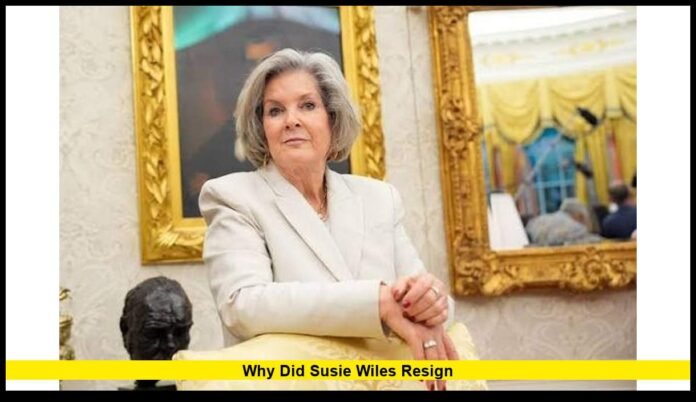

The question Why did Susie Wiles resign has attracted widespread attention following President Donald Trump’s announcement that he would replace her as White House chief of staff with longtime adviser Stephen Miller. Wiles submitted her resignation on November 5, 2026, and Trump announced the leadership change the following day, shortly after Republicans suffered major losses in the midterm elections. Although Trump praised Wiles publicly and said she would move to his political operation, reporting indicates that the election results contributed to the circumstances surrounding her departure.
Wiles held one of the most influential positions in the federal government and played a central role in Trump’s political organization. Her ability to manage competing personalities, coordinate presidential advisers, and maintain a close working relationship with Trump helped establish her reputation as a powerful Republican strategist. Her departure therefore represents more than a routine personnel change.
The timing also raises important questions about the administration’s response to its electoral setbacks, the future of White House decision-making, and the role Wiles may continue to play in Trump’s political activities. Understanding her resignation requires examining the reported reasons for the decision, her career, her relationship with the president, and the significance of Stephen Miller’s appointment.
Why Did Susie Wiles Resign From Her Position?
Susie Wiles resigned as White House chief of staff following Republican losses in the 2026 midterm elections. Reports from people familiar with the discussions indicated that the results contributed to the decision, as Trump and his advisers faced questions about the administration’s political strategy and its ability to maintain Republican control of Congress.
Wiles submitted her resignation to Trump on Thursday evening, November 5. The president announced on Friday, November 6, that Stephen Miller would replace her, with the transition scheduled to take effect on November 9.
The announcement came at a particularly difficult moment for the Republican Party. Losing control of Congress creates new obstacles for a president’s legislative agenda and gives the opposition greater opportunities to investigate executive branch decisions, challenge administration policies, and influence national political debates.
As chief of staff, Wiles was closely involved in coordinating the president’s priorities and managing the White House team. Her position made her an important figure in the administration’s political and operational planning.
According to reporting published after the announcement, Trump was unhappy with the scale of the Republican losses and questioned the performance of his political team. Wiles’ departure followed those discussions, although the precise details of the private conversations between the president and his chief of staff remain incomplete.
Trump publicly described the decision as a leadership change and praised Wiles for her work. His announcement did not present a detailed explanation of every factor behind her departure.
The available information supports a clear distinction: Wiles formally resigned, but the reported political circumstances surrounding that resignation suggest that the election results played an important role.
How the 2026 Midterm Elections Affected Wiles’ Departure
The 2026 midterm elections changed the political environment facing the Trump administration. Republican losses weakened the party’s congressional position and created new challenges for the White House as it approached the remaining years of Trump’s presidency.
Midterm elections often serve as a referendum on the party occupying the White House. Voters may use them to express concerns about economic conditions, immigration enforcement, foreign policy, government performance, and the president’s overall leadership.
When a president’s party suffers substantial losses, senior officials responsible for political strategy can face increased scrutiny. Campaign planning, voter outreach, public messaging, and policy priorities may all become subjects of internal review.
Wiles had helped lead Trump’s successful 2024 presidential campaign and subsequently became responsible for managing the White House operation. Her experience made her an important connection between the president’s electoral strategy and his administration’s daily work.
Following the midterms, reporting linked her departure to dissatisfaction over the Republican performance. Accounts also indicated that Trump had begun reconsidering aspects of his team’s strategy.
However, election losses do not automatically establish that one official was responsible for the outcome. Voters make decisions for many reasons, and the results reflect a combination of national conditions, individual races, candidate performance, and public attitudes toward the government.
The available reporting does not establish that Wiles alone caused the Republican defeats. Her resignation instead occurred within a broader reassessment of the administration’s political direction.
The decision to appoint Miller also suggests that Trump wanted a different leadership arrangement as he prepared to confront a more difficult congressional environment.
Did Trump Fire Susie Wiles or Did She Resign Voluntarily?
One of the central issues surrounding the story is whether Wiles independently chose to leave or whether Trump effectively pushed her out of the position.
The confirmed sequence is that Wiles submitted her resignation on November 5 and Trump publicly announced her replacement on November 6. She also stated that November 6 was her final day as White House chief of staff.
Reporting from people familiar with the matter described discussions surrounding the timing of her departure and indicated that Trump had become frustrated with the midterm results. Some accounts suggested that the president had considered replacing her, while others characterized the departure as a mutual decision influenced by the election outcome.
Trump publicly praised Wiles and said he wanted to make a change. He also announced that she would move to his political operation.
These details make it difficult to describe the departure as either a completely independent decision or a straightforward dismissal without qualification.
In Washington, a chief of staff serves at the president’s discretion. Even when an official submits a resignation, the surrounding circumstances can involve pressure, disagreements, or a mutual recognition that a leadership transition is necessary.
The most accurate conclusion is that Wiles resigned from the position during a politically sensitive period, with the Republican midterm losses contributing to the circumstances surrounding the change.
There is no need to assume that the public praise Trump offered proves there was no tension behind the scenes. Equally, the available reporting does not justify presenting every reported disagreement as an established cause of her departure.
Who Is Susie Wiles? Her Political Career and Influence
Susie Wiles is an experienced Republican political strategist whose career includes campaign management, political consulting, and work with prominent Republican candidates.
She developed much of her political reputation through her work in Florida, where she became known for organizing campaigns and building relationships with candidates, donors, and political organizations.
Her experience included managing Rick Scott’s successful 2010 campaign for Florida governor and working on other Republican campaigns. She also played a significant role in Ron DeSantis’ successful 2018 gubernatorial campaign before later becoming a central figure in Trump’s political organization.
Wiles’ relationship with Trump grew particularly important during the 2024 presidential campaign. She helped manage the campaign that returned Trump to the White House and earned his trust through her organizational abilities and understanding of his political style.
After Trump’s victory, he appointed Wiles as White House chief of staff. She became the first woman to hold the position.
The chief of staff is responsible for coordinating the president’s senior advisers, managing the White House staff, controlling the flow of information to the president, and helping turn presidential priorities into administrative action.
The position requires political judgment as well as strong management skills. A chief of staff must balance competing demands, resolve disagreements, and determine which issues need the president’s immediate attention.
Wiles earned a reputation for maintaining discipline within Trump’s political operation. Her approach generally emphasized organization, loyalty, and private discussions rather than public confrontations.
Her departure is significant because she had achieved a level of trust with Trump that allowed her to remain in a demanding role through major political developments and personal challenges.
Did Policy Disagreements Contribute to Susie Wiles’ Resignation?
Reporting surrounding Wiles’ departure has also highlighted differences among senior administration officials over policy and political strategy.
Immigration enforcement and the administration’s approach to the conflict involving Iran have been among the issues associated with internal disagreements. Wiles was widely viewed as an influential adviser who sometimes raised concerns about the consequences of major decisions.
Stephen Miller, by contrast, has been one of the strongest advocates for Trump’s hard-line immigration policies and an expansive approach to executive authority.
These differences are relevant because a chief of staff must work with advisers who may have competing views about how the president should pursue his goals. The role involves managing those differences while ensuring that the president’s decisions are implemented.
However, reports of policy disagreements do not establish that any single dispute caused Wiles to leave.
The midterm election results provide the clearest immediate context for the timing of the change. Reports also describe broader dissatisfaction within Trump’s circle over the political outcome and the performance of his team.
It remains important to distinguish between the circumstances reported by news organizations and the details that have been officially confirmed. No complete public account has established exactly how much each policy disagreement influenced the resignation.
The leadership change may affect how competing viewpoints are represented inside the White House, but its practical consequences will become clearer through future administration decisions.
What Role Did Stephen Miller Play in the White House Shake-Up?
Stephen Miller is a longtime Trump adviser who served as deputy chief of staff for policy before being selected to replace Wiles.
He became prominent during Trump’s first presidential campaign in 2016 and has remained influential in shaping the administration’s policy agenda. He is particularly associated with immigration restrictions, deportation initiatives, border enforcement, and the use of executive authority to advance presidential priorities.
Trump announced that Miller would become chief of staff beginning November 9, 2026. The president described him as one of his most trusted advisers and praised his political abilities.
The appointment represents a significant change in White House management. Miller already had extensive responsibilities, but the chief of staff position gives him a broader role in coordinating the president’s senior team and managing the administration’s internal operations.
His appointment also comes as Democrats prepare to exercise greater influence in Congress. A Democratic-controlled Congress can pursue investigations, hold oversight hearings, challenge administration policies, and complicate the passage of legislation.
Miller’s promotion may indicate that Trump wants a highly loyal adviser to coordinate his agenda during a more confrontational political period.
However, a personnel change does not automatically mean that every administration policy will change. The president’s priorities, court decisions, congressional negotiations, and implementation challenges will continue to shape what the administration can accomplish.
For Wiles, Miller’s appointment marks the end of her responsibility for the White House’s daily operations. For the administration, it begins a new phase of leadership at a time when political pressure is increasing.
Did Susie Wiles’ Health Influence Her Decision to Leave?
Wiles’ health has also received attention because she publicly disclosed an early-stage breast cancer diagnosis in March 2026.
She continued serving as chief of staff while undergoing treatment and later announced in September that she was cancer-free. Her experience demonstrated the personal demands of holding one of the most demanding positions in the federal government.
Nevertheless, there is no confirmed public statement establishing that her cancer diagnosis or treatment caused her November resignation.
The timing of her departure coincided with the Republican midterm losses and a White House leadership change. Reporting about the resignation has focused primarily on those political developments and discussions surrounding the administration’s electoral performance.
Her health history remains relevant to understanding the personal circumstances of her tenure, but it should not be presented as the reason she left without supporting confirmation.
It is possible for an official to consider personal and professional factors when deciding how long to remain in a demanding role. That general possibility, however, is not evidence that health concerns determined Wiles’ decision.
The responsible conclusion is that her diagnosis formed part of her recent public history, while the specific reasons for her resignation must be assessed using the available reporting about the leadership transition.
What Will Susie Wiles Do After Leaving the White House?
Trump announced that Wiles would move to his political operation after leaving the chief of staff position. Her own public statement indicated that her role was changing but that her commitment to the president and his political mission remained.
This means her departure should not automatically be interpreted as a complete separation from Trump.
Wiles brings substantial campaign experience, political relationships, and knowledge of Trump’s decision-making style. Those skills may remain valuable as the president and his allies prepare for future elections and respond to the changing congressional landscape.
Her work outside the White House could allow her to concentrate on political organization without managing the government’s daily operations. Campaign strategy and White House management involve overlapping skills, but they have different responsibilities and demands.
Her precise future title, assignments, and level of involvement have not been fully detailed publicly. Until those details are confirmed, it would be premature to describe a particular new job or project as settled.
Her continuing connection with Trump’s political organization nevertheless provides a clear indication that she may remain active in Republican politics.
Whether she retains the same level of influence she exercised as chief of staff will depend on her new responsibilities and how Trump chooses to use her experience.
What Susie Wiles’ Resignation Means for Trump’s Administration
The departure of a chief of staff can affect how an administration organizes its work, manages disagreements, and coordinates policy decisions.
Wiles was known for her ability to maintain relationships across Trump’s political operation and manage competing personalities. Her departure removes an experienced figure who had helped organize the administration’s internal processes.
Miller brings a different set of strengths and policy priorities. His appointment places a prominent advocate of Trump’s agenda in charge of coordinating the White House staff.
The change could affect how advisers present policy options, how disagreements are handled, and how quickly the administration moves to implement presidential decisions. These are potential consequences of the new arrangement, not confirmed outcomes.
The political environment makes the transition particularly important. With Democrats gaining greater control of Congress, the White House will face new challenges involving oversight, legislative negotiations, and public scrutiny.
The administration will also need to evaluate how it communicates with voters following the Republican losses. Whether the leadership change produces a new political strategy or reinforces existing priorities remains to be seen.
For now, the confirmed appointment establishes who will lead the White House staff, while the broader implications will emerge through the administration’s subsequent actions.
Latest Update on Why Did Susie Wiles Resign
As of the latest available reporting, several important developments define the story.
- November 5, 2026: Wiles submitted her resignation to Trump.
- November 6, 2026: Trump announced that Stephen Miller would replace her and said Wiles would move to his political operation.
- November 6, 2026: Wiles identified that day as her final day serving as White House chief of staff.
- November 9, 2026: Miller’s transition into the chief of staff position is scheduled to begin.
- Political context: Reporting connected Wiles’ departure to the Republican midterm losses and the administration’s response to the election outcome.
- Unresolved details: The full extent of private discussions, the precise influence of individual policy disagreements, and Wiles’ future responsibilities have not been completely established publicly.
These developments provide a clearer picture of why the resignation matters. It occurred at a moment when Trump needed to address political setbacks and prepare his administration for a more difficult relationship with Congress.
The appointment of Miller also signals that the president intends to rely on a trusted adviser with extensive experience in his policy agenda. Whether this decision leads to changes in strategy, management, or political messaging will become clearer over time.
Final Thoughts on Why Did Susie Wiles Resign
The question of why Susie Wiles resigned is best understood through the combination of her formal resignation, the Republican midterm losses, and Trump’s decision to reorganize his White House leadership.
Wiles submitted her resignation on November 5, and Trump announced Miller as her replacement the following day. Although the president praised her work and indicated that she would remain involved in his political organization, reporting linked the departure to dissatisfaction over the election results.
Her experience as a campaign strategist and chief of staff made her one of the most influential figures in Trump’s political circle. Her departure therefore represents a major transition for an administration facing new congressional challenges.
Miller’s appointment puts a longtime presidential adviser in charge of White House operations as the administration prepares for a more difficult political environment. The decision may influence how the president’s agenda is managed, but the long-term effects remain uncertain.
For Wiles, the move marks the end of her tenure as chief of staff rather than a confirmed end to her political involvement. Her next responsibilities and the full circumstances surrounding her departure will remain important developments to watch.
Share your thoughts in the comments and stay updated for the latest verified news about Susie Wiles, Donald Trump, and major changes in the White House.