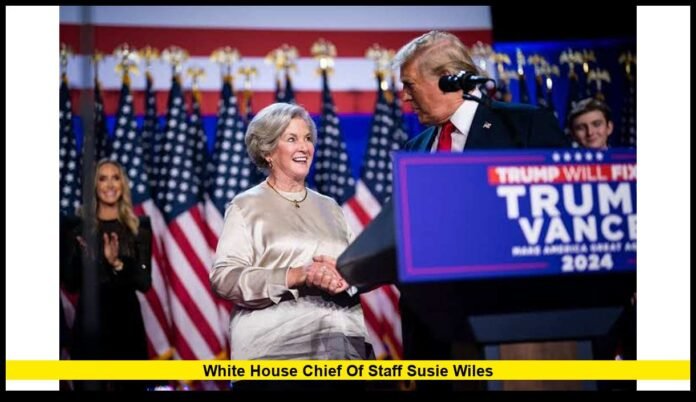

White House chief of staff Susie Wiles is making headlines following President Donald Trump’s announcement that Stephen Miller will replace her in one of the most influential positions in the federal government. The latest development marks a significant leadership change within the Trump administration, as Wiles prepares to leave her White House position after helping guide the president’s return to office and manage his second-term agenda.
The announcement, made on November 6, 2026, comes shortly after the midterm elections and represents a major change in the administration’s senior leadership. Trump has praised Wiles for her service and indicated that she will move to his political operation. Miller, previously the administration’s deputy chief of staff for policy, is scheduled to assume the chief of staff position on November 9.
Wiles made history as the first woman to serve as White House chief of staff. Her departure brings an important chapter of her political career to a close while raising questions about the administration’s leadership, internal coordination, and priorities for the remainder of Trump’s term.
Latest Update on White House Chief of Staff Susie Wiles
The most significant development concerning Susie Wiles is her departure from the White House chief of staff position. President Trump announced that Miller would succeed her, with the transition scheduled to take effect on Monday, November 9, 2026.
The announcement followed the November midterm elections, which produced significant Republican losses and changed the political environment facing the administration. The timing has attracted attention because the president must now work with a Congress in which Democrats have gained greater influence.
Trump publicly described Wiles’ tenure positively, crediting her with helping manage his administration. He also indicated that she would continue working with his political operation rather than disappear from his broader political circle.
The circumstances surrounding her departure have also attracted considerable attention. Political observers are examining the potential influence of the midterm results, the administration’s future strategy, and the changing demands of White House leadership.
However, the confirmed developments should be separated from interpretations of the decision. Wiles is leaving the chief of staff position, Miller has been selected as her successor, and Trump has indicated that Wiles will remain connected to his political operation. Her precise future responsibilities have not been fully detailed.
Who Is Susie Wiles?
Susie Wiles is an American political strategist and longtime Republican campaign operative who became one of Donald Trump’s most influential advisers. Before joining the White House, she built a career in campaign management, political consulting, and Republican politics, particularly in Florida.
Her political experience helped establish her reputation as an experienced organizer who could manage complicated campaigns, coordinate competing interests, and maintain a disciplined political operation.
Wiles became nationally prominent during the 2024 presidential election, when she played a central role in Trump’s campaign. Her work helped coordinate the campaign’s messaging, staffing, strategic decisions, and organization across multiple states.
Following Trump’s victory, she was selected to lead the White House staff. The appointment placed her at the center of the administration’s daily operations and made her one of the president’s most important institutional advisers.
Her influence extended beyond campaign strategy. As chief of staff, she occupied a position connecting the president with Cabinet officials, senior advisers, congressional leaders, and other parts of the federal government.
Wiles’ career demonstrates how experienced campaign professionals can move into senior government positions, where political judgment and organizational management become essential to the president’s ability to implement an agenda.
Susie Wiles’ Career Before the White House
Wiles’ professional background stretches across several decades of American politics. Her experience includes work on Republican campaigns, political consulting, and efforts to build winning electoral strategies.
She became particularly influential in Florida, a state that has played an important role in presidential elections and national Republican politics.
Early Political Experience
Wiles developed her political career through campaign work and relationships with Republican candidates and political organizations. Over time, she acquired experience in campaign planning, voter outreach, communications, and the management of political teams.
Her background helped her understand the practical challenges of running campaigns, including coordinating staff members, responding to changing political conditions, and keeping an organization focused on its objectives.
Political campaign management also requires balancing different personalities and competing priorities. These responsibilities became especially relevant when Wiles joined Trump’s inner circle.
Work in Florida Politics
Florida became an important part of Wiles’ professional identity. She worked with Republican political figures and gained recognition for her involvement in campaigns and political strategy.
Her experience in the state gave her insight into voter behavior, campaign organization, and the relationships between state-level politics and national elections.
Florida’s importance to Republican presidential campaigns also made her background valuable to Trump’s political operation.
Over the years, Wiles developed relationships within the Republican Party that helped strengthen her position as a political adviser. Her career was built on practical campaign experience rather than simply holding a public-facing political title.
Leadership During Trump’s 2024 Campaign
Wiles’ most prominent political achievement before her White House appointment was her role in Trump’s 2024 presidential campaign.
She helped oversee the campaign’s organization and strategy during a highly competitive election. Her responsibilities included maintaining coordination among senior advisers, supporting the campaign’s overall direction, and helping manage the operational demands of a nationwide presidential race.
Trump’s victory led to greater recognition of Wiles as a trusted member of his political team.
Her appointment as chief of staff reflected the importance the incoming administration placed on continuity between campaign leadership and governing operations.
What Does the White House Chief of Staff Do?
The White House chief of staff is one of the most consequential positions in the executive branch. Although the role is not an elected office, the person holding it can have substantial influence over how the president’s administration operates.
The chief of staff generally manages the president’s senior staff, oversees internal coordination, helps determine which issues require presidential attention, and works to keep the administration functioning efficiently.
The position also involves managing access to the president. Senior officials, advisers, lawmakers, and outside representatives may seek meetings or decisions, and the chief of staff helps coordinate these competing demands.
Major responsibilities commonly include:
- Managing White House operations: Coordinating the work of senior advisers and staff members.
- Organizing presidential priorities: Helping determine which policy matters and decisions receive attention.
- Coordinating departments: Supporting communication between the White House and executive departments.
- Handling political challenges: Advising the president on political considerations and the practical consequences of major decisions.
- Maintaining internal discipline: Establishing processes for communication, decision-making, and staff accountability.
- Responding to urgent developments: Helping organize the administration’s response to national and international events.
The chief of staff does not independently replace the president’s authority. Instead, the position supports presidential decision-making and helps translate the administration’s priorities into coordinated government action.
For Wiles, these responsibilities represented a transition from managing a presidential campaign to overseeing the operations of the executive office.
Why Susie Wiles’ Departure Matters
Wiles’ departure is significant because the chief of staff serves as a central point of coordination within the White House. Changes in this position can influence how an administration organizes its senior team and approaches its remaining policy objectives.
Her departure also comes at a politically sensitive time. The midterm elections have altered the balance of power in Congress, creating a different environment for the administration as it prepares for the remainder of Trump’s term.
A president facing a more challenging Congress may need to reassess legislative priorities, strengthen political messaging, and determine how best to advance executive policies.
The chief of staff plays an important role in organizing those efforts. The person in the position helps ensure that the president receives advice, that departments communicate effectively, and that senior officials understand the administration’s immediate objectives.
Wiles’ experience as a campaign strategist gave her a particular perspective on political organization and internal coordination. Her departure therefore raises questions about how the White House will manage those responsibilities under new leadership.
Nevertheless, a change in chief of staff does not automatically mean that the administration will abandon its existing agenda. Policy decisions remain the responsibility of the president and the officials empowered to carry them out.
The practical impact of the transition will become clearer as Miller assumes the position and the White House establishes its next phase of leadership.
Stephen Miller’s Appointment as Her Successor
Stephen Miller is a longtime Trump adviser who has served in senior policy roles during the president’s political career. Before his appointment as chief of staff, he was the administration’s deputy chief of staff for policy and was closely associated with Trump’s immigration and border policies.
Trump announced that Miller would take over the chief of staff position beginning November 9, 2026.
Miller’s appointment brings a different professional background to the role. While Wiles became prominent through campaign management and political organization, Miller has been particularly influential in developing and advancing the administration’s policy agenda.
His experience includes working on presidential policy initiatives, immigration enforcement, and the implementation of Trump’s political priorities.
As chief of staff, Miller will be responsible for a broader range of internal management duties in addition to his existing policy experience.
The transition will require him to oversee senior staff coordination, manage competing demands for the president’s attention, and support communication across the administration.
His appointment has also attracted political attention because it follows the midterm elections. Observers are examining whether the leadership change will affect the administration’s approach to immigration, executive authority, congressional relations, and other major issues.
Those outcomes remain to be seen. Miller’s appointment is confirmed, but the precise effects of the transition on future policy decisions cannot be established solely from the personnel announcement.
Susie Wiles and Her Historic Role as Chief of Staff
One of the most important aspects of Wiles’ tenure is that she became the first woman to serve as White House chief of staff.
The position has traditionally been held by individuals with extensive experience in politics, government, or executive leadership. Its responsibilities require close coordination with the president and the ability to manage complex institutional demands.
Wiles’ appointment marked a milestone for women in senior White House leadership.
Her achievement also reflected the growing importance of campaign professionals in presidential administrations. Modern presidential campaigns require extensive coordination, strategic planning, communications management, and the ability to respond rapidly to changing political circumstances.
Wiles brought experience in those areas to the White House.
Her departure does not diminish the historical significance of her appointment. Instead, it closes a distinctive period in which she moved from managing Trump’s successful presidential campaign to overseeing his administration’s daily operations.
Her influence on the president’s political organization may continue beyond her formal White House role, although the details of her future responsibilities have not been fully established.
Public Interest in Susie Wiles’ Leadership
Public interest in Wiles extends beyond the latest staffing announcement because the chief of staff generally works behind the scenes rather than serving as the administration’s primary public spokesperson.
The position can nevertheless shape how the White House functions, how officials communicate, and how presidential decisions are organized.
Wiles attracted attention for her role in Trump’s 2024 campaign and her subsequent appointment to the administration’s highest-ranking staff position.
Her leadership was also discussed in connection with the administration’s internal operations and the challenges of coordinating a large team around a president with an extensive political agenda.
Another aspect of public interest is her ability to remain an influential political figure without holding an elected office. Campaign strategists and senior presidential advisers can have significant responsibilities even when they do not regularly appear in public or represent the administration in formal government proceedings.
Her career illustrates the distinction between public office and political influence. While the president holds executive authority, experienced advisers help organize the information, personnel, and processes through which presidential decisions are made.
The latest leadership transition is likely to sustain interest in Wiles’ next professional role and the extent to which she continues working with Trump’s political organization.
However, her future activities should be described according to confirmed announcements rather than assumptions about what she might do next.
Latest Developments and What Comes Next
As of the latest update, the central development is Wiles’ departure from the White House chief of staff position and Miller’s scheduled succession on November 9.
Trump has indicated that Wiles will move to his political operation, suggesting that her experience may remain relevant to his broader political activities. The exact scope of that work, including her title and specific responsibilities, has not been fully detailed.
The transition also comes as the administration confronts a changed congressional environment following the midterm elections.
Over the coming weeks, attention is likely to focus on several practical questions: how the White House reorganizes its senior staff, whether additional personnel changes follow, and how Miller approaches the management of presidential priorities.
The administration’s response to congressional opposition will also be important. Legislative negotiations, executive actions, and internal coordination may all be affected by the political environment created by the election results.
At this stage, it would be premature to conclude that Wiles’ departure will produce a particular policy outcome. Personnel changes can influence an administration, but their effects depend on decisions made after the transition.
For readers following White House leadership, the most reliable indicators will be official announcements, confirmed appointments, and concrete policy decisions rather than speculation about internal disagreements.
Final Thoughts
The story of White House chief of staff Susie Wiles reflects the intersection of political strategy, presidential leadership, and government administration. Her career as a Republican strategist, her role in Trump’s 2024 election campaign, and her historic appointment to the White House’s top staff position established her as a significant figure in modern American politics.
Her departure, announced on November 6, 2026, marks an important change within the Trump administration. Stephen Miller is scheduled to succeed her on November 9, while Trump has indicated that Wiles will move to his political operation.
The timing of the transition has drawn attention because it follows a difficult midterm election for Republicans. Nevertheless, the confirmed staffing changes should be separated from interpretations of their political significance.
Wiles’ legacy as the first woman to serve as White House chief of staff remains an important part of her career. Her next chapter may continue to involve political work, but the details will depend on further confirmed announcements.
For now, the key development is clear: Wiles is leaving her White House leadership role, and the administration is preparing for a new phase under Miller’s leadership.
Share your thoughts on Susie Wiles’ political career and stay updated on the latest White House leadership developments.