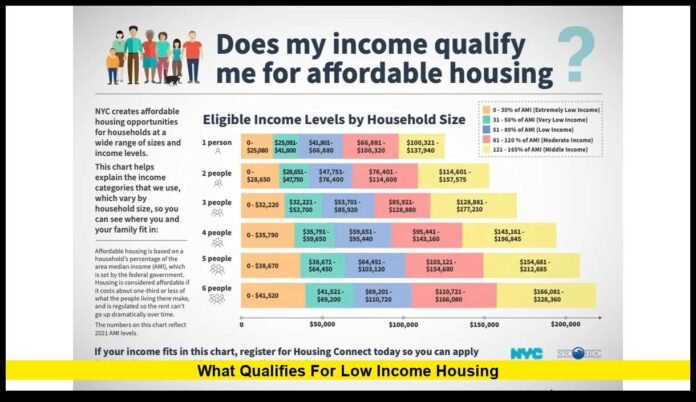

Understanding what qualifies for low income housing can help individuals and families find affordable rental homes when their income is not sufficient to keep up with rising housing costs. Across the United States, several government-supported and privately managed housing programs provide rental opportunities for people with limited financial resources.
Low-income housing is designed to make rent more affordable for eligible households. These programs may serve working individuals, unemployed adults, families with children, senior citizens, people with disabilities, and others who meet specific income and housing requirements.
However, not everyone who earns a modest income automatically qualifies. Eligibility depends on several factors, including annual household income, family size, location, available housing assistance, and the rules of the selected program.
The U.S. Department of Housing and Urban Development (HUD) oversees important affordable housing initiatives, including public housing and the Housing Choice Voucher Program, commonly known as Section 8. Other opportunities are available through state housing agencies, local governments, nonprofit organizations, and privately managed affordable apartment communities.
Knowing how these programs work can help applicants understand their options, prepare the necessary paperwork, and avoid common application mistakes.
What Qualifies for Low Income Housing in the United States?
Low-income housing generally serves households whose earnings fall below established income limits for a particular housing program or affordable rental property.
These limits are not identical across the country. HUD uses area median income (AMI) to establish income benchmarks for many federal housing programs. Local housing agencies and property managers then apply the relevant requirements when evaluating applicants.
Several factors determine whether someone qualifies.
1. Annual household income
The total income of eligible household members is one of the most important considerations. Applicants must generally fall within the income limits established for their location and household size.
2. Household size
The number of people living in the home affects the applicable income threshold. A family of four generally has a higher income limit than a single-person household.
3. Location
Housing costs and median incomes vary across the United States. Therefore, someone who qualifies in one county may not meet the requirements in another.
4. Household circumstances
Some affordable housing programs are specifically designed for families, older adults, or individuals with disabilities. Applicants must meet any additional requirements associated with those programs.
5. Citizenship or eligible immigration status
Certain federally assisted housing programs require applicants to meet citizenship or eligible immigration status rules. Specific provisions may apply to households with mixed eligibility statuses.
6. Additional screening requirements
Depending on the housing program, applicants may undergo reviews involving rental history, identity, household information, and other eligibility factors.
Meeting the income requirement is an important step, but approval also depends on the remaining program rules and the availability of housing.
What Is Considered Low Income for Housing?
Low income is generally measured using a household’s earnings compared with the area median income.
HUD uses several income categories to help determine eligibility for different affordable housing programs.
| Income category | General income threshold |
|---|---|
| Extremely low income | At or below 30% of area median income |
| Very low income | At or below 50% of area median income |
| Low income | At or below 80% of area median income |
These are general benchmarks. Actual income limits may include federal adjustments and vary according to household size, geographic location, and program requirements.
Extremely low-income households
This category generally includes people earning no more than 30% of the applicable area median income. Households in this category may receive priority under certain housing assistance programs.
They may include individuals with very limited earnings, families experiencing financial hardship, and older adults relying on small retirement benefits.
Very low-income households
Households earning up to 50% of area median income may qualify for several federal affordable housing programs, including certain public housing opportunities and Housing Choice Vouchers.
Low-income households
Households earning up to 80% of area median income may qualify for certain income-restricted apartments, affordable housing developments, and local rental assistance initiatives.
Not every program accepts applicants from all three categories. The applicable income limit must be checked separately.
How Area Median Income Affects Housing Eligibility
Area median income, commonly called AMI, plays a major role in determining who qualifies for affordable housing.
It represents the midpoint of household income in a particular geographic area. Half of households earn more than the median, while the other half earn less.
HUD uses this information to establish income limits for different household sizes.
For example, a household earning $40,000 annually may qualify for an affordable apartment in one metropolitan area but exceed the income limit for a similar property in another location.
This happens because housing costs, wages, and median incomes are different across communities.
Household size also changes the calculation. A family with four members may qualify at a higher annual income than a single adult applying in the same area.
HUD’s fiscal year 2026 income limits became effective May 1, 2026, or on the applicable later issuance date. Applicants should use the current figures for their location instead of relying on outdated income charts.
How Much Can You Earn and Still Qualify for Low Income Housing?
There is no single income amount that determines eligibility throughout the United States.
The maximum qualifying income depends on:
- Your city, county, or metropolitan area.
- The number of people in your household.
- The type of housing assistance you are applying for.
- The property’s income restrictions.
- Applicable federal and local program rules.
For example, a single adult and a family of four may have significantly different income limits even when applying for housing in the same city.
Applicants should calculate their expected annual household income and compare it with the current income limit for the specific program.
How to Calculate Household Income
Household income generally includes earnings and other financial payments that must be counted under the applicable housing program.
Common income sources may include:
- Full-time and part-time employment.
- Self-employment earnings.
- Social Security retirement benefits.
- Supplemental Security Income (SSI).
- Disability benefits.
- Pension payments.
- Unemployment compensation.
- Child support and other qualifying payments.
- Interest or income generated by financial assets, where applicable.
The exact calculation depends on the program.
For example, consider a household with two working adults. One earns $2,500 monthly, while the other earns $1,200 monthly.
Their combined monthly income is $3,700.
If their earnings remain consistent throughout the year, their estimated annual household income would be $44,400.
The housing agency will determine the official countable income using its applicable calculation rules. This may differ from a simple estimate based on monthly earnings.
Applicants should not assume that take-home pay is the correct amount. Some programs use gross income, while others calculate adjusted income after permitted deductions.
Does Social Security Count as Income for Low Income Housing?
Social Security benefits generally need to be reported when applying for affordable housing.
Retirement benefits, Supplemental Security Income, and certain disability payments may be included in household income calculations.
The treatment of each payment depends on the program’s regulations.
For example, an older adult receiving Social Security retirement benefits may qualify for affordable housing if their countable income falls below the applicable limit.
Similarly, someone receiving SSI may qualify for public housing or other rental assistance.
Applicants should provide accurate benefit statements when requested. A housing agency can determine which amounts count and whether any deductions or exclusions apply.
Can You Qualify for Low Income Housing If You Have a Job?
Yes. Having a job does not automatically disqualify someone from affordable housing.
Many low-income households include people who work full-time but still struggle to afford rent, utilities, transportation, groceries, and other basic expenses.
Housing assistance is not exclusively intended for unemployed individuals.
A working household may qualify if its combined income remains within the applicable program limit.
For example, a single parent working part-time may qualify for rental assistance if their household income falls below the required threshold.
However, all required income information must be disclosed during the application process.
Types of Low Income Housing Programs Available
Several affordable housing programs operate across the United States. Each has different eligibility requirements, rental arrangements, and application procedures.
Understanding these options can help applicants identify the most suitable housing opportunity.
1. Public Housing
Public housing provides affordable rental homes through local public housing agencies.
These properties are supported by federal funding and are intended for eligible low-income families, older adults, and people with disabilities.
Applicants generally need to meet income limits, household composition requirements, and applicable citizenship or eligible immigration status rules.
Rent is commonly calculated using a portion of adjusted household income, although specific rules and exceptions apply.
Public housing may include apartments, townhouses, and other residential properties.
Availability depends on the local housing authority and the number of units it manages. Some communities have waiting lists because demand is greater than the available supply.
2. Section 8 Housing Choice Vouchers
The Housing Choice Voucher Program is one of the best-known federal rental assistance programs.
It helps eligible households rent privately owned homes and apartments.
Instead of requiring tenants to live in government-owned housing, the program generally allows participants to choose an eligible rental property.
The local public housing agency determines whether an applicant meets the income and other eligibility requirements.
Most new admissions are directed toward very low-income households, with federal rules requiring a substantial share of vouchers to serve extremely low-income families, subject to applicable exceptions.
Once approved, the household receives rental assistance according to program rules.
The tenant generally contributes a portion of their adjusted income toward rent and utilities, while the housing agency pays an approved subsidy.
The selected property must satisfy applicable rent and housing quality requirements, and the landlord must agree to participate.
3. Income-Restricted Apartments
Income-restricted apartments are rental properties reserved for households that meet specific income requirements.
These communities may receive financial support through government programs, including the Low-Income Housing Tax Credit program.
Unlike traditional rental assistance, these apartments generally have predetermined rent restrictions.
For example, a property may offer apartments for households earning no more than a specified percentage of area median income.
Some developments provide different rent levels depending on household income.
Applicants should contact property managers to understand the current income limits, apartment availability, rental rates, and required documentation.
4. Affordable Senior Housing
Older adults may qualify for housing communities designed specifically for senior residents.
These apartments can provide more affordable rental options for people living on Social Security, pensions, retirement savings, or other limited income.
Age requirements vary by community. Some properties serve people aged 62 and older, while others may accept residents aged 55 and older under applicable housing rules.
Income restrictions also depend on the individual development and funding program.
Some senior communities offer accessible facilities and additional services to support independent living.
5. Housing for People With Disabilities
Individuals with disabilities may qualify for several affordable housing opportunities.
These can include public housing, Section 8 vouchers, accessible apartments, and housing developments specifically designed for people with disabilities.
Some programs provide reasonable accommodations or accessible units to address an applicant’s housing needs.
However, disability alone does not guarantee approval. Applicants must satisfy the relevant eligibility requirements.
Disability benefits may count as income, depending on the program’s rules.
6. Rural Affordable Housing
People living in rural communities may have access to affordable rental housing supported by the U.S. Department of Agriculture and other housing initiatives.
These programs may assist very low-income households, older adults, people with disabilities, and families who need affordable rental accommodations.
Income requirements and application procedures vary according to the program and property.
Applicants should check whether their preferred property is located in an eligible rural area.
Does Household Size Affect Low Income Housing Eligibility?
Yes. Household size directly affects the income limits used by many affordable housing programs.
A larger household generally has a higher qualifying income limit because more people share the household’s expenses.
For example, a single-person household may have a lower income threshold than a household consisting of two adults and two children.
Housing agencies also use household information to determine the appropriate apartment size.
Applicants may need to identify:
- Adults living in the household.
- Dependent children.
- Spouses or partners.
- Other eligible household members.
- People who may be temporarily absent under applicable program rules.
The housing provider will determine which individuals count as household members.
Providing accurate information is important because household composition can affect both income eligibility and the size of the apartment offered.
Can a Single Person Qualify for Low Income Housing?
Yes. A single adult can qualify for affordable housing even without children or dependents.
There is no general requirement that applicants must have a family to receive housing assistance.
A single person may qualify based on employment earnings, retirement benefits, disability payments, or other countable income.
Some affordable housing communities specifically provide smaller apartments for individuals.
However, the applicant must meet the applicable income limit and other program requirements.
Can You Get Low Income Housing Without a Job?
Yes. Employment is not a universal requirement for all affordable housing programs.
An unemployed person may qualify if their countable household income meets the applicable requirements.
However, having no job does not necessarily mean the household has no income.
Housing agencies may consider unemployment compensation, Social Security benefits, SSI, pensions, child support, and other payments.
Applicants may also need to provide information about their financial circumstances.
Some privately managed properties have additional screening requirements, so it is important to understand the specific property’s policies before applying.
Do Savings and Bank Accounts Affect Eligibility?
Savings do not automatically disqualify someone from low-income housing.
However, some housing programs require applicants to disclose their financial assets.
These may include:
- Checking and savings accounts.
- Retirement accounts.
- Investment accounts.
- Certain real estate holdings.
- Other financial resources.
The housing agency determines how these assets are treated under the applicable regulations.
In some cases, income generated by an asset may count toward household income. Other programs may apply separate asset restrictions or exclusions.
Applicants should provide accurate information about their financial resources rather than assuming that having savings will prevent approval.
Does Your Credit Score Matter When Applying for Low Income Housing?
A credit score is not a universal eligibility requirement for every affordable housing program.
However, individual property managers may conduct credit checks as part of their rental screening process.
Some providers also review rental history, previous lease violations, unpaid rent, or other relevant information.
Having a low credit score does not automatically prevent someone from qualifying for every type of affordable housing.
If you have limited credit history or previous financial difficulties, ask the property manager about its screening requirements before submitting an application.
Can a Criminal Record Prevent You From Getting Low Income Housing?
A criminal record may affect eligibility for certain housing programs, but the rules depend on the nature of the offense and the applicable federal, state, and local requirements.
Some convictions or conduct may result in mandatory restrictions under federal housing regulations.
Housing agencies may also have screening policies that apply to specific programs.
However, not every criminal record automatically results in rejection. The type of offense, circumstances, and applicable rules may influence the decision.
Applicants should review the housing provider’s screening policy and ask how previous criminal records are evaluated.
What Documents Are Required for Low Income Housing?
Most affordable housing applications require documents to verify identity, household composition, income, and other eligibility information.
Although the exact requirements vary, applicants may need:
- Government-issued identification.
- Social Security numbers or other required identification documents.
- Recent pay stubs.
- Employer income statements.
- Tax returns or self-employment records.
- Social Security or SSI benefit statements.
- Pension and retirement income documents.
- Bank statements, when requested.
- Birth certificates or household relationship documents, when required.
- Rental history or landlord information.
- Citizenship or eligible immigration status documentation, where applicable.
- Disability-related documentation when required for a specific eligibility category or accommodation.
Not every applicant needs to submit all these documents.
For example, an unemployed person may provide benefit statements or other financial records instead of employment pay stubs.
The housing agency will explain which documents are necessary.
Providing complete and accurate information can help reduce delays during the application process.
How to Apply for Low Income Housing
Applying for affordable housing involves several steps. The process depends on whether you are applying for public housing, Section 8, or an income-restricted apartment.
Step 1: Identify the housing program
Determine whether you want public housing, rental assistance through Section 8, senior housing, disability-focused housing, or an income-restricted apartment.
Step 2: Check the income limits
Review the current income requirements for your location and household size.
Make sure the limits apply to the program you intend to use.
Step 3: Find your local housing agency
Public housing agencies manage public housing and Housing Choice Voucher applications.
Contact the agency to ask whether applications are currently being accepted.
Step 4: Complete the application
Provide accurate information about your household members, income, assets, and other requested details.
Step 5: Submit the required documents
Provide identification, income records, and any additional paperwork requested by the housing provider.
Step 6: Monitor your application
Check your application status and respond to requests for additional information.
If you are placed on a waiting list, keep your contact information current and follow the agency’s instructions.
How Long Does It Take to Get Approved for Low Income Housing?
The approval timeline depends on the housing program, location, application volume, and availability of rental units.
Some income-restricted apartments may process applications relatively quickly when suitable units are available.
Public housing and Section 8 programs may have longer waiting periods because demand can exceed the available housing supply.
The following factors can influence the timeline:
- Number of available apartments or vouchers.
- Length of the waiting list.
- Household eligibility and applicable preferences.
- Time required to verify income.
- Additional documentation requirements.
- Property availability and inspection procedures.
Applicants should understand that being eligible does not guarantee immediate placement.
Some housing agencies temporarily close their waiting lists when they receive more applications than they can process.
Applying to multiple suitable affordable housing programs may provide additional opportunities, provided each program permits the application.
What Happens If You Qualify but Are Placed on a Waiting List?
Being placed on a waiting list generally means that your application has entered the program’s selection process.
It does not mean that an apartment or voucher has already been approved.
Housing agencies may select applicants according to waiting-list preferences, available resources, local policies, and applicable federal requirements.
If you are placed on a waiting list, take the following steps:
- Keep your application confirmation.
- Save your application or reference number.
- Update your mailing address and phone number.
- Respond to official notices promptly.
- Follow any instructions to confirm continued interest.
- Check whether other housing programs are accepting applications.
Missing an important notice or failing to respond within the required period may affect your position or application status.
What If Your Income Is Too High for Section 8?
If your household income exceeds the Section 8 eligibility limit, you may still qualify for another affordable housing opportunity.
Different programs use different income requirements.
For example, some income-restricted apartment communities accept households earning more than the limits used for certain rental assistance programs.
You may also explore affordable housing supported by state governments, local housing authorities, nonprofit organizations, and tax-credit developments.
The best approach is to compare several programs rather than assuming that exceeding one income limit makes you ineligible for all affordable housing.
Latest Updates on Low Income Housing Eligibility
HUD’s fiscal year 2026 income limits are now in effect for applicable public housing and Section 8 programs.
The updated limits reflect area median income calculations, household size adjustments, and other applicable federal considerations.
However, income requirements for affordable apartment developments, tax-credit properties, and state-supported housing programs may follow different rules.
Applicants should always confirm the current requirements with the housing agency or property manager responsible for the specific program.
There is no single nationwide income amount, employment requirement, or credit score that guarantees eligibility for every low-income housing opportunity.
Frequently Asked Questions About What Qualifies for Low Income Housing
1. What income qualifies for low-income housing?
Income eligibility depends on the household’s location, size, and housing program. HUD commonly uses income categories based on 30%, 50%, and 80% of area median income, subject to applicable adjustments.
2. What is the maximum income to qualify for low-income housing?
There is no universal maximum income. Some programs serve households earning up to 50% of area median income, while certain income-restricted apartments may accept households earning up to 80% of area median income or other applicable limits.
3. Can a single person qualify for low-income housing?
Yes. A single adult can qualify if their income and other circumstances meet the requirements of the selected housing program.
4. Can I qualify for low-income housing if I work full-time?
Yes. Full-time employment does not automatically disqualify you. Your household’s total countable income must fall within the applicable limit.
5. Can unemployed people qualify for low-income housing?
Yes. Many housing programs accept eligible unemployed applicants. However, other income sources and program requirements must still be considered.
6. Does Social Security count as income for low-income housing?
Social Security retirement benefits, SSI, and certain disability payments generally need to be disclosed. Their treatment depends on the applicable housing program’s income calculation rules.
7. Does having money in the bank disqualify you from low-income housing?
Not automatically. Some programs consider assets or income generated by financial accounts, but the rules differ. Applicants should disclose financial information when requested.
8. Does bad credit prevent you from qualifying for affordable housing?
Not necessarily. There is no universal credit-score requirement for all affordable housing programs. Individual property managers may conduct credit checks under their screening policies.
9. Can people with disabilities qualify for low-income housing?
Yes. Eligible people with disabilities may qualify for public housing, Section 8 vouchers, accessible apartments, and specialized housing programs. They must still meet the applicable requirements.
10. Can seniors qualify for low-income housing?
Yes. Older adults may qualify for public housing, senior apartment communities, and other affordable rental programs based on income, age, and property-specific eligibility rules.
11. How much rent do people pay in low-income housing?
Rent depends on the program. Public housing and Housing Choice Voucher tenants commonly pay approximately 30% of adjusted monthly income, subject to program rules and exceptions. Income-restricted apartments may use different rent schedules.
12. How long is the waiting list for low-income housing?
Waiting times vary by city, housing agency, and program. Some applicants may receive assistance relatively quickly, while others may wait much longer because of limited housing availability.
13. Can I apply for low-income housing in another state?
You may apply to programs outside your current location, depending on their requirements. Some housing agencies have residency preferences or other restrictions, so check the application rules first.
14. Can I apply for Section 8 and public housing at the same time?
You may apply to both programs when their waiting lists are open and you meet their respective requirements. They generally involve separate applications and selection processes.
15. Does getting approved for low-income housing guarantee an apartment?
No. Approval of eligibility and actual housing availability are separate matters. Applicants may need to remain on a waiting list until a suitable apartment or rental subsidy becomes available.
16. Can my rent increase if my income goes up?
Yes. Under income-based housing programs, a change in household income may affect the tenant’s rental contribution. Participants must report changes according to their program’s requirements.
Final Thoughts
Understanding what qualifies for low income housing can make it easier to identify affordable rental opportunities and determine which assistance programs match your financial circumstances.
Income, household size, location, and program-specific requirements are among the most important factors considered during the application process.
Whether you are working, unemployed, living on retirement benefits, raising children, or managing a disability, you may have access to an affordable housing option.
Public housing, Section 8 vouchers, income-restricted apartments, senior communities, and rural housing programs each provide different opportunities for eligible households.
Before applying, review the current income limits, prepare the necessary documents, and contact the appropriate housing agency or property manager. If you do not qualify for one program, consider checking other affordable housing opportunities in your area.
Have questions about low-income housing eligibility? Share your experience or questions in the comments, and stay updated for more information about affordable housing and rental assistance programs.