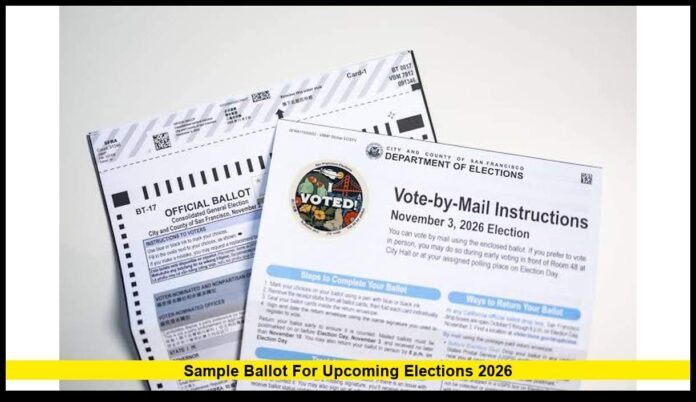

The sample ballot for upcoming election 2026 is an important resource for American voters looking to understand the candidates, political offices, and ballot measures appearing in their local elections. With the November 3, 2026, general election taking place today, voters have an opportunity to make decisions that will influence representation in Congress, state governments, and local communities. Reviewing ballot information helps voters understand their choices and avoid confusion when completing their official ballots.
The 2026 election is particularly significant because it is a midterm election year. Every seat in the U.S. House of Representatives is scheduled to be contested, while several U.S. Senate seats and numerous state and local positions are also part of the election cycle. Depending on their location, voters may encounter gubernatorial contests, legislative races, judicial elections, county positions, school board contests, and local ballot propositions.
However, not every American voter receives the same ballot. The candidates and questions depend on the voter’s state, county, congressional district, precinct, and local election boundaries. This makes it important to review the correct ballot for the address where a person is registered.
Key Points Summary
– November 3, 2026, is the scheduled date of the U.S. midterm general election.
– Voters can review sample ballots to understand candidates, political offices, and local ballot questions.
– All 435 voting seats in the U.S. House of Representatives are scheduled for election.
– Approximately one-third of the U.S. Senate seats are included in the regular election cycle.
– State elections may include governors, legislators, attorneys general, and other statewide officials.
– Local ballots can feature judges, county officials, school board members, referendums, and tax proposals.
– The correct ballot depends on the voter’s registered address and election district.
– Official state and county election offices are the best places to obtain accurate ballot information.
Why the 2026 Midterm Election Is Important for American Voters
Midterm elections play an important role in the American political system because they give voters an opportunity to determine who represents them during the second half of a presidential administration.
Unlike presidential election years, midterm elections do not include a regularly scheduled presidential contest. Instead, attention focuses on congressional representation, state leadership, and local government positions.
The results can influence federal legislation, government spending, public policy, and the direction of state governments. Changes in congressional representation can affect legislative priorities, committee leadership, investigations, and the consideration of major national issues.
State and local elections are equally important because many decisions affecting everyday life are made outside Washington, D.C. Education funding, transportation projects, property taxes, public safety, housing policies, and local infrastructure can all be influenced by elected officials at the state and community levels.
For this reason, voters should examine the entire ballot rather than concentrating exclusively on the most widely discussed national races.
How to Find Your Sample Ballot for the 2026 Election
Finding the correct ballot requires identifying the election jurisdiction associated with your registered residential address. A ballot available for one county or precinct may not apply to someone living in another part of the same state.
The process generally involves the following steps.
1. Identify Your Registered Voting Location
Start by confirming the state and county where you are registered. Your residential address determines the congressional district, state legislative district, local jurisdiction, and precinct associated with your ballot.
If you have recently moved, make sure your registration information reflects your current voting address.
2. Visit Your State Election Office
State election authorities publish important information about upcoming elections, including registration procedures, election calendars, voting requirements, and links to local election offices.
Look for sections containing election information, sample ballots, voter resources, or ballot lookup services.
3. Check Your County Election Website
County election offices frequently provide more specific information about the contests appearing on local ballots.
Depending on the jurisdiction, voters may find downloadable ballot documents, precinct-based candidate lists, or online lookup tools.
4. Select the Correct Precinct or District
Some counties publish multiple sample ballots because different precincts have different candidates or ballot questions.
Selecting the wrong precinct could result in reviewing information that does not match your official ballot. Always verify the applicable voting district before relying on a downloaded document.
5. Review the Latest Available Information
Election information can change when official circumstances require updates. Candidate withdrawals, court decisions, administrative corrections, and ballot certification changes may affect the information voters see.
Use the latest version published by the responsible election authority.
Which Federal Elections Are Included in 2026?
The federal portion of the 2026 election includes congressional contests that can influence national legislative priorities.
U.S. House of Representatives Elections
All 435 voting seats in the U.S. House of Representatives are scheduled to appear in the regular 2026 congressional election cycle.
Representatives serve two-year terms and are elected from individual congressional districts. This means voters select candidates based on the district in which they are registered.
The House has several important responsibilities, including considering federal legislation, approving revenue measures, overseeing government agencies, and participating in the federal budget process.
The balance of political representation in the chamber can influence which proposals advance and how Congress approaches national policy questions.
When reviewing a congressional contest, voters should pay attention to the candidates’ experience, policy positions, legislative priorities, and qualifications.
U.S. Senate Elections
The U.S. Senate operates differently from the House because senators serve six-year terms, with elections staggered across three classes.
Approximately one-third of the Senate is ordinarily up for election every two years. Consequently, only certain states have regularly scheduled Senate contests in 2026.
Some states may also have special Senate elections associated with vacancies.
Voters should check their individual ballot to determine whether a Senate race is included. The candidates appearing in one state will not necessarily be relevant to voters in another.
Why Congressional Representation Matters
Congressional elections can have long-term consequences for federal policymaking.
Representatives and senators participate in decisions involving taxation, federal spending, national security, healthcare legislation, infrastructure, and government oversight.
The 2026 results will therefore help determine the composition of Congress during the remaining portion of the presidential term and influence the legislative environment leading into the 2028 presidential election.
Which States Have Important Gubernatorial Elections in 2026?
Governors are among the most influential elected officials in state government. They oversee executive departments, participate in budget negotiations, approve or veto legislation, and help establish policy priorities.
The 2026 election cycle includes 36 gubernatorial contests across the country. These races are important because voters will determine who leads their respective state governments for the next term.
States holding gubernatorial elections in 2026 include Alabama, Alaska, Arizona, Arkansas, California, Colorado, Connecticut, Florida, Georgia, Hawaii, Idaho, Illinois, Iowa, Kansas, Maine, Maryland, Massachusetts, Michigan, Minnesota, Nebraska, Nevada, New Hampshire, New Mexico, New York, Ohio, Oklahoma, Oregon, Pennsylvania, Rhode Island, South Carolina, South Dakota, Tennessee, Texas, Vermont, Wisconsin, and Wyoming.
Not every gubernatorial contest will appear on every voter’s ballot. Residents should check their state-specific election information to identify the candidates and applicable voting requirements.
What State and Local Positions May Appear on the Ballot?
Federal elections receive significant national attention, but state and local contests can be just as important to voters.
Depending on the jurisdiction, the 2026 ballot may contain several additional positions.
State Legislators: State representatives and senators make decisions involving education, transportation, taxation, public safety, and state spending.
Attorney General: State attorneys general oversee important legal responsibilities, including representing state governments and enforcing applicable laws.
Secretary of State: In many states, this office has responsibilities involving elections, business registrations, and official government records.
State Treasurer and Auditor: These officials may oversee financial administration, accounting, public funds, and government spending oversight.
Judicial Candidates: Some states hold elections for judges or ask voters whether certain judges should remain in office.
County Commissioners: These officials can influence local budgets, public infrastructure, community services, and county development.
Sheriffs and Other County Officials: Depending on local election schedules, voters may select sheriffs, clerks, assessors, prosecutors, recorders, and other county officers.
School Board Members: School board elections can influence district policies, school budgets, educational programs, and administrative priorities.
Not every jurisdiction elects these officials during the November general election. The official ballot determines which positions are actually contested.
Understanding Ballot Measures, Referendums, and Constitutional Amendments
One important part of election preparation is understanding ballot questions.
Unlike candidate contests, ballot measures ask voters to make decisions about specific laws, government policies, financial proposals, or constitutional changes.
A ballot may include:
- State constitutional amendments.
- Local property tax proposals.
- School district funding measures.
- Transportation and infrastructure bonds.
- Public safety funding proposals.
- Local government referendums.
- Changes to state or local laws.
Some measures can have a direct financial impact on residents. For example, a local proposal may involve issuing bonds to finance school construction or improving transportation facilities.
Other measures may address broader questions involving state government authority or constitutional protections.
Voters should read the complete ballot language rather than making decisions based only on a short title. The wording of a proposal can provide important information about what a Yes or No vote would actually mean.
Official voter information materials may also explain the purpose, financial implications, and legal consequences of certain measures.
How to Prepare Before Casting Your Vote
Preparing for an election does not require extensive research into every political issue. However, spending time understanding the available choices can make the process more organized.
Here are several practical ways to prepare.
Compare Candidate Qualifications
Look at candidates’ professional backgrounds, public service experience, and stated priorities. Consider whether their qualifications align with the responsibilities of the office they are seeking.
Understand the Responsibilities of Each Office
A candidate running for Congress has different responsibilities from someone seeking a county commission position. Understanding those differences can help voters evaluate candidates more effectively.
Review Important Policy Positions
Pay attention to issues that matter to your community, including employment, education, public safety, housing, transportation, and government spending.
Read Ballot Questions Carefully
Do not overlook referendums or constitutional amendments. These decisions may have long-term consequences for local communities.
Check Your Voting Instructions
Make sure you understand how to complete your ballot correctly. Follow the instructions provided by election officials, particularly when voting by mail.
Avoid Relying on Outdated Information
Candidate lists and election details should be checked against the latest official information. Old sample ballots may contain candidates or instructions that are no longer applicable.
Can You Take a Sample Ballot to the Polling Place?
Many voters prefer to review a printed ballot before arriving at their polling location. This can help them remember the candidates and questions they want to consider.
However, rules governing printed reference materials differ by jurisdiction.
In some places, voters can bring personal notes or a sample ballot for reference. Other locations may have restrictions concerning materials brought into voting areas.
A sample ballot should never be confused with the official ballot issued by election authorities.
If you are uncertain whether you can bring a printed document into your polling place, check the rules established by your local election office.
When completing the official ballot, follow the instructions carefully. If you make a mistake, ask an election worker how to obtain assistance or correct the ballot according to local procedures.
What Should Mail-In Voters Know About the 2026 Election?
Mail voting remains an important option in many parts of the United States. However, procedures and deadlines differ by state.
Some jurisdictions allow voters to request absentee ballots, while others automatically send ballots to eligible voters or provide broader mail-voting options.
Voters using mail ballots should pay attention to several requirements:
- Complete every required section of the ballot.
- Follow the instructions for marking selections.
- Sign the appropriate envelope if required.
- Use the correct return envelope.
- Check the applicable return deadline.
- Use an authorized drop box or return method.
- Track ballot status when the election office provides that service.
A ballot that is completed correctly but returned improperly may face processing problems.
Since November 3 is Election Day, voters who still need to return a mail ballot should immediately check their jurisdiction’s rules for accepted delivery and drop-off options. A deadline in one state should not be assumed to apply elsewhere.
What Happens After the Polls Close?
Election Day does not mean every result will become official immediately.
After voting ends, election officials begin processing ballots, reporting preliminary results, and conducting the procedures required by state law.
Depending on the jurisdiction, the process may involve counting ballots cast in person, processing eligible mail ballots, reviewing provisional ballots, and completing additional verification procedures.
Media organizations and election authorities may report unofficial results as counting progresses. However, preliminary totals are not the same as certified election results.
Close contests may require additional counting or legally established recount procedures. Certification takes place after the required election administration steps are completed.
Voters should therefore avoid treating early projections as final official outcomes.
Why Every Voter Should Check Their Own Ballot
A major challenge during nationwide elections is that election information is often presented as though every voter has the same choices.
In reality, the American electoral system is highly localized.
A resident of one congressional district may vote for a different House candidate from someone living in the neighboring district. County residents may also face different judicial races, school board elections, and local propositions.
The sample ballot for upcoming election 2026 is therefore most useful when it matches the voter’s registered address and precinct.
A statewide candidate announcement does not necessarily mean that the candidate appears on every ballot. Similarly, a local tax proposal may apply only to residents within a particular municipality or school district.
Checking the correct ballot helps prevent misunderstandings and gives voters a clearer picture of the decisions they are being asked to make.
Final Thoughts
The 2026 midterm election represents an important opportunity for Americans to participate in decisions affecting federal representation, state leadership, and local government.
From congressional contests and gubernatorial races to judicial elections and community ballot measures, the choices appearing on individual ballots can have consequences well beyond Election Day.
Voters should rely on official election information, review the candidates and proposals relevant to their districts, and follow the voting instructions established by their local authorities.
Understanding the ballot is an important part of participating responsibly in the democratic process.
Have you reviewed the candidates and ballot measures in your area? Share your thoughts in the comments and follow our coverage for the latest 2026 election developments.