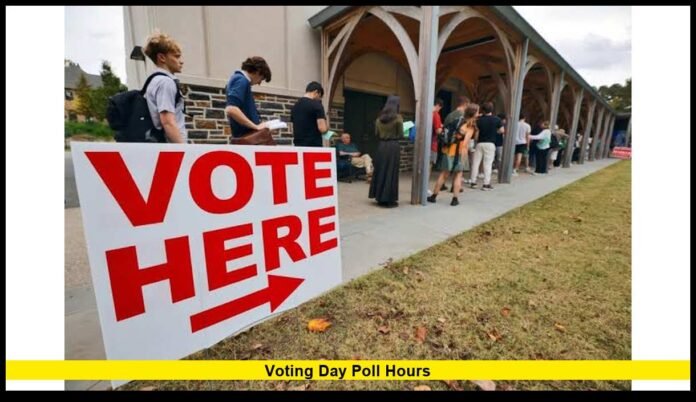

Voting day poll hours are an important part of Election Day planning for millions of Americans. Knowing when polling locations open and close helps registered voters make arrangements, avoid unnecessary delays, and ensure they have enough time to cast their ballots. Across the United States, polling hours are not identical because each state establishes its own election schedules and procedures.
Election Day voting takes place on Tuesday, November 3, 2026, for the 2026 U.S. general election. Voters will participate in congressional, state, and local elections, with races and ballot measures varying by jurisdiction. Although the date is the same nationwide, the opening and closing times of polling places depend on state law and, in some cases, county or municipal election administration.
Understanding local polling schedules is especially important for people who plan to vote before or after work. Some locations open early in the morning, while others begin voting later. Closing times also differ, making it essential to check the official schedule for the polling place assigned to your residential address.
Key Points Summary
╔════════════════════════════════════════════════════════════════════╗
║ – Election Day for the 2026 U.S. general election is Tuesday, ║
║ November 3, 2026. ║
║ – Voting hours vary by state, county, and assigned polling place. ║
║ – Many states open polling places between 6 a.m. and 8 a.m. ║
║ and close between 6 p.m. and 9 p.m. local time. ║
║ – California polling places are scheduled to remain open from ║
║ 7 a.m. to 8 p.m. on Election Day. ║
║ – Voters who are in line when polls close generally have the ║
║ right to vote, subject to applicable election rules. ║
╚════════════════════════════════════════════════════════════════════╝
What Time Do Polls Open on Election Day?
Polling places across the United States do not all open at the same time. Many states begin voting at 7 a.m., while others allow voters to cast ballots as early as 6 a.m. Some jurisdictions have different schedules depending on local election laws.
For people who want to vote before heading to work, checking the opening time in advance can make the process easier. Arriving shortly after polls open may also help voters avoid busier periods, although actual wait times depend on the location and number of voters.
Here are examples of scheduled opening times in several states:
| State | Scheduled opening time |
|---|---|
| Arizona | 6 a.m. |
| Connecticut | 6 a.m. |
| Illinois | 6 a.m. |
| Virginia | 6 a.m. |
| California | 7 a.m. |
| Florida | 7 a.m. |
| Georgia | 7 a.m. |
| Texas | 7 a.m. |
| Colorado | 7 a.m. |
| Arkansas | 7:30 a.m. |
| Idaho | Generally 8 a.m., with some local variations |
All times are local. These are general statewide schedules, and local election rules may affect individual locations. Voters should confirm the hours for their assigned polling place before traveling.
What Time Do Polls Close on Election Day?
Poll closing times are equally important because arriving after the deadline may prevent someone from voting. Depending on the state, polls may close at 6 p.m., 7 p.m., 7:30 p.m., 8 p.m., or another legally established time.
The following examples illustrate the differences:
| State | Scheduled closing time |
|---|---|
| Indiana | 6 p.m. Eastern; 6 p.m. Central in the relevant counties |
| Kentucky | 6 p.m. local time in each time zone |
| Virginia | 7 p.m. |
| Georgia | 7 p.m. |
| Texas | 7 p.m. |
| California | 8 p.m. |
| Connecticut | 8 p.m. |
| Florida | 7 p.m. local time in the relevant time zones |
| New York | 9 p.m. |
| Alaska | 8 p.m. Alaska time in most areas |
These examples are not a substitute for checking the complete local schedule. States that span multiple time zones may have different closing times across their jurisdictions, and certain local rules can create additional variations.
The most important rule is to follow the official closing time for your assigned voting location rather than relying on a national estimate.
Voting Day Poll Hours by State: Why Schedules Differ
The United States does not have one nationwide opening and closing schedule for in-person voting. Election administration is largely handled at the state and local levels, so voters must follow the rules that apply where they live.
States with early morning opening times
Some states open their polling places at 6 a.m. This can be useful for voters who want to vote before starting their workday. Arizona, Connecticut, Illinois, and Virginia are examples of states with early opening schedules for statewide elections.
States with 7 a.m. opening times
A 7 a.m. opening is common in many states. California, Georgia, Florida, Texas, and Colorado generally follow this schedule for Election Day voting, although local election arrangements can differ.
States with different opening and closing schedules
Some states allow local officials to determine opening times within limits established by law. Maine, Massachusetts, New Hampshire, North Dakota, and Vermont have rules that can produce differences between municipalities or voting locations.
As a result, voters should not assume that a friend or relative in another town will have the same voting hours.
California Voting Hours for November 3, 2026
California voters can visit their assigned polling locations between 7 a.m. and 8 p.m. on Tuesday, November 3, 2026.
California also provides vote-by-mail ballots to active registered voters. Voters who choose to return their ballots in person can use eligible ballot drop-off locations or election offices, subject to the applicable deadline.
Because California conducts much of its voting by mail, residents should distinguish between the hours of an in-person polling location and the deadline for returning a ballot. A ballot drop box may be available at a different location from a traditional polling place.
Voters should confirm their county’s arrangements and ensure that their ballots are delivered according to the applicable rules.
Can You Vote After Polls Close If You Are in Line?
In general, voters who are already waiting in line when polls officially close are permitted to cast their ballots. However, they should remain in the designated line and follow instructions from election officials.
This protection is important for people who encounter long queues, unexpected delays, or heavy turnout late in the day.
Voters should not leave a line simply because the clock has reached the closing time. Instead, they should ask an authorized poll worker for guidance and remain in line as directed.
Rules and procedures can vary, so following official instructions at the polling location is essential.
How to Find Your Assigned Polling Place and Its Hours
Knowing the state’s general schedule is only the first step. Voters also need to know where they are registered to vote and whether their assigned location has special instructions.
Use the following steps to prepare:
- Check your voter registration. Confirm that your registration details are current and that you are eligible to vote in the election.
- Find your assigned polling place. Use your state’s official election website or contact your local election office.
- Confirm opening and closing times. Check the schedule for your specific precinct or voting center.
- Review identification requirements. Determine whether you need to bring an accepted form of identification or other documentation.
- Plan your travel. Allow enough time for transportation, parking, accessibility needs, and potential lines.
- Check ballot options. If you cannot visit a polling place during its operating hours, find out whether early voting, absentee voting, or mail voting is available and whether you meet the applicable requirements.
These steps can reduce last-minute confusion and help voters make informed plans.
What Should Voters Bring on Election Day?
The documents required for voting depend on state law and individual circumstances. Some states require specific forms of identification, while others use different procedures to verify a voter’s identity.
Before leaving home, check the official requirements for your jurisdiction. If you are voting for the first time, recently registered, or have moved, additional verification rules may apply.
It is also useful to bring any election information you received from your local election office, such as a voter information card or details identifying your assigned precinct. These materials can help you locate the correct polling place, although they may not replace identification required by law.
Voters who need accessible entrances, language assistance, or other accommodations should contact their local election officials before Election Day when possible.
What If You Cannot Reach the Polls Before They Close?
If you are unable to vote during Election Day polling hours, check whether your state offers another lawful voting option that remains available to you.
Depending on your location and eligibility, options may include early in-person voting, absentee voting, or voting by mail. Availability and deadlines differ by state, and not every option remains open on Election Day.
For voters who already possess a mail ballot, it is particularly important to understand the deadline for returning it. Mailing deadlines, in-person delivery deadlines, and ballot drop-off deadlines are not necessarily identical.
Do not assume that placing a ballot in the mail on Election Day will satisfy every state’s requirements. Confirm the rules with your state or county election office.
Why Checking Voting Hours Before Election Day Matters
Election schedules can affect people who work long shifts, care for family members, rely on public transportation, or live far from their assigned polling places.
Checking the schedule in advance allows voters to choose a practical time to vote and identify potential problems before they become urgent. It also helps prevent mistakes caused by outdated polling-place information or confusion about time zones.
Even voters who have used the same location in previous elections should verify their assignment. Polling locations can change because of administrative decisions, building availability, or precinct adjustments.
For the November 3, 2026, general election, the safest approach is to use the official information provided by the relevant state or local election office.
Final Thoughts on Voting Day Poll Hours
Voting hours vary throughout the United States, and there is no single opening or closing time that applies to every polling place. Many locations open between 6 a.m. and 8 a.m., while closing times depend on state law, local arrangements, and time zones.
Voters should confirm their assigned location, review its operating schedule, and allow enough time to cast their ballots. Anyone who encounters a line at closing time should remain in line and follow instructions from election officials.
Preparing ahead of time can make Election Day less stressful and help eligible voters participate in the democratic process.
Have you checked your local polling hours for Election Day? Share your experience in the comments and stay updated on the latest U.S. voting news.