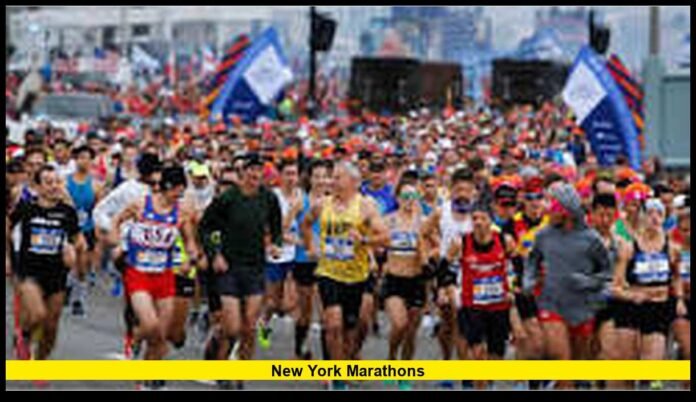

The new york marathon delivered a memorable day of international distance running on Sunday, November 1, 2026, as tens of thousands of athletes crossed New York City’s five boroughs in the 55th edition of the TCS New York City Marathon. Sweden’s Andreas Almgren captured the men’s title in his marathon debut, while Kenya’s Sheila Chepkirui secured her second women’s victory after a dramatic finish. The race also celebrated 50 years of the iconic five-borough course, marking a major milestone in one of the world’s most recognizable road-running events.
Andreas Almgren Wins Men’s Race in Marathon Debut
Swedish distance runner Andreas Almgren produced an impressive performance to win the men’s open division in 2:06:01. Competing in his first marathon, Almgren demonstrated strong endurance and tactical awareness before pulling away from Italy’s Yemaneberhan Crippa during the final mile.
Crippa finished second in 2:06:14, while Lesotho’s Kamohelo Mofolo claimed third place. Defending champion Benson Kipruto finished outside the top three after entering the competition among the leading contenders.
Almgren’s victory represented a significant achievement in his transition from shorter-distance racing to the marathon. His performance also highlighted the increasingly competitive international field competing for major road-racing honors.
The men’s contest featured several accomplished athletes, including American distance-running star Conner Mantz. The demanding course and late-race positioning ultimately played important roles in determining the final standings.
Sheila Chepkirui Secures Second New York Victory
Kenya’s Sheila Chepkirui emerged as the women’s champion after a closely contested battle against compatriot Hellen Obiri.
Chepkirui completed the race in 2:24:36, making a decisive move in the final 150 meters to separate herself from Obiri. The victory marked her second New York City Marathon title, following her previous triumph in 2024.
American runner Jessica McClain finished second in 2:24:42, narrowly ahead of Obiri, who recorded 2:24:43. The result was especially notable for McClain, whose podium finish made her the first American woman to reach the event’s top three since 2018.
Obiri entered the competition as the defending champion after setting a course record of 2:19:51 in 2025. Although she did not repeat that performance, her participation added considerable depth to the women’s field.
The closing stages delivered one of the day’s most compelling moments, with the leading runners separated by only seconds.
Marcel Hug Wins Men’s Wheelchair Competition
The wheelchair divisions once again demonstrated the speed and athletic ability required to compete at the highest level of marathon racing.
Switzerland’s Marcel Hug won the men’s wheelchair race in a reported time of 1:28:14. American competitor Daniel Romanchuk finished second in 1:28:15, just one second behind the winner.
The narrow margin underlined the intensity of the competition. British athlete David Weir and Dutch racer Lito Anker were also among the leading finishers.
Wheelchair racing remains an important part of the New York event, attracting elite athletes from multiple countries and providing spectators with another high-profile competition alongside the open divisions.
Official finishing times and complete rankings are finalized through the race’s results process.
2026 Marathon Marks 50 Years of the Five-Borough Course
This year’s marathon carries special historical significance because it celebrates the 50th anniversary of the race’s five-borough format.
When the marathon began in 1970, the competition was considerably smaller and largely confined to Central Park. Organizers introduced the route through all five boroughs in 1976, transforming the event into a citywide celebration.
That year’s race attracted approximately 2,090 starters, including just 88 women. Today, participation has grown dramatically, with approximately 60,000 runners taking part in the 2026 event.
The course connects communities across Staten Island, Brooklyn, Queens, the Bronx, and Manhattan. Residents, volunteers, musicians, and spectators contribute to the atmosphere that distinguishes the race from other international marathons.
The anniversary highlights how the competition has evolved from a relatively modest local event into a major fixture on the global athletics calendar.
New Bronx Route Introduces a Significant Race-Day Adjustment
Although the marathon continues to cover the traditional 26.2-mile distance, organizers introduced a small adjustment to the Bronx section in 2026.
The change represents the first modification to the course layout in 15 years. After crossing the Willis Avenue Bridge, runners follow a revised sequence of streets before reaching the Madison Avenue Bridge and returning to Manhattan.
The adjustment is intended to simplify turns and reduce disruption in a neighborhood that has changed considerably since the five-borough route was established.
The remainder of the course retains its familiar character, including the Verrazzano-Narrows Bridge start, Brooklyn’s crowded avenues, the Queensboro Bridge crossing, and the demanding final miles through Manhattan.
For runners, the route requires careful pacing. The early bridge crossing can encourage athletes to run too quickly, while the hills and accumulated fatigue near Central Park make energy management essential.
Why the New York Marathon Attracts Global Attention
The race combines elite athletic competition with an accessible atmosphere for participants pursuing personal milestones.
Professional runners compete for prize money and international recognition, while recreational athletes often spend months preparing for their first marathon. Charity participants also use the event to raise funds and awareness for a wide range of causes.
The event’s international appeal is reinforced by its place among the world’s leading marathon competitions. Elite athletes use the race to pursue personal bests, test their endurance, and strengthen their reputations on the global running circuit.
For New York City, the marathon also represents a major public gathering. Spectators line the streets, businesses welcome visitors, and communities organize cheering stations that sustain runners through difficult portions of the course.
The combination of sporting achievement and neighborhood participation has helped the event maintain its international standing for decades.
Road Closures and Transportation Disruptions
Marathon day brings extensive traffic restrictions across New York City. Roads along the route close in stages to accommodate runners, medical teams, volunteers, and race operations.
Major bridges and surrounding streets are affected, including the Verrazzano-Narrows Bridge and sections of the route through Brooklyn, Queens, the Bronx, and Manhattan.
Drivers should anticipate detours and parking restrictions, while spectators are encouraged to plan their journeys carefully. Public transportation can offer a more practical way to reach viewing areas, although travelers should check service advisories before departing.
Street reopening times vary according to race operations and the movement of participants through individual sections.
How to Follow Official Results and Future Race Information
Runners and spectators can follow participant progress through official race-tracking services. Live tracking provides estimated progress and preliminary timing information, while final standings are confirmed after the results process is completed.
Those interested in future editions should begin preparing well before registration opens. Entry opportunities can include a drawing, qualifying performances, charity participation, eligible running programs, and approved international travel packages.
Requirements vary by entry category, and applicants should review the rules for their intended race year.
Training is equally important. A structured program should include gradual mileage increases, long runs, appropriate recovery, and a tested nutrition strategy. Because the New York course features several bridges and late-race hills, runners benefit from practicing changes in elevation and maintaining a sustainable pace.
A Memorable Day for New York City Running
The 2026 race combined a historic anniversary with compelling performances across the professional divisions. Andreas Almgren’s marathon debut victory, Sheila Chepkirui’s second women’s title, and Marcel Hug’s narrow wheelchair triumph provided memorable highlights.
Beyond the finishing times, the event demonstrated the enduring appeal of bringing runners and spectators together across New York City’s diverse neighborhoods.
As official results are confirmed and participants celebrate their achievements, the 2026 edition will stand out as an important chapter in the marathon’s history.