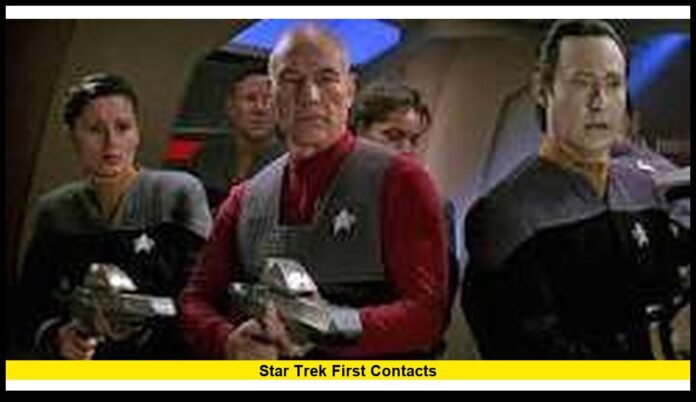

Star Trek First Contact remains a landmark in science-fiction cinema as the beloved movie approaches its 30th anniversary in November 2026. Featuring Captain Jean-Luc Picard and the crew of the USS Enterprise-E, the film combines a battle against the terrifying Borg with a time-travel mission that could determine humanity’s future among the stars. Nearly three decades after its original theatrical release, its memorable performances, dramatic storytelling, and optimistic vision of exploration continue to make it a favorite among franchise fans.
Released in 1996, the movie brought the cast of Star Trek: The Next Generation back to theaters for an adventure that balanced action with deeper questions about identity, technology, revenge, and the consequences of changing history. Its upcoming anniversary also offers an opportunity to revisit the film’s influence and its enduring place in the franchise.
Star Trek: First Contact Approaches Its 30th Anniversary
The movie premiered in U.S. theaters on November 22, 1996. Its 30th anniversary falls on November 22, 2026, during a year that also marks six decades since the original Star Trek television series debuted.
The milestone is particularly significant because the film helped establish the Enterprise-D crew’s successor ship, the Enterprise-E, as the setting for a new chapter in the franchise’s cinematic history. Rather than relying exclusively on familiar television storylines, the movie introduced a time-travel adventure with consequences extending across centuries.
Anniversary interest has also been supported by renewed home-entertainment attention, including a 30th-anniversary 4K Ultra HD SteelBook edition. Collectors and longtime viewers can revisit the story in a format designed for modern home theaters, although availability and package contents may differ by retailer.
The anniversary does not automatically mean a new sequel or remake is in development. The original film’s return to the spotlight is a celebration of an established franchise favorite rather than confirmation of a new production.
What Is the Movie About?
Directed by Jonathan Frakes, the film follows Picard and his crew as they confront an attempt by the Borg to alter humanity’s past.
The Borg are a technologically advanced collective that assimilates other species, incorporating their biological characteristics, knowledge, and technology. Individuality is sacrificed to the collective, making the Borg one of the Federation’s most disturbing adversaries.
When the Borg threaten Earth, Picard becomes personally invested in stopping them. Starfleet initially orders the Enterprise-E away from the main battle, but the captain eventually joins the fight after discovering the scale of the danger.
The Borg travel through time to the year 2063, targeting a pivotal event in human history. The Enterprise follows them and discovers that the enemy intends to prevent inventor Zefram Cochrane from completing humanity’s first successful warp flight.
Cochrane’s experimental spacecraft, the Phoenix, represents a turning point for Earth. Its successful journey attracts the attention of a passing Vulcan spacecraft, leading to humanity’s first official contact with an extraterrestrial civilization.
If the Borg disrupt that event, the future known to Picard and his crew could be erased or radically changed.
The Enterprise crew must therefore defend its ship while protecting Cochrane’s mission on Earth. Their challenge is not simply to defeat an enemy but to preserve a historical moment that will influence humanity’s development for generations.
The Main Cast and Their Roles
One of the film’s greatest strengths is its combination of familiar television characters and new personalities.
Patrick Stewart as Jean-Luc Picard
Stewart’s performance gives the movie its emotional center. Picard is an experienced captain, but his history with the Borg makes this encounter unusually personal. His determination gradually becomes entangled with anger, forcing him to confront the difference between protecting his crew and pursuing revenge.
Jonathan Frakes as William Riker
Riker leads the away team on Earth and helps keep Cochrane’s project moving forward. Frakes also directed the film, bringing his understanding of the characters to a production filled with large-scale action and suspense.
Brent Spiner as Data
Data’s search for a deeper understanding of humanity becomes central to the conflict with the Borg Queen. His curiosity and desire to experience human sensations make him vulnerable to manipulation, creating one of the movie’s most distinctive character arcs.
James Cromwell as Zefram Cochrane
Cochrane is the inventor whose warp flight changes the course of human history. He is not initially portrayed as a flawless visionary. Instead, he is practical, reluctant to accept the responsibility placed on him, and interested in the rewards his invention might bring.
This characterization makes his eventual achievement more believable: historic progress can come from imperfect people rather than idealized heroes.
Alfre Woodard as Lily Sloane
Lily is Cochrane’s associate and an important ally to Picard. Her directness allows her to challenge the captain when his judgment becomes clouded by his experiences with the Borg.
Alice Krige as the Borg Queen
Krige gives the Borg Queen a chilling personality that distinguishes her from the collective drones. Her strategy involves psychological manipulation as well as technological power, especially in her interactions with Data.
The returning cast also includes Michael Dorn as Worf, LeVar Burton as Geordi La Forge, Gates McFadden as Beverly Crusher, and Marina Sirtis as Deanna Troi.
Together, these performers preserve the relationships that made The Next Generation popular while giving the characters a story designed for the big screen.
Why the Borg Queen Became Such a Memorable Villain
The Borg Queen provides the film with a more personal antagonist than a faceless collective alone could offer. She embodies the Borg’s desire for control while displaying the ability to manipulate individuals through temptation, fear, and persuasion.
Her relationship with Data is particularly important. Data is an android who has spent years exploring what it means to be human. The Queen recognizes this interest and attempts to exploit it by offering him an experience he has long desired.
The conflict creates a tension between curiosity and autonomy. Data’s wish to understand humanity is not inherently a weakness, but it becomes dangerous when another intelligence uses that desire to influence his decisions.
The Borg Queen’s presence also changes how audiences perceive the Collective. The Borg remain a technological threat, but the Queen gives their objectives a more direct and unsettling expression.
Her approach helps make the movie’s conflict both physical and psychological. The Enterprise crew must fight an invading force while confronting the ways that fear, ambition, and personal vulnerabilities can be exploited.
Captain Picard’s Struggle With His Past
Picard’s emotional journey is one of the film’s defining elements. His previous assimilation by the Borg left him with lasting trauma, and their attack on Earth forces him to confront memories that remain deeply painful.
Initially, his desire to destroy the enemy appears consistent with his responsibility as captain. However, his behavior becomes increasingly extreme as the Borg take control of sections of the Enterprise.
Lily Sloane recognizes that Picard is losing perspective. Her confrontation with him forces him to examine whether his decisions are being driven by the needs of his crew or by his desire to settle a personal score.
This conflict adds weight to the movie’s action sequences. Picard cannot win simply by being more determined than the Borg; he must also regain control over his own reactions.
His eventual decision to prioritize his crew demonstrates the importance of leadership under pressure. Courage is necessary, but sound judgment and the ability to recognize personal limitations are equally important.
The Phoenix and Humanity’s First Contact
The Phoenix is the central symbol of hope in the film. Its warp flight demonstrates that humanity has reached a technological threshold capable of opening the way to interstellar exploration.
Earth in 2063 is not depicted as a perfect society. The planet is recovering from devastating conflict, and Cochrane himself does not initially embrace the grand historical role that others attach to his invention.
That contrast is essential to the story. Humanity’s future is not secured because every person has become wise or selfless. Instead, progress emerges from scientific achievement, cooperation, and the willingness to move beyond the limits of the present.
When Cochrane successfully tests the Phoenix, a Vulcan spacecraft detects the flight and initiates contact. The encounter establishes the turning point that the Borg attempted to prevent.
The scene connects the film’s large-scale conflict to the broader philosophy of Star Trek: exploration can encourage societies to cooperate, challenge their assumptions, and imagine a future beyond their immediate struggles.
How the Film Ends
The climax brings the struggle aboard the Enterprise together with the mission on Earth. Picard and his crew fight to stop the Borg from taking complete control of the starship, while Riker and his team work to protect Cochrane’s launch.
After recognizing the destructive influence of his anger, Picard changes course and places the survival of his crew above his personal desire for revenge.
Data also resists the Borg Queen’s manipulation, undermining her attempt to gain control over him. The Enterprise crew ultimately defeats the immediate Borg threat and prevents the enemy from changing the course of history.
Meanwhile, the Phoenix achieves warp speed, allowing the historic encounter with the Vulcans to take place.
The ending is both a victory over a dangerous enemy and a celebration of human possibility. The Enterprise crew protects a future in which humanity can participate in a larger interstellar community, while Cochrane’s achievement demonstrates that progress does not require perfect individuals.
Instead, it requires people to make meaningful choices even when the consequences extend far beyond their own lives.
Production, Box Office, and Critical Legacy
The screenplay was written by Brannon Braga and Ronald D. Moore, writers familiar with the characters and mythology of The Next Generation. Rick Berman produced the film, while Jerry Goldsmith composed its musical score.
Frakes’ direction helped the movie combine character-driven storytelling with space battles, suspense, and visual effects. The production also gave audiences a closer look at the Enterprise-E, the next-generation starship that would become an important part of the franchise’s cinematic era.
The film earned approximately $146 million worldwide, based on commonly reported box-office figures, against an estimated production budget of $45 million. The exact totals can vary between reporting sources, but its commercial performance established it as a successful theatrical release.
Its reputation has endured because the story does more than present a battle between Starfleet and the Borg. It gives the conflict personal stakes through Picard, explores Data’s evolving identity, and connects the characters’ survival to humanity’s historical future.
These elements have helped the film remain a popular recommendation for viewers exploring the franchise’s movie catalog.
Where to Watch Star Trek: First Contact
U.S. viewers can check current streaming catalogs, including Paramount+, for availability. Digital rental and purchase options may also be offered by major entertainment retailers.
Physical formats include DVD, Blu-ray, and 4K Ultra HD editions. Viewers considering the anniversary SteelBook should check the specific release details to confirm which discs and bonus features are included.
The movie runs for approximately 111 to 112 minutes and is rated PG-13. Although previous knowledge of The Next Generation adds emotional context, newcomers can follow the main story without watching the entire television series first.
Frequently Asked Questions
When did the movie premiere?
It premiered in U.S. theaters on November 22, 1996, and celebrates its 30th anniversary on November 22, 2026.
Who directed the film?
Jonathan Frakes directed the movie while also reprising his role as Commander William Riker.
Is the movie a sequel?
Yes. It follows Star Trek: Generations and continues the adventures of the Star Trek: The Next Generation crew.
What are the Borg trying to accomplish?
The Borg attempt to prevent Cochrane from completing the Phoenix’s first warp flight, potentially disrupting humanity’s historic first contact with the Vulcans.
Who plays the Borg Queen?
Alice Krige portrays the Borg Queen in the 1996 film.
Is a new movie confirmed for the 30th anniversary?
The anniversary is an opportunity to celebrate the original film, but it should not be interpreted as confirmation of a sequel or remake without an official announcement.
Can newcomers watch the movie?
Yes. The central conflict is explained within the film, although familiarity with Picard’s history with the Borg provides additional emotional context.
Final Takeaway
Three decades after its debut, the movie continues to stand out for its combination of suspense, memorable performances, and a hopeful vision of humanity’s future. The Borg provide a formidable threat, but the film’s lasting power comes from the choices its characters make when history itself is at stake.
As the 30th anniversary approaches, the story remains a reminder that exploration, cooperation, and personal growth are at the heart of the franchise.
Have a favorite moment from the film? Share your thoughts in the comments and stay tuned for more science-fiction movie news and Star Trek updates.