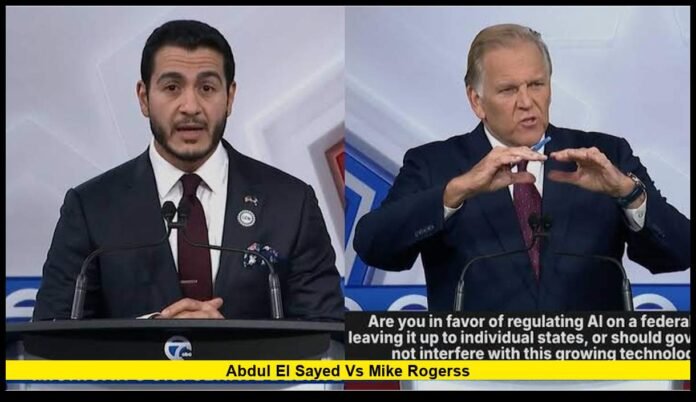

The Abdul El Sayed vs Mike Rogers contest is approaching a decisive moment as Michigan voters prepare to choose their next U.S. senator on November 3, 2026. Recent polling gives Democratic nominee Abdul El-Sayed an advantage over Republican Mike Rogers, although the size of that lead varies among surveys. The race has attracted national attention because Michigan’s result could affect the balance of power in Washington and influence debates over health care, manufacturing, immigration and federal spending.
Both candidates are making their final arguments to voters across the state. El-Sayed is emphasizing affordable health care and economic fairness, while Rogers is highlighting national security, manufacturing and conservative economic policies. Their contrasting backgrounds and priorities have made the election an important test of competing political messages.
Latest Michigan Senate Polls Show El-Sayed Ahead
A statewide survey released October 28 found El-Sayed leading Rogers by seven percentage points. The poll, conducted October 26–27 among 636 likely voters, placed El-Sayed at 51% and Rogers at 44%. Three percent remained undecided, while other candidates received minimal support.
The reported margin of error was approximately 3.9 percentage points. Although the result favors El-Sayed, polling uncertainty means the survey cannot establish who will win.
Other recent polls have shown a smaller Democratic advantage. A survey conducted by the Glengariff Group between October 19 and 22 placed El-Sayed at approximately 51% and Rogers at 45%. A RedBox Research poll from October 20–23 reported 48.9% for El-Sayed and 44% for Rogers.
Meanwhile, an InsiderAdvantage survey conducted October 21–22 showed a much closer contest, with El-Sayed at 47% and Rogers at 46%.
The differences illustrate why voters should consider multiple surveys instead of relying on one headline number. Pollsters use different methods, samples and turnout assumptions, which can produce varying estimates of candidate support.
Overall, the latest available polling suggests that El-Sayed has an advantage entering the final days of the campaign. Rogers, however, remains within striking distance if turnout or late voter preferences shift in his favor.
Why This Senate Seat Is Important
Michigan’s Senate election is part of the nationwide struggle for congressional control. Republicans began the 2026 election cycle with a 53–47 Senate majority, while Democrats are seeking additional seats to regain power.
The seat is open because Democratic Senator Gary Peters announced that he would not seek reelection. His departure has created a competitive opportunity for both parties.
Michigan presents a challenging political environment because its electorate includes large Democratic voting blocs, Republican strongholds and numerous communities where neither party can assume victory. The state’s manufacturing economy, labor movement and diverse population also make local concerns important in federal elections.
The next senator will vote on legislation affecting taxes, health care, immigration, trade and government spending. The winner will also participate in judicial confirmations and congressional oversight.
For Democrats, retaining Michigan would support their effort to challenge Republican control. For Republicans, winning the seat would strengthen their position in Washington and provide another vote for their legislative priorities.
Abdul El-Sayed’s Campaign and Priorities
El-Sayed is a physician and former public health administrator whose professional background shapes his campaign. He previously held public health leadership positions in Detroit and Wayne County, giving him experience with issues involving health care access and community well-being.
His campaign focuses on making medical treatment more affordable, improving economic security and reducing the financial pressures facing working families.
One of his central proposals is Medicare for All, a policy intended to establish broader public health coverage. El-Sayed argues that Americans should not face financial hardship because they need medical treatment.
He has also criticized the influence of wealthy donors and corporate interests in politics. His broader agenda reflects a progressive approach that favors stronger public programs and government action to address economic inequality.
El-Sayed won the Democratic nomination in August after a competitive primary against Representative Haley Stevens. The result placed him at the center of a nationally watched Senate contest.
His main challenge is to maintain support among progressive voters while appealing to independents and moderate Democrats. Michigan’s political diversity makes that coalition essential to his chances of winning.
Mike Rogers’ Experience and Republican Platform
Rogers enters the general election with experience in Congress and national security. He represented Michigan in the U.S. House for seven terms and chaired the House Intelligence Committee.
Before his congressional career, he served in the U.S. Army and worked as an FBI special agent. His campaign uses that background to emphasize national security, law enforcement and experience with federal policymaking.
Rogers supports conservative economic priorities and argues that Michigan needs policies that encourage manufacturing, strengthen business competitiveness and improve employment opportunities.
Border security is another central theme of his campaign. He has criticized El-Sayed’s progressive agenda, arguing that its proposed government programs could create additional costs and economic challenges.
Rogers also brings experience from his 2024 Senate campaign, when Democrat Elissa Slotkin defeated him. His return offers Republicans another opportunity to win a seat in a competitive state.
To prevail in 2026, Rogers needs to mobilize Republican voters and attract enough independents and undecided voters to overcome El-Sayed’s polling advantage.
The Candidates’ Biggest Policy Differences
Health care is one of the clearest dividing lines between the candidates. El-Sayed supports Medicare for All, while Rogers emphasizes affordability and approaches that do not require replacing the existing health insurance system with a single-payer model.
Their economic messages also differ. El-Sayed prioritizes household costs, public investment and economic fairness. Rogers emphasizes manufacturing, business competitiveness and conservative policies.
On immigration, Rogers has made border security a central campaign issue. El-Sayed places greater emphasis on domestic priorities, including health care and financial security.
Foreign policy has also generated disagreement. El-Sayed has advocated an arms embargo on Israel, while Rogers supports continued U.S. military assistance. Both have addressed the conflict involving Iran, although their broader approaches to American involvement in the Middle East differ.
The candidates have also discussed data center development, an issue involving energy demand, infrastructure and economic investment. Their positions reflect differing views about how government should respond to the industry’s growth and its effects on local communities.
These policy distinctions give voters an opportunity to compare practical proposals rather than relying solely on party affiliation.
Trump’s Influence on the Race
President Donald Trump has become a prominent figure in the campaign. El-Sayed argues that Rogers would support Trump’s agenda too consistently, potentially limiting his independence in the Senate.
Rogers has rejected that criticism and emphasized his experience and conservative priorities. His supporters may view alignment with the administration as an advantage, particularly on immigration and economic policy.
The campaign has also involved controversy over El-Sayed’s Muslim identity and allegations about his political associations. El-Sayed has denied claims linking him to the Muslim Brotherhood, and accusations should not be treated as established facts without credible supporting evidence.
The dispute has raised questions about how religion and identity feature in American political campaigns. It has also competed with discussions about health care, employment and the cost of living.
Ultimately, voters must evaluate the candidates’ documented records, public statements and policy proposals when deciding whom to support.
What Could Determine the November 3 Result?
Several factors could influence the final outcome.
- Independent voters: El-Sayed’s advantage among independents in the latest Mitchell survey could help him maintain his lead.
- Turnout: Strong participation among Democratic or Republican supporters could change the statewide result.
- Economic concerns: Voters’ views on medical costs, employment, manufacturing and household expenses may influence their choices.
- National politics: Public opinion about Trump and the administration could affect support for both candidates.
- Late decisions: Undecided voters and last-minute changes in enthusiasm may influence the final margin.
Early and absentee voting also matter because the campaigns must persuade supporters to cast ballots, not merely express a preference in surveys.
The latest polling provides useful evidence about the race, but only the official vote count will determine the winner.
Final Outlook for Michigan’s Senate Election
El-Sayed enters the final stretch with a measurable polling advantage, supported by several surveys showing him ahead of Rogers. However, differences between pollsters and the state’s competitive political environment mean the election remains uncertain.
El-Sayed is asking voters to prioritize affordable health care, economic security and a progressive approach to federal policy. Rogers is presenting his congressional and national security experience as a foundation for conservative leadership focused on manufacturing and border security.
The result will determine who succeeds Gary Peters and could affect the national balance of power in the Senate. Michigan voters will make that decision on November 3, 2026.
Which candidate do you believe offers the stronger vision for Michigan’s future? Share your opinion as the Senate race approaches Election Day.