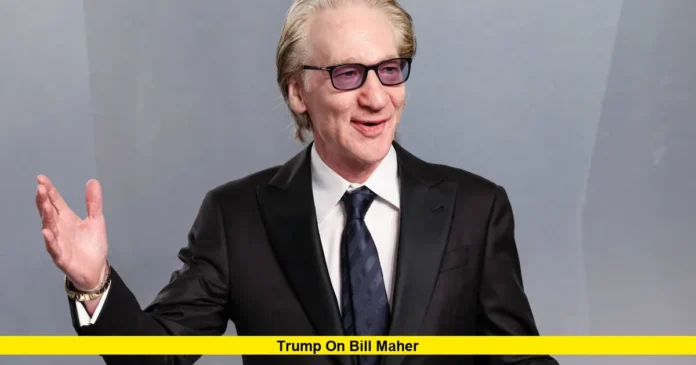

Trump on Bill Maher became a major political entertainment talking point after President Donald Trump launched a lengthy social media attack against the comedian following their second White House dinner. The approximately 1,323-word post, published on Sunday, October 25, 2026, sharply criticized Maher just days after the HBO host defended his decision to dine with the president. The confrontation renewed questions about their complicated relationship, the limits of private political conversations, and why two public figures who have shared cordial moments continue to clash publicly.
The latest dispute follows Maher’s October 23 appearance on Real Time with Bill Maher, where he addressed criticism of his second dinner with Trump. The gathering took place on October 15 and included sports commentator Stephen A. Smith and musician Kid Rock. Trump’s subsequent social media outburst turned an apparently friendly private meeting into another public disagreement between the president and the outspoken comedian.
The episode also highlights a recurring pattern in their relationship. They can reportedly engage in extended conversations behind closed doors, yet their public exchanges often feature sharp insults, political disagreements, and conflicting interpretations of what those meetings mean.
What Trump Said in His 1,300-Word Post About Bill Maher
Trump’s lengthy post attacked Maher’s television program, political commentary, audience, and treatment of the president. He described the comedian as a loser, questioned the popularity of Real Time with Bill Maher, and accused him of spreading falsehoods. Trump also criticized HBO, argued that Maher had misrepresented his political standing, and said he did not want Republicans to continue appearing on the comedian’s program. The president’s message included personal insults and claims about Maher’s behavior during their recent dinner. Those claims represent Trump’s account of the encounter and should not be treated as independently established facts.
The post went beyond criticism of a television monologue. Trump revisited the history of their relationship, discussed the people who helped arrange their meetings, and questioned why Maher had sought another White House dinner. He also criticized the comedian’s remarks about immigration, election politics, Iran, and Republican support for the administration.
One of the clearest messages in Trump’s post was that he no longer wanted further contact with Maher. He told the comedian not to call again and characterized additional conversations as pointless. The remarks suggested a sharp deterioration in the goodwill that had surrounded the second dinner.
Why Trump Turned Against Bill Maher Again
The immediate backdrop was Maher’s October 23 broadcast, which aired eight days after the White House dinner. Rather than offering unqualified praise for Trump, Maher used the program to describe their interaction while continuing to criticize the president’s policies and public statements.
Maher explained that he liked the dinners because they gave him an opportunity to address Trump directly. He argued that political commentators often publish criticism that may never reach the person they are criticizing. A face-to-face conversation, in his view, offered a different opportunity to challenge the president.
That approach did not prevent Maher from returning to his usual comedic style. His monologue included jokes about Trump’s public approval, Republican candidates, and the president’s remarks about other politicians.
Trump responded by focusing on what he considered inaccuracies and unfair attacks. He rejected Maher’s characterization of his political standing and disputed the comedian’s comments about the administration.
The disagreement illustrates a central tension between the two men. Maher appears willing to maintain a personal channel of communication with Trump while criticizing him publicly. Trump, meanwhile, has repeatedly expressed displeasure when Maher returns to negative commentary after their private meetings.
Their latest confrontation also demonstrates that a cordial dinner does not necessarily signal a political reconciliation. Neither man has indicated that the meeting resolved their substantial differences.
The October 15 White House Dinner Explained
The second dinner took place on Thursday, October 15, 2026. Trump hosted Maher alongside sports commentator Stephen A. Smith and musician Kid Rock.
The gathering attracted attention because Maher has spent years criticizing Trump on television. Their first widely discussed White House dinner took place in April 2025, after Kid Rock helped facilitate the introduction.
Trump later described the October gathering as a good and informative dinner. Speaking to reporters the following day, he said the group discussed a wide range of subjects and spent considerable time together. He also suggested that Maher liked him more than many people realized.
Kid Rock offered a similarly positive public description of the meeting. He characterized the dinner as an opportunity for people with different political perspectives to share a meal, laugh, and discuss difficult issues.
Stephen A. Smith subsequently described an extended conversation in which the president answered questions and responded to disagreements. Smith portrayed the encounter as substantive, while acknowledging that Trump remained forceful when challenged.
The guests’ accounts established that the dinner involved political discussion, but they did not demonstrate that the participants had reached agreement on major policy questions.
The difference between those public descriptions and Trump’s later attack on Maher became a defining feature of the story.
What Bill Maher Said After Meeting Trump
Maher addressed the controversy during the October 23 episode of Real Time with Bill Maher. He openly acknowledged the backlash surrounding his decision to attend another dinner with Trump and rejected the idea that meeting the president required him to abandon his political opinions.
His response was direct and deliberately provocative. Maher declared that he had attended another dinner and said he enjoyed these meetings, despite criticism from people who disagreed with his decision.
He also described the practical value of speaking to Trump in person. Maher said the president listens, maintains eye contact, and does not automatically become angry when someone challenges him during a conversation.
That description contrasted with the confrontational tone Trump frequently uses in public political disputes. However, Maher did not present the experience as evidence that the president had changed his policies or abandoned his positions.
Instead, he explained that direct communication and political disagreement could coexist.
Maher also used humor to describe the atmosphere at the White House. He joked about being announced to the president and made remarks about the dinner’s length. His account mixed observations about the encounter with criticism of Trump’s public conduct.
The comedian’s willingness to describe the meeting positively while continuing to attack the president became a central point of disagreement.
For Maher, a private conversation did not create an obligation to offer public praise. For Trump, Maher’s subsequent monologue appeared to undermine the value of their meeting.
Trump’s Complaints About Maher’s Political Commentary
A significant portion of Trump’s post concerned what he viewed as inaccurate reporting and commentary on Maher’s program.
Trump objected to the comedian’s discussion of his approval ratings and Republican support. He cited polling figures that he said demonstrated strong backing within the Republican Party and rejected Maher’s suggestion that his political position had weakened.
Those numbers were presented as Trump’s claims in his social media post. They should not be interpreted as a comprehensive assessment of public opinion without examining the underlying polling methodology, survey dates, sample sizes, and results.
Trump also criticized Maher’s remarks about California and allegations involving illegal voting. He claimed that the comedian had misstated the facts and referred to figures that he said could grow substantially.
The post did not, by itself, establish the accuracy of those allegations. Claims about illegal voting require evidence that distinguishes verified cases from allegations, administrative errors, and other voting irregularities.
Trump further objected to Maher’s criticism of his approach to Iran and the issue of nuclear weapons. The president argued that his policies had protected the United States and international security.
These disagreements reflect broader differences over how the administration’s actions should be evaluated. Trump generally presented his decisions as successful, while Maher used his program to question the president’s judgments and political claims.
The dispute also highlights how political entertainment programs can become part of a wider debate over polling, election administration, foreign policy, and presidential accountability.
Why the First White House Dinner Matters
The latest clash cannot be understood without considering the men’s first White House dinner in 2025.
After that meeting, Maher described Trump as more gracious and measured in person than he had expected. His account attracted attention because it came from a comedian who had frequently criticized the president.
The dinner did not lead Maher to stop criticizing Trump. He continued to challenge the administration on his HBO program, and Trump subsequently resumed attacking the comedian in public.
That pattern created an unusual relationship. The two men demonstrated a willingness to meet privately, yet neither abandoned his public identity.
Maher continued presenting himself as a critic who was prepared to challenge politicians directly. Trump continued using social media to confront people he believed had treated him unfairly.
Their second dinner initially appeared to reopen a channel of communication. Trump’s latest post, however, showed how quickly that opening could close when the president objected to Maher’s public remarks.
The earlier meeting is therefore important not because it established lasting agreement, but because it demonstrated the temporary nature of their personal goodwill.
What the Feud Means for Bill Maher and Trump
The renewed confrontation raises questions about how public figures should approach private meetings with political leaders.
For Maher, attending a White House dinner offers access to the president and an opportunity to raise questions directly. His critics may see the meetings as an unnecessary gesture toward a politician whose policies they oppose. Maher has made clear that he does not accept the argument that conversation itself amounts to political endorsement.
Trump’s response reflects a different interpretation. The president has emphasized his belief that Maher misrepresents him on television and has questioned the comedian’s motives.
The conflict may also affect how audiences interpret future comments from either man. Supporters of Maher may view his willingness to challenge Trump publicly after dining with him as evidence of independence. Others may question why he continues to accept invitations from a president he regularly criticizes.
Similarly, Trump’s supporters may welcome his response as a defense against hostile commentary. Critics may see the personal insults as an example of the president’s unwillingness to tolerate unfavorable coverage.
Neither interpretation changes the underlying facts of the dispute: the men met privately, Maher continued criticizing Trump, and the president responded with an extended public attack.
There is no confirmed indication that another dinner has been scheduled. Trump’s statement that Maher should not contact him again suggests that the relationship has entered another difficult period, although it does not establish what either man might do in the future.
Will Trump and Bill Maher Meet Again?
As of the latest reported developments on October 26, 2026, the immediate focus remains Trump’s social media post and Maher’s public defense of the second dinner.
Trump’s demand that Maher stop calling him indicates that he is dissatisfied with the comedian’s latest commentary. However, the pair’s history shows that their relationship has moved repeatedly between private cordiality and public hostility.
Their first dinner did not prevent subsequent insults. The second dinner has likewise failed to produce a lasting truce.
A future meeting remains uncertain. Neither a third invitation nor a reconciliation should be treated as confirmed without a direct announcement or reliable reporting.
For now, the dispute provides another example of the complicated relationship between political leaders and entertainers who criticize them. Access to the president can create opportunities for direct discussion, but it does not guarantee agreement, mutual respect, or lasting goodwill.
The latest Trump and Bill Maher feud is still developing, so share your thoughts in the comments and stay tuned for verified updates on what happens next.