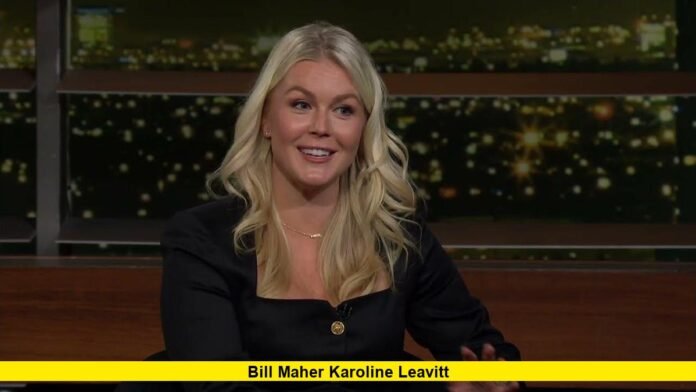

The Bill Maher Karoline Leavitt interview became a major talking point after the former White House press secretary appeared on HBO’s Real Time with Bill Maher on October 23, 2026. The conversation covered President Donald Trump’s political future, the upcoming midterm elections, Leavitt’s departure from the White House, and her plans to join Fox News. Maher also discussed his recent dinner with Trump, creating a conversation that attracted attention from both supporters and critics.
The appearance marked a notable change for Leavitt, who spent much of her time in the Trump administration defending the president during contentious White House press briefings. Instead of responding to questions from reporters in the briefing room, she sat across from a late-night host who had previously used her public statements as material for political comedy.
What Happened During Bill Maher’s Interview With Karoline Leavitt?
Maher welcomed Leavitt to Real Time for an interview that mixed political discussion with personal questions and humor. Their exchange covered her decision to leave government, her assessment of Trump’s leadership, and concerns about how the president might respond if Republicans suffer losses in the November midterm elections.
The conversation also reflected Maher’s increasingly complicated relationship with Trump. Although the comedian has criticized the president on several issues, he recently visited the White House for another dinner with him. That meeting became an important part of the discussion surrounding the episode.
Leavitt acknowledged Maher’s recent interaction with Trump and said the president had sent his regards. She also referred to Maher’s positive comments about the dinner, prompting the host to acknowledge that he had enjoyed the experience.
The exchange established a relatively relaxed atmosphere before the discussion moved toward more consequential political questions. Their conversation did not eliminate their ideological differences, but it offered viewers an opportunity to hear Leavitt explain the administration’s positions directly.
Why the Interview Drew Attention
Several factors made the appearance particularly noteworthy.
First, Leavitt had regularly appeared in Maher’s commentary during her time as press secretary. His jokes often focused on her explanations of controversial presidential statements and administration decisions.
Second, her departure from the White House had changed her professional position. By the time of the interview, she was speaking as a former administration official rather than as the person responsible for delivering the president’s official responses to reporters.
Third, the midterm elections were approaching. Maher used that political backdrop to question how Trump might exercise his authority if the election weakened Republican control in Washington.
Finally, Maher’s recent White House dinner had renewed debate about whether direct engagement with Trump could be productive or whether it risked softening criticism of the president. His interview with Leavitt brought those questions together in a single television appearance.
Bill Maher Questions Trump’s Political Future Before the Midterms
One of the interview’s central subjects was the possibility that Republicans could face significant losses in the November 2026 midterm elections.
Maher raised concerns about how Trump might react if the election reduced his political leverage. He suggested that a president facing a weaker position could become more inclined toward retaliation, particularly given Trump’s reputation for responding aggressively to political opponents.
Maher’s concern centered on the possibility that Trump could enter the final two years of his presidency with less influence over Congress. A change in the balance of power could complicate legislative priorities and increase conflict between the White House and congressional Democrats.
Leavitt rejected the suggestion that Trump would necessarily respond negatively to such a result. She said she was not worried about the scenario and argued that the president had repeatedly defied expectations throughout his political career.
She also pointed to Trump’s efforts to encourage Republican voters to participate in the midterms. In her view, it was premature to draw firm conclusions before voters had cast their ballots.
Leavitt further maintained that Trump remained willing to work with Democrats when cooperation could advance his agenda. She cited his dealings with Washington, D.C., Mayor Muriel Bowser as an example of cross-party cooperation.
The exchange highlighted a familiar divide in American politics. Critics question whether Trump can work constructively with political opponents, while his supporters argue that he can pursue practical agreements when circumstances require them.
The election itself will determine the congressional balance of power. Neither Maher’s concerns nor Leavitt’s assurances establish how Trump would respond to a particular electoral outcome.
Leavitt Defends Trump’s Willingness to Listen
Maher also discussed Trump’s behavior during private meetings, drawing on his own experiences at the White House.
The comedian said Trump had listened to concerns raised during their dinner. He described the president as someone who maintained eye contact, allowed others to speak, and considered different opinions during private conversations.
Leavitt agreed with that assessment. She said Trump often asked people in the room for their views, including staff members at different levels of the administration.
According to Leavitt, the president genuinely wanted to understand how people felt and what they thought before making decisions. She characterized his approach as one that included seeking advice before determining what he believed was best for the country.
The discussion offered a contrast between Trump’s public political style and the private behavior Maher described. Public appearances often feature combative exchanges, sharp personal remarks, and disputes with journalists. Maher suggested that his own experience during private conversations had been different.
However, a favorable description of a private meeting does not independently establish how a president makes decisions across the administration. Maher offered his personal impressions, while Leavitt defended the leadership style she had observed as a senior White House official.
The exchange nevertheless became an important part of the interview because it explained why Maher continues to support direct conversations with Trump despite disagreements over policy.
Bill Maher Explains His Recent White House Dinner
Maher’s relationship with Trump was another major subject surrounding the interview. The host returned to the White House on October 15, 2026, for a dinner with Trump, sports commentator Stephen A. Smith, and musician Kid Rock.
The dinner attracted attention because Maher had previously faced criticism for accepting an invitation to meet Trump in 2025. Critics questioned whether the comedian’s willingness to engage with the president conflicted with his frequent criticism of the administration.
Maher defended his decision during the October 23 episode of Real Time. He argued that speaking directly with Trump offered an opportunity to raise concerns that the president might not encounter through ordinary political commentary.
During his discussion with Leavitt, Maher described raising concerns about Trump’s approach to Russia and Ukraine. He criticized the administration’s handling of the conflict and expressed concern about its treatment of Ukrainian President Volodymyr Zelenskyy.
Maher also discussed the president’s reported willingness to reconsider certain proposals after receiving advice. He presented those experiences as evidence that direct engagement could sometimes influence a political leader’s thinking.
Leavitt, meanwhile, emphasized that Trump listened to people around him and considered their advice before making decisions.
Their comments illustrated two different aspects of the same relationship. Maher remains willing to criticize the president’s policies, but he also believes private conversations can be more useful than criticism delivered exclusively from a distance.
The dinner did not mean that Maher had abandoned every criticism of Trump. Instead, his defense focused on the value of maintaining access and communicating disagreements directly.
The White House Ballroom Debate Enters the Conversation
The interview also touched on Trump’s plans for a White House ballroom and the administration’s broader ideas for changing parts of the White House grounds.
Maher expressed support for the proposed ballroom, saying that the United States needed an appropriate space for formal events. His comments contrasted with criticism from opponents who have questioned the project and its priorities.
The ballroom discussion became part of a broader exchange about the White House press briefing room and reports that Trump had considered changes to its location or purpose.
Maher joked about the idea of converting the briefing room into an actual swimming pool. The remark referred to reporting about the president’s interest in restoring a pool-related feature to the area.
The topic gave the interview a lighter moment while remaining connected to the president’s management of the White House.
It also demonstrated how Maher’s views do not always align neatly with conventional partisan divisions. He can criticize Trump’s policies in one discussion while supporting a particular building project in another.
For viewers, that contrast helped explain why Maher’s political commentary continues to generate debate. Supporters of his approach see value in evaluating individual issues separately, while critics worry that friendly exchanges can distract from more consequential policy disagreements.
Karoline Leavitt Explains Why She Left the White House
Leavitt’s career transition was another important part of the conversation.
She left her position as White House press secretary in August 2026 after serving as one of the administration’s most visible public representatives. During the interview, she explained that spending more time with her young children was a major reason for her departure.
Leavitt said she had two young children and wanted to devote more time to her family. She acknowledged that family responsibilities are sometimes cited in Washington but emphasized that the explanation applied to her own decision.
The role of White House press secretary involves demanding schedules, frequent public scrutiny, and responsibility for communicating administration positions. The position also requires regular engagement with journalists who challenge official statements and ask about controversial decisions.
Leavitt described the job as exceptionally difficult. She said the pressure inside the briefing room was substantial and expressed sympathy for the person who took over the position after her departure.
Her comments provided a personal explanation for leaving a high-profile government role at a politically significant moment. They also helped shift the interview away from Trump and toward Leavitt’s own professional plans.
Her departure did not mean she was ending her involvement in conservative politics. She indicated that she remained in contact with Trump and continued to help the president’s team as the midterm elections approached.
The Press Secretary Role and Her Successor
Maher also asked Leavitt about the person who briefly replaced her as White House press secretary. The discussion touched on the challenges of the position and the administration’s decision to move on quickly after the transition.
Leavitt described the job as demanding and said she respected anyone willing to step behind the briefing-room podium. She emphasized the pressure involved in answering questions on behalf of a president and facing a room full of reporters.
When Maher expressed surprise at the speed of the personnel change, Leavitt responded with a reference to Trump’s history as the host of The Apprentice. She suggested that replacing people was consistent with his approach to management.
The exchange brought humor into a discussion that otherwise focused on government responsibilities and political strategy. It also reinforced Leavitt’s willingness to defend the administration while acknowledging the difficult nature of the position she had left.
Karoline Leavitt’s New Role at Fox News
Leavitt’s next professional step was already established before her appearance on Maher’s program. Fox News announced on October 5 that she would join the network as an on-air contributor beginning November 1, 2026.
In the new position, she is expected to provide political commentary and analysis across Fox News Media platforms. Her experience as White House press secretary and as a spokesperson during Trump’s presidential campaign will inform her television appearances.
The move represents a transition from speaking as an official administration representative to offering commentary as a media contributor. As press secretary, Leavitt was responsible for communicating the administration’s positions. At Fox News, she will have greater scope to provide her own analysis while drawing on her experience inside the White House.
Her appointment also places her within a familiar career path for former presidential press secretaries. Several people who have held the position have moved into television commentary after leaving government service.
Leavitt’s appearance on Real Time offered an early example of how she may approach that next phase: defending Trump’s record, explaining her experiences inside the administration, and responding to questions about the political challenges facing Republicans.
How the Interview Reflects Maher’s Political Approach
Maher’s interview with Leavitt also raised questions about his style as a political commentator. His program frequently criticizes political figures across the ideological spectrum, but his willingness to meet Trump and host administration allies has generated debate.
Some critics argue that friendly interviews can allow powerful political figures to avoid difficult follow-up questions. Others believe that direct conversations with people who hold opposing views can reveal more than exchanges built around prepared talking points.
The Leavitt interview illustrated that tension. Maher questioned her about the midterms and Trump’s potential response to political setbacks, but he also agreed with some of her positive descriptions of the president and expressed support for the ballroom project.
Those moments became part of the broader reaction to the episode. Viewers assessing the conversation may focus on the questions Maher asked, the subjects he did not pursue further, and the extent to which Leavitt was able to present her perspective without sustained challenge.
The interview should therefore be understood as a television conversation rather than a formal news conference or an exhaustive examination of administration policy. It offered insight into the participants’ views, but it did not settle the larger debates surrounding Trump or the midterm elections.
Why the Bill Maher Karoline Leavitt Interview Matters
The Bill Maher Karoline Leavitt conversation brought together three developments: Leavitt’s departure from the White House, Maher’s continued willingness to speak directly with Trump and his allies, and the approaching midterm elections.
For Leavitt, the appearance provided a platform to explain her decision to leave government and outline her next career move. She defended Trump’s leadership, rejected concerns about his response to a possible Republican setback, and described a president who listens to advice in private meetings.
For Maher, the interview highlighted his argument that engaging directly with Trump can be worthwhile even when disagreements remain. His comments about Ukraine demonstrated that a cordial relationship does not necessarily erase his objections to specific policies.
The midterm discussion may have the greatest political significance. The November elections will determine the composition of Congress and could shape the administration’s ability to advance its agenda. Leavitt expressed confidence in Trump’s political instincts, while Maher raised concerns about how the president might react to diminished influence.
Neither participant can determine the election outcome in advance. Voters will decide the results, and the consequences for the administration will depend on the balance of power that emerges.
What Comes Next for Bill Maher and Karoline Leavitt?
The immediate next step for Leavitt is her scheduled start as a Fox News contributor on November 1. Her new role will keep her in the public conversation about Trump’s administration, Republican strategy, and the national political landscape.
Maher, meanwhile, continues to host Real Time with Bill Maher, where political interviews and panel discussions remain central features of the program. His decision to welcome Leavitt demonstrated that former administration officials can appear on the show even after serving as frequent targets of his commentary.
The interview also leaves open a larger question about political communication in a polarized country: whether conversations across ideological lines can produce meaningful exchanges without reducing scrutiny of public officials.
The answer will depend on the substance of future interviews, the willingness of guests to address difficult questions, and the extent to which hosts challenge claims that require further examination.
Ultimately, the Maher-Leavitt interview offered a revealing look at Trump’s political allies, the debate over his leadership, and Leavitt’s next chapter in television. What did you think of their conversation? Share your views and stay tuned for the latest verified developments.