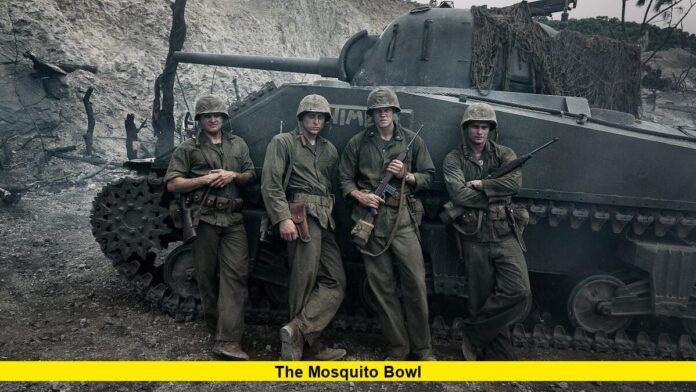

The Mosquito Bowl draws fresh attention this week as Peter Berg’s film adaptation premieres at AFI Fest and heads toward theaters on October 30, 2026, with a Netflix streaming debut set for November 25. Reviews arriving today call the R-rated drama powerful and visceral while noting its technical strengths. The project rests on a real Christmas Eve game played in 1944 by Marine units training for the invasion of Okinawa. That forgotten contest, and the young men who took part, form the entire focus of the story.
College football stood at a peak of national popularity when Japan attacked Pearl Harbor in December 1941. Many of the country’s top players chose the Marine Corps. They trained at places like Parris Island and later assembled in the Pacific. By late 1944 two regiments of the Sixth Marine Division—the 4th and the 29th—found themselves on Guadalcanal. Their ranks held one of the largest concentrations of college talent ever gathered in a single unit.
The Game on Christmas Eve
On December 24, 1944, the two regiments staged their own bowl game on a field carved from parade grounds of dirt, coral, and pebbles. Roughly 65 Marines took part. The group included three All-Americans, several team captains from schools such as Wisconsin, Brown, Notre Dame, and Purdue, and nearly twenty men who were drafted or later played in the NFL. At least 1,500 spectators ringed the field. The players wore cut-off dungarees, stenciled T-shirts, and standard field shoes. Official rules called for two-handed touch, yet the game quickly turned into full tackle. It ended in a 0-0 tie. Mosquitoes swarmed the island, and the contest took the name The Mosquito Bowl.
The game offered a brief return to something familiar. Players who had once filled stadiums now lined up against teammates from rival campuses. Wagers circulated among the spectators. Beer was available. For two hours the war receded. The score itself mattered less than the chance to compete again as athletes rather than only as riflemen.
Key Players Who Took the Field
Four figures emerge most clearly from the roster. John McLaughry starred at Brown, earned All-American notice, and had already appeared briefly with the New York Giants. Bob Bauman and Dave Schreiner both played for Wisconsin. Schreiner was a unanimous All-American and team captain who declined a medical-school deferment. Tony Butkovich led the nation in rushing at Purdue in 1943 and was selected high in the NFL draft. Other participants included Notre Dame captain George Murphy and former Detroit Lion Chuck Behan.
These men were in their early twenties. Many wrote letters home that described training, boredom, and the approaching fight. Schreiner’s correspondence with his fiancée, Odette Hendrickson, survives in archives. McLaughry’s family preserved extensive personal papers. The players carried the habits of the gridiron into Marine life—leadership, physical toughness, and loyalty to the man beside them.
The Battle That Followed
Months later the same men landed on Okinawa. The campaign lasted 82 days and became the bloodiest of the Pacific War. American forces suffered more than 49,000 casualties, including roughly 12,500 killed or missing. Japanese military losses were far higher, and tens of thousands of Okinawan civilians died. Within that larger toll, 15 of the 65 Mosquito Bowl players were killed. Roughly 20 more were wounded. The casualty rate among the participants reached about 54 percent. Historians and the book that later recorded the story describe this as the largest number of American athletes to die in any single battle.
Tony Butkovich was shot by a sniper on April 18, 1945. Bob Bauman died from a head wound during heavy fighting. Dave Schreiner lasted until the final day of the battle before a chest wound proved fatal. McLaughry survived. He later coached at several colleges and returned to Brown. The surviving players scattered into civilian lives, yet the concentration of deaths among one afternoon’s roster remained unmatched.
Buzz Bissinger, the Pulitzer Prize-winning author of Friday Night Lights, spent years reconstructing the episode. He first encountered the story while working on another project and soon realized his own father had served in the 4th Regiment at Okinawa. The resulting nonfiction work, The Mosquito Bowl: A Game of Life and Death in World War II, appeared in September 2022 from Harper. It became an instant New York Times bestseller and won the General Wallace M. Greene Jr. Award from the Marine Corps Heritage Foundation. Bissinger draws on military records, family archives, letters, and interviews with descendants. The narrative follows the players from campus fields through Marine training and into the final months of combat. John Grisham called the book destined to become a classic. Readers encounter both the brief Christmas Eve contest and the far longer cost that followed.
From Page to Screen
Peter Berg, who directed the film version of Friday Night Lights, adapted the book with co-writer Mark L. Smith. Nicholas Galitzine plays McLaughry. Bill Skarsgård portrays Bauman. Ray Nicholson appears as Butkovich. Tom Francis takes the role of Schreiner. The production shot in sequence to build on-screen camaraderie. Brian Grazer is among the producers. The film runs approximately two hours and six minutes and carries an R rating. Early festival reactions published on October 23, 2026, describe intense combat sequences and a focus on the human price of the war. Some reviewers praise the performances and technical craft. Others note that the football game itself occupies limited screen time. Theatrical release begins in select theaters on October 30, followed by the Netflix premiere on November 25.
Why the Story Still Resonates
The Mosquito Bowl sits at the intersection of two American institutions—college football and the Marine Corps—at a moment when both demanded total commitment. The players traded Saturday crowds for coral beaches and coral ridges. Their letters reveal ordinary young men who accepted the risk because peers were already in uniform. The 0-0 score on Christmas Eve 1944 has no lasting place in the record books. The names of the fifteen who did not return do. Contemporary audiences encounter the tale first through Bissinger’s research and now through Berg’s film. Both versions keep the focus on the individuals rather than on larger strategic outcomes.
Interest continues because the facts remain precise and the human details remain accessible. Archives hold the letters. Unit records confirm the roster and the later casualties. The film’s release calendar is fixed and public. Nothing in the account requires invention. The game happened. The invasion followed. Fifteen of the participants did not come home. Those verified elements continue to draw attention in October 2026.
What remains after the final whistle?
Share your thoughts on the game, the book, or the film in the comments below, and check back for updates as more viewers see the story on screen.