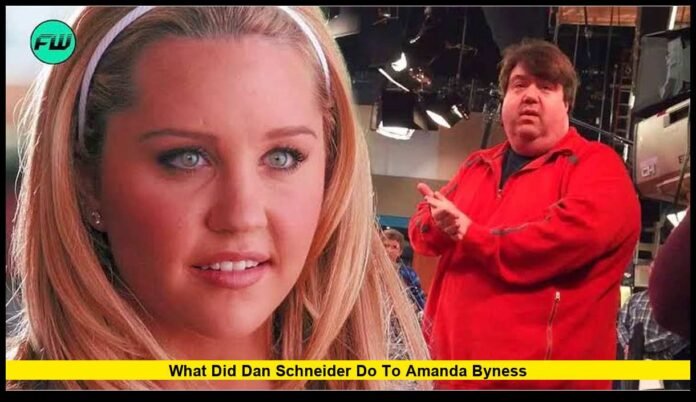

The question what did dan schneider do to amanda bynes has become a major topic of discussion among television fans revisiting Nickelodeon’s most popular shows from the late 1990s and early 2000s. Their professional relationship attracted renewed scrutiny after the documentary Quiet on Set: The Dark Side of Kids TV examined the working environment behind several children’s television productions and raised questions about the responsibilities of adults who worked closely with young performers.
Dan Schneider was a prominent television producer and comedy writer who helped develop Amanda Bynes’ career through All That and The Amanda Show. Bynes became one of Nickelodeon’s best-known young stars, while Schneider gained considerable influence over the network’s comedy programming. Their professional connection later became part of a broader discussion about workplace boundaries, inappropriate comedy, and the treatment of child actors in the entertainment industry.
However, understanding the controversy requires separating documented events from allegations and online speculation. The documentary raised questions about Schneider’s conduct and his working relationship with Bynes, but it did not establish that he sexually abused her. Bynes also did not appear in the series to provide her own firsthand account of their relationship.
Key Points Summary
╔════════════════════════════════════════════════════════════════════╗
– Dan Schneider helped establish Amanda Bynes as a Nickelodeon star through All That and The Amanda Show.
– Quiet on Set brought renewed attention to their close professional relationship and questioned workplace boundaries in children’s television.
– A hot-tub sketch featuring Schneider and Bynes became a subject of retrospective criticism.
– Schneider discussed Bynes’ reported emancipation efforts and a family-related incident in a 2024 interview.
– Schneider acknowledged shortcomings in his workplace behavior and apologized for certain actions, while disputing aspects of the documentary’s portrayal.
– A September 2026 California appeals court ruling reversed a lower court decision that had allowed Schneider’s defamation lawsuit against the documentary’s producers to proceed.
╚════════════════════════════════════════════════════════════════════╝
How Dan Schneider and Amanda Bynes Built Their Nickelodeon Connection
Amanda Bynes began attracting attention as a young performer on Nickelodeon’s sketch comedy series All That. The program introduced viewers to a rotating cast of young comedians who performed short sketches, impersonations, and recurring characters.
Bynes quickly became one of the show’s most recognizable performers. Her energetic delivery, expressive reactions, and ability to play different comedic personalities made her a natural fit for the series.
Schneider was an important creative figure behind the production. As a writer and producer, he helped shape the comedy style that defined several Nickelodeon programs during that period. His influence extended beyond individual scripts to the development of shows built around young performers.
Bynes’ popularity eventually led to The Amanda Show, which premiered in 1999. The series placed her at the center of a sketch comedy format, giving her more opportunities to demonstrate her range as a performer.
The show became an important milestone in her career and helped establish her as a recognizable television personality among younger audiences.
Their professional relationship developed within a workplace where Schneider held substantial creative authority and Bynes was a teenage performer. That difference in position is central to later questions about professional boundaries and the responsibilities adults have when working with minors.
A close working relationship is not, by itself, evidence of abuse or misconduct. Nevertheless, the power imbalance between a producer and a young actor makes transparency, appropriate supervision, and clear professional standards especially important.
Why Quiet on Set Put Their Relationship Under Scrutiny
The documentary Quiet on Set: The Dark Side of Kids TV examined allegations and recollections concerning the production culture behind several Nickelodeon programs.
The series featured former performers and employees who described experiences they considered troubling. Their accounts included concerns about workplace behavior, adult authority, and comedy that appeared inappropriate in productions made for young audiences.
Schneider became a central subject because of his influential role in creating and producing several successful shows. The documentary also revisited scenes from older programs that viewers began interpreting differently as public conversations about child protection and workplace accountability evolved.
Bynes’ connection to Schneider was discussed within this wider examination. Viewers were particularly interested in how closely the producer worked with her and how decisions involving young performers were made.
The documentary encouraged audiences to reconsider the environment behind programs they remembered from childhood. For some viewers, scenes that had once seemed like ordinary sketch comedy appeared uncomfortable when reconsidered in light of the ages of the performers and the authority held by the adults directing the productions.
However, the documentary did not establish every allegation viewers subsequently discussed online. Nor did it provide a firsthand account from Bynes about her personal relationship with Schneider.
The distinction matters because documentaries can raise legitimate questions about professional conduct without proving every interpretation or accusation circulated by audiences.
The Amanda Show Hot-Tub Sketch Explained
One scene that attracted renewed attention involved a hot-tub sketch featuring Schneider and Bynes.
The scene showed Schneider fully clothed while Bynes appeared in a swimsuit. After the documentary prompted audiences to reconsider the material, some viewers questioned why the scene had been written and filmed that way.
The criticism focused on the judgment of the adults responsible for creating comedy involving a teenage performer. It also contributed to a larger discussion about how children’s television handled jokes, costumes, physical comedy, and situations involving adult and young cast members.
The scene became especially controversial because it was reconsidered years after the program originally aired, when public expectations about safeguarding and workplace boundaries had developed.
Still, the existence of a questionable or uncomfortable scene does not automatically establish criminal conduct. The sketch is part of the public discussion about Schneider’s creative decisions, but it does not independently prove that he sexually abused Bynes.
The broader concern is whether television producers and networks exercised appropriate judgment when developing material for children’s programming and whether young performers had sufficient protection when uncomfortable situations arose.
That question extends beyond one producer or one television show. It involves the policies, supervision, and workplace culture of the entire production environment.
Did Dan Schneider Help Amanda Bynes Seek Emancipation?
Another important aspect of the controversy concerns Bynes’ reported effort to become legally emancipated from her parents during her teenage years.
Emancipation is a legal process that can grant a minor certain rights and responsibilities normally associated with adulthood. It involves legal requirements and is different from simply leaving home or disagreeing with a parent.
In a 2024 interview responding to the documentary, Schneider discussed Bynes’ reported interest in emancipation when she was approximately 16 or 17 years old.
He said she approached members of her professional team, including her lawyer, agent, manager, publicist, and Schneider himself. According to his account, the people around her supported her effort, but the attempt was unsuccessful.
Schneider also described an incident in which Bynes reportedly contacted him late at night following a conflict at home.
He said she was distressed and that he arranged for someone nearby to pick her up. According to his recollection, she was subsequently taken to the police.
Schneider presented his involvement as an attempt to help a young person he believed needed assistance. The account also raised questions about how a producer should respond when a teenage performer seeks help with a family problem.
Such circumstances can be complicated. A young actor may view members of a production team as trusted adults, particularly after spending substantial time with them at work. At the same time, professional relationships do not replace the responsibilities of parents, legal representatives, or appropriate safeguarding professionals.
Schneider’s account represents his recollection of the events. Without a complete firsthand account from Bynes, it would be inappropriate to claim that the incident proves either misconduct or the absence of every possible concern.
What Did Dan Schneider Say About the Allegations?
Schneider responded publicly to the controversy in 2024, acknowledging that certain aspects of his behavior had been inappropriate and that he owed people apologies.
He admitted that he could be impatient, demanding, rude, and difficult to work with. He also apologized for asking people to give him massages on set, acknowledging that such requests placed employees in an uncomfortable position.
His comments addressed concerns about workplace conduct and the power dynamics that can exist between a successful producer and the people working under him.
Schneider also disputed aspects of the documentary’s presentation and defended his intentions in situations involving Bynes. In discussing her reported family conflict, he maintained that his actions were motivated by concern for her safety.
These statements are important because they provide his response to the criticism. However, an apology for inappropriate workplace behavior should not be misrepresented as an admission to sexual abuse, which he did not acknowledge.
Likewise, his defense of his conduct does not mean every concern raised by former employees should automatically be dismissed.
A balanced account recognizes that people can acknowledge certain workplace failures while disputing other allegations. It also recognizes that the experiences of former cast members and employees deserve careful consideration without turning unverified claims into established facts.
Why Dan Schneider Left Nickelodeon
Schneider and Nickelodeon ended their professional relationship in 2018 following an internal investigation into workplace allegations. His departure marked a significant turning point for a producer who had helped define the network’s programming for an entire generation.
The separation came amid concerns about his management style and workplace behavior. Schneider later acknowledged that he had sometimes treated colleagues poorly, although he disputed certain interpretations of his conduct.
His departure did not immediately end public interest in his work. Shows he created or helped develop continued attracting viewers through reruns and streaming platforms, while former cast members’ accounts encouraged audiences to reconsider how those productions were made.
The controversy also raised questions about the entertainment industry’s responsibility to protect young employees. Child performers may depend on adults for career opportunities, scheduling, professional guidance, and access to decision-makers. When a single producer exercises considerable influence over a young actor’s career, independent oversight becomes particularly important.
The debate surrounding Schneider consequently extended beyond his individual actions. It prompted broader conversations about workplace policies, accountability, and whether networks responded appropriately when concerns arose.
The Latest Legal Development in the Quiet on Set Controversy
Schneider’s dispute with the producers of Quiet on Set continued into 2026.
He filed a defamation lawsuit arguing that the documentary’s presentation suggested he had sexually abused children. His legal challenge focused on the meaning conveyed by the program and its promotional material, rather than simply on whether the documentary criticized his management style or creative decisions.
In September 2026, a California appeals court reversed a lower court decision that had allowed his lawsuit to proceed. The appeals court concluded that the documentary and its promotional trailer were not reasonably susceptible to the specific defamatory interpretation Schneider alleged.
The decision concerned the legal sufficiency of his defamation claim. It should not be interpreted as a comprehensive judicial determination about every disputed event discussed in the documentary or about Bynes’ personal experiences.
Similarly, the lawsuit and its outcome do not establish that Schneider sexually abused Bynes. The controversy requires careful attention to the difference between a legal dispute about a documentary’s portrayal, criticism of workplace conduct, and evidence of a specific act of abuse.
The ruling added another chapter to a story that has involved entertainment reporting, personal accounts, public apologies, and questions about the limits of documentary storytelling.
Where Does Amanda Bynes Fit Into the Larger Discussion?
Bynes’ career and personal life have frequently attracted intense public attention because she became famous at a young age.
After her Nickelodeon success, she appeared in mainstream films, including What a Girl Wants, She’s the Man, and Hairspray. These projects demonstrated that she could transition from children’s television to broader film audiences.
She eventually stepped away from acting, and her life outside Hollywood became a subject of public discussion. However, her later experiences should not automatically be connected to Schneider or to any particular event from her childhood career.
There is a meaningful difference between examining the conditions under which a young performer worked and claiming that a specific individual caused later personal difficulties. The latter requires evidence that cannot be replaced by assumptions or online speculation.
The renewed interest in Bynes also highlights the challenges faced by former child stars. Growing up in public can make it difficult to maintain privacy, establish boundaries, and move beyond a professional identity formed during adolescence.
For that reason, discussions about her career should acknowledge her achievements as well as the concerns raised about the industry in which she worked. Her story should not be reduced to controversy surrounding a former colleague.
What the Controversy Reveals About Child Actors in Hollywood
The discussion surrounding Schneider and Bynes illustrates several important issues affecting young performers.
First, successful productions need clear professional boundaries. Adults working with minors should understand their responsibilities and avoid placing young employees in situations where they feel pressured to accommodate inappropriate requests.
Second, networks and production companies need reliable reporting procedures. Young actors should have access to trusted adults and independent channels through which they can raise concerns without fearing damage to their careers.
Third, creative authority should not eliminate accountability. Producers may have substantial influence over scripts, casting, working conditions, and future employment opportunities, but that influence should be accompanied by meaningful oversight.
Finally, audiences should approach retrospective documentaries with both openness and critical judgment. Former performers’ experiences can reveal problems that were overlooked at the time, but individual claims still need to be represented accurately.
These principles apply throughout the entertainment industry, from television comedy and film production to streaming programs and online content featuring minors.
Frequently Asked Questions
What did Dan Schneider do to Amanda Bynes?
Schneider worked with Bynes on All That and The Amanda Show. Their professional relationship became a subject of renewed scrutiny following Quiet on Set, particularly because of a controversial sketch and Schneider’s reported involvement in her emancipation efforts. The documentary did not establish that he sexually abused her.
Did Amanda Bynes appear in Quiet on Set?
Bynes did not participate in the documentary to give her own firsthand account of her relationship with Schneider. Other people’s recollections and the program’s examination of television scenes should not be treated as a substitute for her personal testimony.
Did Dan Schneider apologize?
Yes. In 2024, Schneider acknowledged shortcomings in his workplace behavior and apologized for certain actions, including asking employees for massages. He also disputed aspects of the documentary’s portrayal of him.
Why did Dan Schneider and Nickelodeon part ways?
They ended their professional relationship in 2018 after an internal investigation into workplace allegations. His management style and conduct subsequently became subjects of renewed public discussion.
What happened in Schneider’s lawsuit against Quiet on Set?
In September 2026, a California appeals court reversed a lower court decision that had allowed his defamation lawsuit against the documentary’s producers to proceed. The decision addressed the specific defamatory implication he alleged, not every question concerning his past conduct.
Conclusion
The controversy surrounding Dan Schneider and Amanda Bynes reflects a larger debate about power, accountability, and professional boundaries in children’s television. Schneider helped build Bynes’ early career, but their working relationship later attracted scrutiny because of scenes from their programs, accounts of his workplace behavior, and his reported involvement in her personal affairs.
A responsible understanding of the story requires distinguishing documented events from allegations and speculation. The documentary brought renewed attention to questions about how young performers were treated, but it did not establish that Schneider sexually abused Bynes.
What changes do you think Hollywood should make to protect young performers? Share your thoughts in the comments and follow the latest entertainment developments.