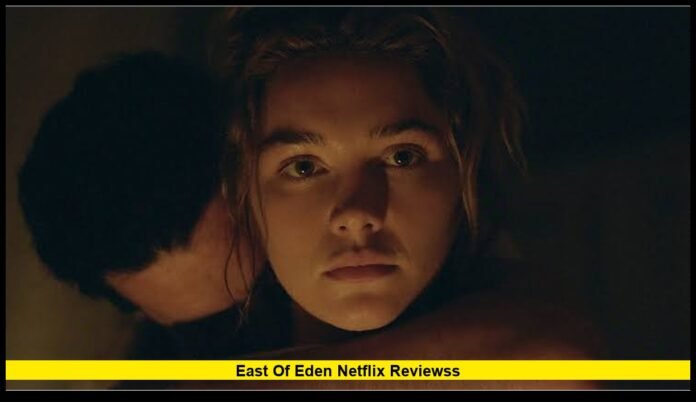

The latest east of eden netflix reviews are giving viewers plenty to discuss following the arrival of Netflix’s new seven-episode limited series based on John Steinbeck’s celebrated novel. Led by Florence Pugh, Christopher Abbott and Mike Faist, the drama takes a sweeping look at family rivalry, love, ambition, betrayal and the choices that can shape generations. Created by Zoe Kazan, the series brings a fresh interpretation to one of America’s most recognizable literary stories while giving Cathy Ames a much larger role than audiences may have seen in previous screen versions.
Netflix’s New East of Eden Adaptation Has Arrived
Netflix released East of Eden as a seven-episode limited series, allowing the production considerably more time to explore Steinbeck’s sprawling story than a conventional feature film.
The series follows the Trask family across decades, beginning with brothers Adam and Charles and eventually moving toward the next generation. Their complicated relationship is shaped by their father Cyrus, whose treatment of his sons creates a deep emotional divide that continues to affect the family long after their childhood.
The arrival of Cathy Ames changes the balance dramatically.
Played by Florence Pugh, Cathy enters the story under disturbing circumstances and quickly becomes one of the central forces driving the narrative. Her relationship with Adam, her conflict with Charles and her ambitions create consequences that extend well beyond the family’s immediate circumstances.
Rather than rushing through the material, the Netflix production uses its seven-episode format to build the family history gradually.
Florence Pugh Is the Center of the Critical Conversation
Florence Pugh has emerged as the most frequently discussed element of the new adaptation.
Cathy Ames is one of the most controversial characters in Steinbeck’s novel. She has traditionally been presented as manipulative, calculating and deeply destructive, but Zoe Kazan’s adaptation takes a more layered approach to her background.
Pugh’s performance is therefore required to operate on several levels. Cathy must remain frightening and unpredictable while also becoming a character audiences can understand in ways that earlier interpretations did not necessarily attempt.
Early reviews have frequently praised Pugh’s ability to dominate scenes without making Cathy feel one-dimensional. Her performance gives the series much of its tension, particularly during moments when Cathy’s intentions remain unclear.
The role also gives Pugh a significant opportunity to move between vulnerability and menace. The contrast becomes particularly important because the series does not tell Cathy’s story only through the reactions of the men around her.
A Different Approach to Cathy Ames
One of the biggest creative decisions in the series is the greater attention given to Cathy’s past.
Steinbeck’s original character has long generated debate among readers and critics. Some interpretations view Cathy primarily as a representation of evil, while others have questioned whether her portrayal can be understood through a more complicated lens.
Zoe Kazan’s adaptation enters that debate directly.
The series gives viewers additional context surrounding Cathy and attempts to explore how her experiences may have influenced the person she becomes. That does not eliminate the character’s darker qualities, but it changes the way the audience is encouraged to interpret them.
This approach is also one of the reasons the series has produced differing reactions. Some reviewers have appreciated the attempt to provide Cathy with additional depth, while others have questioned whether explaining more about the character makes her more compelling.
Pugh’s performance sits at the center of that creative experiment.
Christopher Abbott Brings a Different Side to Adam Trask
Christopher Abbott plays Adam Trask, a character whose emotional journey is closely connected to Cathy’s arrival.
Adam is initially presented as the more gentle and hopeful of the Trask brothers. His relationship with Charles is complicated by the attention they receive from their father, creating an emotional rivalry that influences their adult lives.
Abbott’s performance focuses heavily on Adam’s vulnerability.
His character wants to believe in people and dreams of creating a stable family life, but his optimism repeatedly collides with circumstances that he cannot control. Cathy’s arrival becomes especially important because Adam sees possibilities in their relationship that other characters do not.
The performance also gives the series a counterbalance to Pugh’s Cathy. While Cathy often keeps her intentions hidden, Adam tends to approach the world with a degree of openness that makes him susceptible to disappointment.
Mike Faist Plays the Troubled Charles
Mike Faist portrays Charles Trask, Adam’s brother and lifelong rival.
Charles is one of the key characters in the first part of the story because his relationship with Adam establishes many of the family’s central conflicts.
Unlike Adam, Charles has a much more suspicious view of the people around him. His distrust of Cathy becomes particularly important after she enters the brothers’ lives.
Faist’s performance emphasizes Charles’s frustration, anger and complicated relationship with his family.
The character is not simply an obstacle to Adam. His behavior is rooted in years of feeling overlooked and emotionally damaged by his father’s favoritism. That makes the rivalry between the brothers one of the more important emotional foundations of the series.
Hoon Lee Provides Another Important Perspective
Hoon Lee’s portrayal of Lee has also attracted attention from reviewers.
Lee occupies a distinctive position within the Trask household and becomes increasingly important as the story moves forward. His intelligence, observations and emotional understanding allow him to see family conflicts from a different perspective.
The character also helps the series explore themes surrounding identity, loyalty and belonging.
While much of the drama is driven by the rivalry between the Trask brothers and the complicated presence of Cathy, Lee provides moments in which the story can step back and examine the consequences of those conflicts.
His role becomes particularly important as the younger generation begins to confront the legacy created by the previous generation.
The Series Covers More Than the Famous James Dean Movie
Comparisons with the 1955 East of Eden film are unavoidable.
The classic movie starring James Dean remains one of the best-known adaptations of Steinbeck’s work. However, that film focused primarily on the latter portion of the novel rather than attempting to reproduce the entire story.
Netflix’s version takes a much broader approach.
The seven episodes move through different stages of the family’s history, allowing the adaptation to introduce characters, relationships and conflicts that could not receive the same amount of attention in a feature-length production.
That difference is especially important for viewers who know the story primarily through the James Dean movie.
The Netflix series is not simply a longer version of that film. It approaches the source material as a multigenerational family drama and places considerably more emphasis on Cathy and the events that shape her relationship with the Trask family.
A Story About Family, Choice and Inheritance
Although East of Eden contains dramatic twists and intense family conflicts, its central concerns are broader than the individual characters.
The story repeatedly asks whether people are destined to repeat the mistakes of their parents.
Adam and Charles inherit an emotionally complicated family history from Cyrus. Later, the next generation becomes caught in conflicts that originated before they were born.
That generational structure gives the Netflix adaptation much of its emotional weight.
The characters are constantly dealing with questions about whether their identities are determined by their family history or whether they can make different choices.
This is particularly important in the later episodes, when the story shifts more attention toward the younger generation and the consequences of decisions made years earlier.
The Visual Style Adds to the Period Drama
Netflix has given the production a substantial visual scale.
The story moves through different locations and periods, requiring the series to recreate rural communities, family homes, farms and other environments associated with the world of Steinbeck’s novel.
The cinematography emphasizes landscapes as well as intimate character moments.
Large outdoor settings help establish the sense of an American family saga, while quieter scenes between individual characters provide the emotional foundation for the story.
The contrast between the beauty of the surroundings and the increasingly complicated relationships inside the families is one of the production’s recurring visual characteristics.
Why the Reviews Are Not Completely Uniform
Despite the strong attention surrounding the series, the critical response is not entirely unanimous.
One area of criticism concerns the enormous scope of Steinbeck’s novel. Even seven episodes provide limited space for a story that spans generations and explores numerous characters and philosophical ideas.
Some reviewers have therefore questioned whether the adaptation can fully capture the novel’s intellectual ambitions.
Another point of discussion is the emphasis on Cathy.
For some viewers, giving Cathy additional background and emotional context makes the character more interesting. For others, the decision can feel like an attempt to reinterpret a character whose mystery and ruthlessness were central to the original story.
The pacing has also generated discussion. The series takes time to establish relationships and family history, meaning viewers expecting a fast-moving thriller may find portions of the drama deliberately measured.
That slower approach is more compatible with audiences who enjoy character-focused period dramas.
The Seven Episodes Tell a Larger Family Story
Netflix’s episode structure gives the story a clear progression.
The opening chapter, “Brothers,” establishes Adam and Charles and the difficult environment in which they grow up.
The second episode, “Cathy,” places greater emphasis on Cathy’s history and her effect on the brothers.
“In the Valley” moves the story toward California, while “Kate” follows Cathy’s efforts to establish a new identity and pursue financial independence.
The later episodes move further into the next stage of the family story. “Departure,” “The Great Try” and “Timshel” bring the generational themes increasingly into focus as the younger characters begin confronting the consequences of their family’s history.
The episode titles themselves reflect the series’ progression from sibling rivalry toward questions about identity, freedom and whether inherited mistakes can be overcome.
What Viewers Should Expect From the Netflix Series
The new adaptation is best approached as a serious literary drama rather than a conventional thriller.
It contains conflict, secrets and shocking developments, but its primary focus remains character development.
Viewers should expect a story that spends considerable time examining relationships and motivations. The series is also deliberately interested in moral questions, particularly the difference between the circumstances people inherit and the decisions they make themselves.
Florence Pugh’s performance makes the series especially compelling for viewers interested in complex female characters, while the performances from Abbott and Faist give the family conflict its emotional foundation.
The production also provides enough scale for the story to feel larger than a conventional domestic drama.
How Critics Are Viewing the Adaptation So Far
The early critical response has generally recognized the ambition of the project.
Several reviews have highlighted Pugh’s performance as a major strength, while others have praised the ensemble cast and the production’s visual presentation.
At the same time, critics have identified limitations in the adaptation’s ability to reproduce every philosophical and narrative element of Steinbeck’s novel.
That distinction is important.
A television adaptation can be successful on its own terms without reproducing every aspect of its source material. Netflix’s East of Eden appears to be making deliberate choices about which elements to emphasize, with Cathy and the Trask family’s complicated relationships receiving significant attention.
The result is a version designed for modern television audiences while remaining closely connected to the themes that made Steinbeck’s novel enduring.
Is East of Eden Worth Watching on Netflix?
For viewers who enjoy ambitious period dramas, literary adaptations and complicated family stories, the series offers plenty to explore.
The combination of Florence Pugh, Christopher Abbott and Mike Faist gives the central family conflict a strong acting foundation, while Hoon Lee adds another important dimension to the ensemble.
The seven-episode format also gives the story enough space to move beyond the familiar image of East of Eden created by the 1955 film.
However, viewers looking for a fast-paced series may need to adjust their expectations. The production takes its time establishing its characters and allowing the consequences of their choices to develop.
Ultimately, the appeal will depend heavily on how much a viewer values character development, literary themes and slow-building family drama.
Final Takeaway
The latest east of eden netflix reviews underline the scale of Netflix’s attempt to bring Steinbeck’s novel to television. Florence Pugh’s performance as Cathy Ames has become the dominant topic in the early conversation, but the series also benefits from a strong ensemble and a story that explores several generations of the Trask family.
Zoe Kazan’s adaptation is particularly notable because it does not simply recreate the famous James Dean movie. Instead, it approaches the novel as a much broader family saga and gives Cathy a central position in the narrative.
Whether audiences agree with every creative choice, the series gives Steinbeck’s story a new life for a modern streaming audience. With all seven episodes available, viewers can now experience the complete adaptation and decide for themselves how effectively it balances the novel’s family drama, moral questions and enduring themes of choice and responsibility.