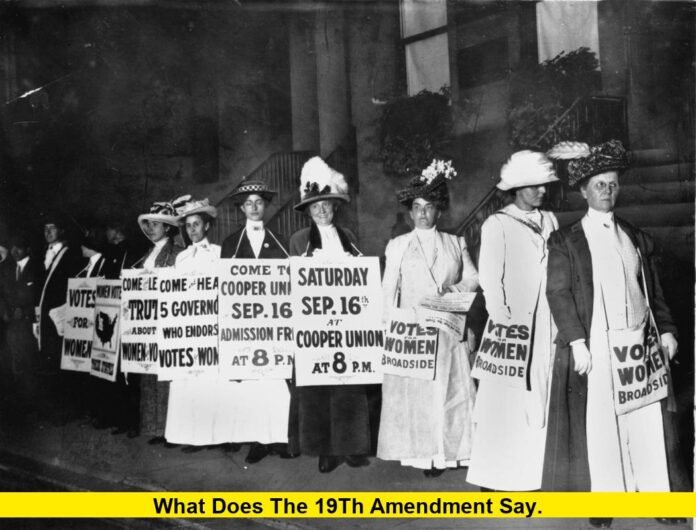

What does the 19th amendment say? It prohibits the United States and individual states from denying or restricting a U.S. citizen’s right to vote because of sex. Ratified in 1920 after decades of organizing and political pressure, the amendment became a major constitutional milestone in the history of voting rights in the United States.
The amendment is short, but its impact is significant. It established a nationwide constitutional protection against sex-based restrictions on voting and gave Congress authority to enforce that protection through legislation.
The Exact Meaning of the 19th Amendment
The 19th Amendment contains two sentences. Its first section establishes the central voting-rights protection, while the second gives Congress enforcement authority.
In substance, the amendment says that a citizen’s right to vote cannot be denied or reduced by the federal government or by a state because of sex. Congress is also empowered to pass appropriate legislation to enforce the provision.
This distinction is important because the amendment does not establish a general constitutional right to vote for every person under every circumstance. Instead, it specifically prevents the government from using sex as a basis for denying or restricting an eligible citizen’s voting rights.
The amendment therefore addresses sex discrimination in voting.
When Was the 19th Amendment Passed and Ratified?
Congress approved the proposed amendment in 1919. The House of Representatives passed it on May 21, 1919, and the Senate approved it two weeks later. The proposal was then sent to the states for ratification.
The decisive ratification came on August 18, 1920, when Tennessee became the 36th state to approve the amendment. That provided the three-fourths of states required for constitutional ratification at the time. Secretary of State Bainbridge Colby formally certified the amendment on August 26, 1920.
That process marked the culmination of a movement that had been pursuing women’s suffrage for generations.
Why Was the 19th Amendment Necessary?
Before the amendment, voting qualifications differed significantly from state to state. Some states had already granted women voting rights, either fully or partially, while others continued to exclude women from elections based on sex.
The movement for women’s suffrage developed over many decades. Activists used petitions, speeches, demonstrations, lobbying, legal challenges, state campaigns and other forms of political organizing to press for voting rights.
A federal constitutional amendment ultimately provided a nationwide constitutional rule rather than leaving the issue entirely to individual states.
The effort was not a short campaign. A woman-suffrage amendment was first formally introduced in Congress in 1878 and continued to be proposed for decades before finally securing congressional approval in 1919.
What Did the 19th Amendment Change?
The central change was constitutional protection against denying or abridging voting rights because of sex.
That meant a state could no longer maintain a voting system that categorically excluded eligible citizens simply because they were women. The federal government was likewise prohibited from denying or abridging voting rights on that basis.
The amendment also contained an enforcement provision. Congress received explicit constitutional authority to enact legislation needed to enforce the amendment.
In practical terms, the amendment transformed women’s voting rights from an issue that could be determined differently by individual states into a federally protected constitutional principle.
Did the 19th Amendment Give Women the Right to Vote?
Yes, the 19th Amendment is commonly described as the constitutional guarantee of women’s suffrage. The National Archives states that the amendment legally guaranteed American women the right to vote and identifies its ratification in 1920 as a major turning point in American democracy.
However, the historical reality was more complicated than the constitutional language alone suggests.
Ratification did not instantly eliminate every barrier preventing women from voting. Many African American women and other minority women continued to encounter discriminatory voting laws and practices. The National Archives notes that the struggle for full enfranchisement continued after 1920.
This distinction is essential when explaining the amendment. The constitutional rule prohibited voting discrimination based on sex, but other forms of voter suppression and discriminatory laws could still prevent particular groups of women from exercising that right.
Did All Women Immediately Gain Equal Access to the Ballot?
The 19th Amendment represented a nationwide constitutional advance, but it did not erase every obstacle to voting.
Race, discriminatory state laws, registration barriers and other practices continued to affect access to the ballot. African American women in particular remained part of a broader struggle for meaningful voting rights after 1920.
This is why the history of women’s suffrage cannot be reduced to the statement that all barriers disappeared in August 1920.
The amendment addressed one specific constitutional problem: government discrimination in voting based on sex. Additional federal protections were needed to address other forms of discrimination and barriers.
The Voting Rights Act of 1965 later became an important part of the federal effort to protect voting rights for citizens across racial and gender lines.
How Is the 19th Amendment Different From the 15th Amendment?
The 15th and 19th Amendments both deal with voting rights, but they prohibit discrimination on different grounds.
The 15th Amendment, ratified in 1870, prohibits the federal government and states from denying or abridging a citizen’s voting rights because of race, color or previous condition of servitude.
The 19th Amendment, ratified 50 years later, prohibits denial or abridgment of voting rights because of sex.
Together with later constitutional amendments and federal voting-rights laws, these provisions form part of the constitutional framework protecting access to elections.
Does the 19th Amendment Apply Only to Women?
The historical purpose of the amendment was to secure women’s voting rights, and it is widely recognized as the constitutional amendment guaranteeing women’s suffrage.
Its actual wording, however, is framed more broadly. It says that the right of citizens to vote cannot be denied or abridged by the United States or any state because of sex. The language therefore establishes a prohibition on sex-based discrimination in voting rather than creating separate voting rules exclusively for women.
This wording is one reason the amendment is often described legally as a prohibition against sex discrimination in voting.
What Does the Enforcement Clause Mean?
The second sentence of the 19th Amendment gives Congress the power to enforce the amendment through appropriate legislation.
That provision matters because constitutional rights can require laws and government mechanisms to protect them in practice. Congress was expressly given enforcement authority so that federal legislation could be used to address violations of the amendment’s protections.
The amendment therefore does two things: it establishes the constitutional protection and identifies Congress as having enforcement authority.
How Long Did the Fight for Women’s Suffrage Last?
The struggle lasted for generations.
The formal congressional campaign for a constitutional amendment dates to the 19th century, with an amendment first introduced in Congress in 1878. During the following decades, suffrage advocates pursued multiple strategies, including state campaigns, lobbying, public demonstrations and civil disobedience.
Some states expanded women’s voting rights before the federal amendment was ratified. Nine Western states, for example, had adopted woman-suffrage legislation by 1912.
The eventual constitutional amendment established a nationwide protection that could not simply be reversed by an individual state’s ordinary voting laws.
Why the 19th Amendment Still Matters
The 19th Amendment remains an important part of the U.S. Constitution because it establishes that voting rights cannot be denied or abridged on the basis of sex.
Its significance extends beyond the immediate historical achievement of women’s suffrage. It represents a constitutional rejection of sex-based exclusion from the electoral process and became part of the broader development of American voting-rights protections.
At the same time, understanding its limits is just as important as understanding its achievement. Ratification did not by itself guarantee that every woman would immediately be able to participate equally in elections. Other discriminatory practices continued, particularly against African American women and other minority women.
The 19th Amendment in Today’s Voting-Rights Context
The constitutional language remains straightforward: the government cannot deny or abridge a U.S. citizen’s voting right because of sex.
Modern debates over elections can involve many different issues, including voter eligibility, election administration, ballot access, registration requirements and voting procedures. Those questions should not be confused with the specific protection established by the 19th Amendment.
The amendment’s core principle remains focused on one particular form of discrimination: sex-based denial or restriction of voting rights.
Its legal framework also remains part of the Constitution alongside the 15th, 24th and 26th Amendments and federal voting-rights legislation. Together, these measures address different aspects of voting access and discrimination.
What Does the 19th Amendment Say in Simple Terms?
In simple terms, the 19th Amendment says that the government cannot prevent a U.S. citizen from voting, or reduce that citizen’s voting rights, simply because of sex.
It was approved by Congress in 1919 and ratified in 1920 after decades of efforts to secure women’s suffrage. The amendment gave the principle of women’s voting rights constitutional protection throughout the United States.
Its wording is brief, but its historical importance is substantial. The amendment changed the constitutional status of voting rights for women and became a lasting part of the nation’s voting-rights framework.
Final Thoughts
The answer to what does the 19th amendment say is ultimately contained in two short sentences: voting rights cannot be denied or abridged by the United States or a state because of sex, and Congress has the authority to enforce that protection. Ratified in 1920, the amendment marked a landmark achievement for women’s suffrage while leaving a broader struggle over equal access to the ballot unfinished.
What do you think about the continuing importance of the 19th Amendment? Share your thoughts in the comments or stay updated for more coverage of U.S. constitutional and voting-rights developments.