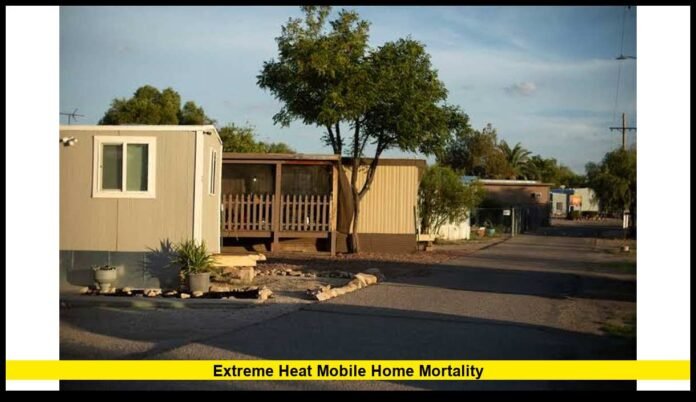

Extreme heat mobile home mortality is receiving renewed national attention as new 2026 reporting highlights the disproportionate danger faced by people living in manufactured homes during severe heat.
The issue is especially visible in Arizona, where researchers have spent years examining heat deaths inside mobile homes and where Maricopa County continues to record hundreds of heat-related fatalities. New reporting published September 7, 2026, has brought the problem back into focus, highlighting evidence that residents of manufactured housing can face substantially greater heat-related mortality risks than people living in conventional housing.
The latest national analysis also challenges the size of the official U.S. heat death count. An investigation by NPR and Boston University estimates that roughly 9,000 Americans die from heat-related causes each year, based on an analysis covering 2018 through 2025. That estimate is about five times higher than the average number recorded in federal mortality statistics during the same period.
For residents of mobile and manufactured homes, the findings matter because extreme heat does not have to remain outside to become deadly. Indoor temperatures can rise rapidly when insulation is inadequate, cooling equipment fails, electricity becomes unaffordable or a home sits in an area with little shade.
Why Mobile Homes Face Greater Heat Risk
Manufactured homes are not automatically dangerous in hot weather. Modern manufactured homes can have strong insulation, efficient heating and cooling systems and substantially better thermal performance than older units.
The greatest concern involves older housing and homes with inadequate cooling, insulation, electrical capacity or weatherization. Federal construction standards for manufactured housing changed substantially in the mid-1970s. Many older units remain occupied decades later.
The problem can become particularly serious during prolonged heat because manufactured homes often have relatively small interior spaces and construction characteristics that can make heat difficult to control.
Researchers studying manufactured housing have also identified a broader concept known as home thermal security. It describes whether households can maintain an indoor environment that is safe and compatible with basic health needs.
That depends on much more than owning an air conditioner.
A household may have an air-conditioning unit but still lack reliable protection from extreme heat if the equipment is broken, the electrical system cannot support it, electricity costs are unaffordable or the resident cannot make necessary improvements to the property. Research published in 2023 found that these overlapping conditions can create significant thermal insecurity among mobile and manufactured housing residents.
The Latest Maricopa County Evidence
Maricopa County remains one of the clearest examples of the connection between housing and heat mortality.
The county’s final 2025 heat report recorded 430 confirmed heat-related deaths, down from 608 in 2024 and the record 645 deaths recorded in 2023. The 2025 report also documented 111 deaths that occurred indoors.
Of those 111 indoor deaths:
- 62 occurred in houses.
- 23 occurred in apartments, condominiums or townhouses.
- 13 occurred in mobile homes.
- 12 occurred in RVs or trailers.
- One occurred in another or unknown type of location.
That means mobile homes alone accounted for nearly 12% of the county’s indoor heat deaths in 2025. When mobile homes and RVs/trailers are considered together, they accounted for 25 of the 111 indoor deaths.
The numbers are especially significant because mobile homes and RVs represent only about 5% of housing structures in Maricopa County.
Earlier county data showed the same disproportionate pattern. In 2024, approximately 25% of indoor heat-related deaths occurred in RVs, trailers or mobile homes, despite those structures representing about 5% of the county’s housing stock.
This pattern has been documented for years. Research examining Maricopa County heat deaths from 2006 through 2016 found that 102 of the 347 indoor heat-associated deaths occurred in trailers, recreational vehicles or mobile homes. That represented 29.7% of indoor deaths in the study.
A Major National Warning From New Research
The latest national investigation adds another dimension to the issue.
NPR and Boston University analyzed heat mortality across nearly every U.S. county and concluded that official statistics substantially undercount deaths influenced by heat. Their model estimated an average of about 9,000 heat-related deaths annually between 2018 and 2025.
The difference exists partly because heat often interacts with existing medical conditions rather than appearing as the only cause of death.
Extreme heat can place major stress on the cardiovascular system and other body systems. A person with an underlying illness may die during or after heat exposure without heat appearing prominently on the death certificate.
That creates a serious measurement problem.
If deaths linked to indoor heat exposure are missed, housing-related patterns can also remain hidden. The result is a public health picture that may not fully show which homes, neighborhoods and populations face the greatest risk.
The mobile-home findings from Arizona demonstrate why housing information matters when examining heat mortality.
Mobile Home Residents Can Face Six to Eight Times the Risk
Researchers led by Arizona State University geographer Patricia Solis identified a striking pattern in Maricopa County.
Mapping heat-related deaths against mobile home communities revealed clusters of fatalities in areas with large concentrations of manufactured housing. Further analysis found that mobile home residents in Maricopa County were estimated to be six to eight times more likely to die from heat-related causes than residents of traditional housing.
That finding does not mean every mobile home carries the same level of danger.
Housing conditions vary considerably. Newer manufactured homes can perform well during extreme temperatures. Older homes can have very different levels of insulation, weather sealing, cooling capacity and electrical reliability.
The disparity instead demonstrates how housing type can interact with other risk factors.
A poorly insulated home in a heavily paved neighborhood can become extremely difficult to cool. If the air conditioner stops working, the resident may have few alternatives. If the household cannot afford a large electricity bill, running the unit continuously may not be realistic.
Those circumstances can transform extreme heat from an uncomfortable weather event into a life-threatening indoor condition.
Air Conditioning Does Not Always Prevent Heat Deaths
One of the most important findings from Maricopa County is that simply having an air conditioner does not guarantee protection.
In the county’s 2024 indoor heat death data, an air-conditioning unit was present in 88% of indoor cases. Yet among those deaths, the unit was not functioning in 70% of cases. Other situations involved the system not being used, lack of electricity or unknown circumstances.
The 2025 data show a similar concern across indoor deaths.
The presence of an air conditioner can therefore create a misleading impression when evaluating heat vulnerability. A unit sitting inside a home does not provide cooling if it is broken, disconnected, too expensive to operate or unable to keep the interior temperature at a safe level.
This distinction is particularly important for older manufactured homes.
Electrical systems in some older units may make modern cooling upgrades more difficult. Repairs can also be expensive, especially for residents with limited financial resources.
Electricity Costs Can Become a Heat-Mortality Issue
Cooling costs are a major part of the problem.
During prolonged periods of extreme heat, air conditioners may operate for many hours each day. That increases electricity consumption and can produce bills that some households cannot afford.
Residents in manufactured housing can face additional barriers because of the way some communities handle utilities.
Some mobile home parks use master-metered systems. In those arrangements, the park receives the utility bill rather than individual residents receiving conventional utility accounts. That arrangement can affect eligibility for certain assistance programs.
Research and interviews with residents in Arizona have repeatedly identified energy costs as a barrier to maintaining safe indoor temperatures.
The problem can become particularly dangerous when a resident must choose between reducing electricity use and maintaining continuous cooling during a heat emergency.
A broken cooling system creates another financial barrier.
Repair costs can be substantial. For households already paying rent, utility bills and other basic expenses, a major air-conditioning repair may not be immediately affordable.
Older Manufactured Homes Remain a Central Concern
Age is one of the clearest factors in the housing-related heat problem.
Manufactured homes built before the major federal standards introduced in the 1970s may lack features found in newer homes. Researchers studying Arizona have pointed to older homes with thin or poorly insulated walls, inefficient windows, aging cooling systems and electrical limitations.
Pima County illustrates the scale of the issue.
About 10% of housing in the county is manufactured housing, and researchers cited in the latest national reporting estimate that roughly 100,000 people live in manufactured homes there. More than one-third of those homes are at least 50 years old.
That creates a substantial population living in housing that may have been constructed for a very different climate and energy environment.
The distinction between old and new manufactured housing is therefore essential. Treating all manufactured homes as equally vulnerable would be inaccurate.
The evidence instead points toward the condition and thermal performance of individual homes as critical factors.
Neighborhood Design Can Intensify Indoor Heat
The home itself is only part of the equation.
Researchers have also examined the environments surrounding mobile home communities. Many manufactured housing communities are located in areas with extensive pavement and limited vegetation.
Trees provide shade and can reduce exposure to intense solar heating. Pavement can absorb and retain heat, contributing to higher temperatures around buildings.
A 2026 study examining manufactured housing in Arizona found that land cover, housing type and tenure can combine to influence exposure to extreme urban heat. The research emphasized that manufactured housing is not inherently inefficient, but that some communities face greater exposure because of their surrounding environments and housing conditions.
That distinction is important when assessing mortality.
Two manufactured homes can have very different heat risks even when they are located in the same city. One may have effective insulation, working air conditioning and shade. Another may have aging equipment, little insulation and no protection from direct sunlight.
2026 Heat Deaths Are Rising Again in Maricopa County
The latest 2026 data show that Maricopa County’s broader heat mortality situation has worsened compared with the same point in 2025.
As of August 22, the county had confirmed 113 heat-related deaths in 2026, with another 584 deaths under investigation for possible heat involvement.
Earlier in August, the county had already recorded more than twice as many confirmed heat deaths as at the same point in 2025.
The 2026 heat season also started unusually early. Phoenix reached 100°F earlier in the year than ever previously recorded, and at least nine heat-related deaths occurred in March. That was an unprecedented March total for Maricopa County.
By September 3, Maricopa County had confirmed 136 heat-related deaths for the year. Phoenix also experienced its second-hottest summer on record, with an average summer temperature of 97°F.
These figures remain preliminary because heat death investigations can take time to complete.
That is especially important when discussing housing-specific mortality. A confirmed total does not necessarily capture every death that heat may have influenced.
The Current Heat Threat Has Not Ended
The heat danger remains active in Arizona as September begins.
A National Weather Service extreme heat warning issued September 7 covers the Phoenix metropolitan area, with afternoon temperatures of 105°F to 109°F expected during the warning period and a major HeatRisk designation.
This matters for manufactured home residents because indoor heat can remain dangerous even after the peak of summer.
Homes with inadequate insulation can retain heat. Air-conditioning systems can struggle during prolonged hot periods. Electricity interruptions can remove the primary source of cooling.
For people living alone, the danger can become even greater because no one may notice worsening heat exposure until serious illness develops.
Maricopa County’s heat surveillance has repeatedly shown the importance of checking on vulnerable residents and ensuring that cooling systems work before temperatures become dangerous.
What Recent Research Says About Solutions
Researchers and local officials have identified several approaches to reducing heat mortality in manufactured homes.
The first is improving the thermal performance of older homes. Better insulation, weatherization, efficient windows and reliable cooling systems can reduce indoor heat exposure.
Electrical upgrades can also matter. A home cannot benefit fully from modern cooling technology if its electrical infrastructure cannot safely support the equipment.
Shade is another important intervention.
Researchers and community organizations in Arizona have worked to make it easier for residents to install shade structures and window air conditioners. Local programs have also supported improvements to insulation, electrical systems and heating and cooling equipment.
The challenge is scale.
Programs helping residents improve manufactured homes can be oversubscribed, leaving some households waiting for assistance while extreme heat continues.
That makes long-term investment particularly important.
Why the Mortality Data Matter Beyond Arizona
Arizona provides some of the strongest documented evidence linking manufactured housing and heat mortality, but the underlying risks are not limited to the Southwest.
Manufactured homes are located throughout the United States, including regions experiencing increasingly severe heat.
A 2026 study of three mobile home communities in Boulder, Colorado, examined indoor temperatures, housing conditions and personal and social risk factors. The research highlighted the importance of housing conditions and cooling access when assessing heat vulnerability in mobile home communities.
Research published in 2025 by the Urban Institute also described manufactured housing as an important source of affordable housing with distinct climate-resilience challenges.
The evidence points toward a broader public-health lesson: heat protection cannot focus only on outdoor temperatures.
The condition of the place where people sleep, recover and spend much of the day can determine whether extreme heat becomes survivable or deadly.
The Real Meaning of Extreme Heat Mobile Home Mortality
The growing body of evidence does not support the idea that manufactured housing itself inevitably causes heat deaths.
Instead, mortality risk emerges from a combination of factors.
Those factors include the age and condition of the home, insulation, cooling equipment, electrical reliability, electricity costs, neighborhood shade, access to assistance and the health circumstances of the people living there.
The strongest warning comes from the disproportionate share of indoor heat deaths occurring in mobile and manufactured homes.
In Maricopa County, those homes represent a small share of the housing stock but have repeatedly represented a much larger share of indoor heat-related fatalities. The 2025 report again documented mobile homes and RVs/trailers accounting for 25 of 111 indoor heat deaths.
New national estimates also suggest that the overall heat mortality burden in the United States is substantially larger than official death records indicate.
Together, those findings make housing an essential part of understanding heat-related mortality.
Extreme heat is not only an outdoor hazard. For people living in poorly cooled manufactured homes, the most dangerous temperatures can develop behind their own front doors.
As extreme heat continues to threaten communities across the United States, the growing evidence on manufactured housing makes the condition of the home an increasingly important part of the nation’s heat-mortality conversation.