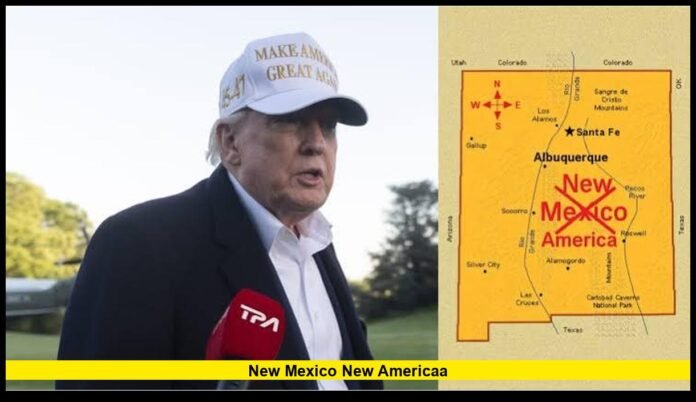

The debate over new mexico new america erupted across the United States after President Donald Trump suggested that New Mexico should be renamed “New America,” sharing a map and social media material promoting the proposed name. The idea immediately drew criticism from New Mexico officials, who emphasized that the state’s name is deeply connected to its history, culture and identity and cannot simply be changed by a presidential social media post.
Trump’s suggestion arrived during the Labor Day weekend and quickly became a national political story. The proposal also fits into a broader pattern of geographic renaming efforts pursued or promoted by the administration since Trump returned to the White House.
Although the president has taken executive action involving the names of certain federal geographic features, a state is fundamentally different. New Mexico is one of the 50 states of the United States, and its legal identity is not controlled by a presidential post or an executive order alone.
Trump Suggests “New America” for New Mexico
Trump raised the issue on social media by sharing an image showing the outline of New Mexico with the word “Mexico” crossed out and “America” inserted in its place.
The president later promoted the concept more directly, saying that people had suggested changing the state’s name and arguing that “New America” would be a more prestigious name. He also shared video material depicting the change on a New Mexico welcome sign.
The White House amplified the attention by reposting the map on its official social media account.
The posts created the impression that a possible name change was being considered at the highest level of the federal government. However, there was no announcement of a signed executive order legally changing New Mexico’s name, and the state continued to operate under its established name.
That distinction is crucial because social media activity does not have the legal effect required to rename a state.
New Mexico Has Not Been Renamed
Despite the attention generated by Trump’s posts, New Mexico remains New Mexico.
Residents, state agencies, schools, businesses and government institutions have not been instructed to replace the state’s official name with “New America.” There has also been no completed legal process establishing a new state name.
The president’s authority over federal agencies and certain geographic naming decisions does not extend to simply rewriting the names of states.
A state has its own government, constitution and legal framework. New Mexico joined the Union as the 47th state in 1912, meaning its identity is part of the constitutional structure of the United States.
For a genuine state name change to occur, considerably more would be required than a presidential announcement.
Governor Michelle Lujan Grisham Rejects the Idea
New Mexico Gov. Michelle Lujan Grisham was among the first prominent officials to respond.
The Democratic governor made clear that New Mexico’s name was not something she considered open for discussion. She pointed to the fact that the state’s name predates the United States itself and argued that attention should instead be directed toward concerns affecting working families.
Her response reflected the broader reaction from Democratic officials throughout New Mexico.
Rather than treating the proposal as a serious administrative initiative, state leaders largely characterized it as a political distraction. They also defended the historical and cultural significance of the existing name.
The governor’s response demonstrated that any attempt to move from a social media suggestion to an actual state name change would face substantial resistance inside New Mexico.
Members of Congress Defend the State’s Name
New Mexico’s congressional delegation also responded forcefully.
Sen. Martin Heinrich said he would continue using the traditional names of New Mexico, the Gulf of Mexico and Lake Ontario. Sen. Ben Ray Luján similarly rejected the proposed change and emphasized that New Mexico would remain New Mexico.
Rep. Melanie Stansbury argued that the state’s name represents generations of history, culture and family. Rep. Gabe Vasquez also defended the state’s identity and said that its name and heritage could not simply be erased.
The reaction showed that opposition was not limited to the governor’s office. Members of Congress representing New Mexico joined the debate, making clear that there is currently no bipartisan political movement inside the state supporting a name change.
Why the Name New Mexico Matters
New Mexico’s name has a much older history than the United States.
The name traces back to the Spanish term “Nuevo México,” which was used centuries ago during the period of Spanish exploration and settlement in the region.
The name survived major political transformations. The region later became part of Mexico before eventually becoming a U.S. territory. New Mexico was admitted to the United States in 1912.
That history makes the name particularly significant.
New Mexico’s identity reflects Indigenous cultures, Spanish traditions, Mexican history and the state’s development as part of the American Southwest. The name therefore represents much more than a reference to a neighboring country.
For many residents, “New Mexico” is inseparable from the state’s cultural heritage.
The state’s official nickname, the “Land of Enchantment,” further reflects its distinctive identity, including its landscapes, architecture, food, art and traditions.
Could a President Legally Rename a State?
One of the biggest questions raised by Trump’s proposal is whether a president has the authority to rename a state.
The answer is no—not through a social media post or unilateral executive action.
The Constitution establishes the framework for states and provides a process involving Congress when new states are admitted or when changes involving existing states occur. State governments also have their own constitutional and legislative procedures.
Renaming an existing state would therefore be a substantially different matter from changing the federal government’s terminology for a geographic feature.
Trump’s administration has already demonstrated that the White House can direct federal agencies to use particular names for certain locations. But that authority does not mean the president can independently change a state’s legal name.
Any serious proposal would need to go through a formal political and legal process.
The Proposal Comes After Other Trump Renaming Efforts
The New Mexico controversy follows several other naming disputes during Trump’s presidency.
Trump has promoted changes involving geographic locations, including the Gulf of Mexico, which his administration has sought to have federal agencies refer to as the Gulf of America.
The administration has also pursued the renaming of Lake Ontario as Lake America for U.S. federal purposes.
These decisions have generated arguments over presidential authority, national identity and the difference between names used by the U.S. government and names recognized internationally.
The New Mexico proposal goes further because it involves a state rather than a geographic feature.
That distinction could become increasingly important if the administration were to pursue the idea beyond social media.
Why “New America” Has Become a Political Flashpoint
The proposed name has become controversial because it touches on questions of history, identity and political symbolism.
Supporters of Trump’s approach may see the idea as an effort to emphasize American national identity. Critics view it as an attempt to disregard the state’s Hispanic, Indigenous, Spanish and Mexican historical influences.
New Mexico occupies a unique position in American history because its cultural development stretches across several political eras.
The state’s name survived Spanish rule, Mexican independence, territorial expansion and eventual U.S. statehood.
Changing it would therefore carry cultural consequences beyond simply replacing words on maps.
For opponents, the proposal represents an attempt to remove a historic connection. For supporters, the concept may represent a symbolic effort to emphasize American sovereignty.
That competing interpretation has helped turn a social media post into a much larger political discussion.
No Formal Renaming Process Has Begun
Despite the national attention, there is currently no completed process that would transform New Mexico into New America.
There is no newly adopted state constitution using the proposed name. There is no state law establishing “New America” as the official designation, and there has been no successful congressional process accomplishing such a change.
The existing name remains in use across official state operations.
That means residents should not assume that government documents, addresses, school records, business registrations or other records are changing.
Any meaningful development would require formal announcements from state and federal authorities.
What Would Happen If a Name Change Were Seriously Proposed?
If political leaders actually attempted to change the name, the process would likely involve multiple levels of government.
New Mexico would have to consider the proposal through its own political and constitutional system. The state Legislature could become involved, and depending on the legal mechanism selected, voters could potentially have a role.
Congress would also have an important role because the state’s legal relationship with the United States is established through federal law.
A genuine change would create a huge administrative workload.
Government documents, federal databases, maps, mailing systems, business records, educational materials, road signs and thousands of other references would potentially have to be updated.
The cost and complexity alone would make a state name change dramatically different from changing a label on a map posted online.
The Historical Debate Will Likely Continue
The controversy is unlikely to disappear immediately.
Trump has repeatedly demonstrated an interest in changing geographic names as a way of emphasizing national identity and presidential priorities. His supporters may continue promoting “New America” as a symbolic concept, while New Mexico officials are likely to continue defending the existing name.
For residents, however, the immediate reality is straightforward: the state is still officially called New Mexico.
The debate may generate additional political statements, social media posts and commentary, but those developments should not be confused with an actual legal change.
The state’s name has survived centuries of political transformation, and changing it would require a formal process far beyond the reach of a single presidential post.
What to Know About New Mexico Right Now
The new mexico new america controversy is currently a political dispute, not an official state name change.
President Trump has publicly promoted the idea of calling New Mexico “New America,” but the state continues to use its established name. Gov. Michelle Lujan Grisham and members of New Mexico’s congressional delegation have rejected the proposal, while emphasizing the historical importance of the state’s identity.
The suggestion has also reignited questions about presidential authority and the administration’s broader approach to geographic names.
For now, there is no legal basis for treating “New America” as the official name of the state.
New Mexico remains the 47th state admitted to the Union, and its established name continues to appear in government records, official communications and everyday life.
Whether the proposal develops into anything more substantial will depend on whether any formal state or congressional action follows. Until such action occurs, the map, documents and government records remain unchanged.
Final Takeaway
Trump’s suggestion has created an unexpected political debate over one of America’s most historically distinctive state names. The reaction from New Mexico’s elected leaders shows that a name change would face significant opposition, while the legal structure surrounding states makes a unilateral presidential renaming impossible.
For residents and observers, the key point is simple: the name has not changed.
The “New America” proposal currently exists as a political suggestion promoted by the president rather than an enacted change to the identity of the state. Any future development would require a formal legal pathway, official government action and potentially extensive political debate.
Until that happens, New Mexico remains New Mexico.