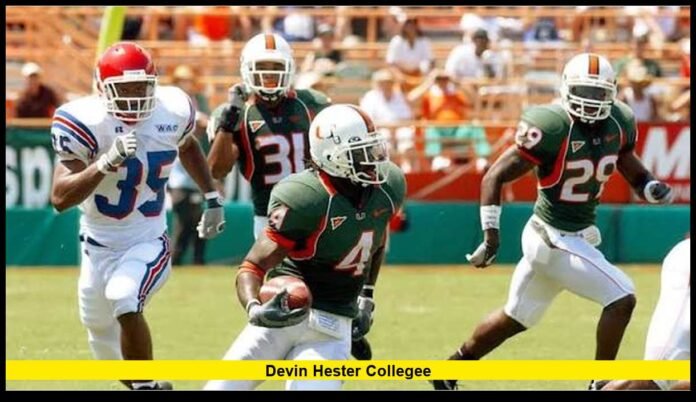

Devin Hester college career at the University of Miami established the foundation for one of the most extraordinary return careers in football. From 2003 through 2005, Hester showed an unusual combination of acceleration, instincts, versatility and athletic ability, becoming a dangerous weapon on special teams while also contributing as a receiver, runner and defensive back.
Devin Hester’s Road to the Miami Hurricanes
Before arriving in Coral Gables, Hester was already considered one of the most talented high school football players in the country.
The Riviera Beach, Florida, native attended Suncoast High School, where he demonstrated his ability to make an impact almost anywhere on the field. As a high school senior, he rushed for more than 1,000 yards, produced more than 1,000 receiving yards and also contributed heavily on defense.
His athletic ability extended beyond football. Hester was an accomplished track and field athlete, with elite speed and long-jump ability that helped explain why he attracted attention from major college programs.
Miami ultimately won his recruitment. He chose the Hurricanes over several other prominent programs, including Florida State, Georgia, Purdue and North Carolina State.
That decision brought one of the most dynamic athletes of his generation into a Miami program already known for producing elite football talent.
An Immediate Impact as a Freshman
Hester did not need several seasons to establish himself.
During his freshman season in 2003, Miami quickly discovered that his greatest immediate value could come on special teams.
He became one of the Hurricanes’ primary kickoff returners and finished the season with 18 kickoff returns for 517 yards, averaging 28.7 yards per return. That average ranked sixth nationally.
His most memorable freshman moment came against rival Florida.
Hester took the opening kickoff and raced 97 yards for a touchdown, instantly giving Miami a major momentum boost. The return became an early signature moment in what would eventually become a spectacular football career.
He also showed promise as a receiver. Hester caught four passes for 116 yards, averaging an impressive 29 yards per reception.
Although his offensive workload was limited, his explosiveness was impossible to overlook.
Miami had discovered a player who could change field position in seconds.
The Transformation During the 2004 Season
Hester’s sophomore season was where his national reputation truly took off.
The 2004 campaign turned him into one of the most dangerous return specialists in college football.
He became a regular presence on punt returns while continuing to handle kickoff-return responsibilities. His ability to accelerate through openings and create space made him exceptionally difficult for opposing special-teams units to contain.
Hester finished the season with 19 punt returns for 326 yards, averaging 17.2 yards per return. He scored three touchdowns on punt returns.
He also returned 15 kickoffs for 389 yards and added another kickoff-return touchdown.
That gave him four return touchdowns during the season, an extraordinary total.
A Historic Game Against Louisiana Tech
One of the most memorable performances came against Louisiana Tech.
Hester returned two punts for touchdowns in the same game, including a 92-yard return that tied a Miami school record.
The two-touchdown performance illustrated his ability to take over a game without needing a large number of offensive touches.
Instead of waiting for a receiver route or running play to develop, Hester could receive a punt and immediately create a scoring opportunity.
His performance against Louisiana Tech became one of the defining games of his Miami career.
The 100-Yard Return Against NC State
Hester produced another spectacular moment later in the 2004 season against NC State.
He returned the opening kickoff 100 yards for a touchdown, tying a Miami record.
The play was another example of his ability to turn a routine special-teams situation into an explosive scoring play.
By that point, opponents understood the danger associated with kicking directly to him.
Teams increasingly tried to avoid giving Hester a clean opportunity. Kicking away from him became a strategic consideration, but that approach could also provide Miami with advantageous field position.
His reputation alone was becoming an important part of Miami’s special-teams strategy.
Hester Was a Three-Phase Player
Although his return skills attracted the most attention, Hester’s college career was much broader.
Miami used him at several positions during the 2004 season.
He saw action at running back, fullback, nickelback and cornerback, while also contributing at receiver and on special teams.
That made him extremely difficult to categorize.
Hester wasn’t simply a returner waiting on the sideline for special-teams opportunities. He was an all-purpose football player who could be inserted into different roles depending on the matchup.
His defensive performance was particularly impressive.
He recorded four interceptions in 2004, leading the Hurricanes in that category. He also recorded tackles and pass breakups while contributing as a defensive back.
For a player already creating touchdowns on special teams, producing interceptions on defense added another layer to his value.
The Blocked Field Goal and Defensive Impact
Hester’s impact wasn’t limited to interceptions and returns.
During the 2004 season, he also made a memorable special-teams contribution by blocking a field goal.
In the Peach Bowl against Florida, Hester returned a blocked field goal 78 yards for a touchdown.
The play perfectly summarized his ability to recognize opportunities and turn them into points.
Whether the ball arrived through a punt, kickoff, interception or blocked kick, Hester possessed the speed and instincts to make something happen.
That versatility made him one of the most fascinating players in college football.
National Recognition Followed
Hester’s outstanding 2004 season brought significant individual recognition.
He earned first-team All-American honors as a return specialist from major organizations, including Walter Camp, the Football Writers Association of America and The Sporting News.
He was also selected as a first-team All-ACC kick returner.
His statistical production supported the recognition.
His 17.2-yard punt-return average ranked among the nation’s best, while his 25.9-yard kickoff-return average also ranked highly nationally.
More importantly, his four return touchdowns demonstrated a level of scoring efficiency rarely seen from a college returner.
Hester had become one of the players opponents specifically planned around.
His Track and Field Success
Football wasn’t Hester’s only athletic pursuit at Miami.
Following his freshman football season, he competed in track and field.
At the 2004 Big East Indoor Championships, Hester won the long jump with a mark of 7.37 meters. He also finished third in the 60-meter dash with a time of 6.82 seconds.
Those performances provided additional evidence of the physical gifts that had made him such a dangerous football player.
Speed was central to Hester’s identity, but his athleticism wasn’t limited to sprinting. His long-jump success demonstrated explosive lower-body power, while his football performances showed how effectively he could translate that athleticism into game situations.
The 2005 Season
Hester returned to Miami for his junior season in 2005.
By then, he was already one of the most recognizable players on the Hurricanes roster.
Opposing teams knew his reputation and often adjusted their kicking strategies accordingly. That made it harder for him to accumulate the same number of opportunities he had received earlier in his career.
Even so, Hester remained highly productive.
He recorded 22 punt returns for 312 yards, averaging 14.2 yards per return, and added another punt-return touchdown.
He also handled seven kickoff returns for 113 yards.
His opportunities were increasingly shaped by the attention he commanded from opposing teams, but the threat remained.
Every time Hester lined up to return a kick, there was a possibility of a momentum-changing play.
Complete Miami Career Statistics
By the time Hester completed his Miami career, his numbers reflected his unusual versatility.
His career totals included:
- 41 punt returns
- 638 punt-return yards
- 4 punt-return touchdowns
- 40 kickoff returns
- 1,019 kickoff-return yards
- 2 kickoff-return touchdowns
- 24 rushing attempts
- 160 rushing yards
- 10 receptions
- 196 receiving yards
- 5 interceptions
- 11 tackles
- 1 sack
His six return touchdowns were particularly significant.
Four came on punts and two came on kickoffs, showing that he was dangerous regardless of the type of return opportunity.
Miami’s official records also continue to place him among the program’s most productive return specialists.
What Made Hester Different?
Statistics only tell part of the story.
The biggest reason Hester became such a memorable player was the way he generated excitement whenever the football was in his hands.
Many returners possess speed. Hester combined speed with exceptional instincts.
He could identify an opening quickly, make a sharp cut and accelerate through a gap before defenders had enough time to react.
His vision also allowed him to recognize developing lanes rather than simply following a predetermined path.
That skill was particularly valuable on punt returns, where a small opening can disappear almost instantly.
Hester’s ability to turn a routine punt into a touchdown threat gave Miami an offensive advantage without requiring its offense to take a snap.
The Importance of His Miami Experience
Hester’s time with the Hurricanes also prepared him for the challenges of professional football.
Playing multiple positions forced him to learn different responsibilities. He had experience reading defenses as a returner and receiver, understanding coverage as a defensive back and handling the unique demands of special teams.
That broad football education helped make him an intriguing professional prospect.
NFL teams knew that Hester had extraordinary return ability, but they also understood that he had played several positions at Miami.
The question was not whether he could make explosive plays.
The question was how a professional team could maximize them.
From Miami to the NFL Draft
After three seasons with the Hurricanes, Hester entered the 2006 NFL Draft.
The Chicago Bears selected him in the second round with the 57th overall pick.
The selection eventually proved enormously valuable.
Hester immediately established himself as one of the most dangerous return specialists in professional football.
His NFL career included remarkable touchdown returns and multiple Pro Bowl selections before ultimately leading to his election to the Pro Football Hall of Fame as part of the Class of 2024.
The professional success made the significance of his Miami career even clearer.
The player who had dazzled college football fans with long returns and spectacular plays went on to establish records at the highest level.
Why Hester Remains a Miami Legend
Hester spent only three seasons at Miami, but his impact was substantial.
His career combined spectacular returns, defensive production, offensive contributions and track-and-field accomplishments.
Few players can point to such a diverse college résumé.
His name also remains closely connected with the tradition of Miami football.
The Hurricanes have produced generations of elite athletes, but Hester occupies a special place because his most memorable plays often happened when the ball was placed in his hands with no offensive blocking scheme designed around him.
He created opportunities himself.
That quality made him one of the most exciting players of his era.
Devin Hester College Legacy in 2026
Interest in Devin Hester college history remains strong in 2026, particularly as Miami continues to celebrate the players who helped define the program’s identity.
Hester’s legacy has also grown because of his place in football history beyond the college level.
His induction into the Pro Football Hall of Fame confirmed his status as one of the sport’s greatest return specialists. Yet his professional achievements don’t overshadow what he accomplished at Miami.
Instead, they reinforce the importance of the three seasons that came before them.
The same traits that made Hester dangerous for the Hurricanes eventually made him one of the most feared returners in NFL history.
His Miami career therefore represents more than a successful college stint. It was the beginning of a playing style that would become synonymous with explosive special-teams football.
A Lasting Hurricanes Legacy
Hester’s Miami career can be remembered through several defining numbers: 638 punt-return yards, 1,019 kickoff-return yards and six return touchdowns.
But the statistics don’t fully capture his influence.
He made opposing teams change their strategy. He gave Miami the ability to score without an offensive possession. He contributed on defense and offense. He excelled in track and field. And he established a reputation for explosive plays that followed him throughout his professional career.
His freshman kickoff return against Florida provided an early glimpse of what was coming. His four-return-touchdown sophomore season confirmed it. His final season cemented his status as one of the Hurricanes’ most dangerous special-teams players.
Hester’s career remains a reminder that one exceptional athlete can influence every phase of a football game.
What is your favorite Devin Hester memory from his Miami Hurricanes days? Share your thoughts and keep following for more stories about college football’s most unforgettable stars.