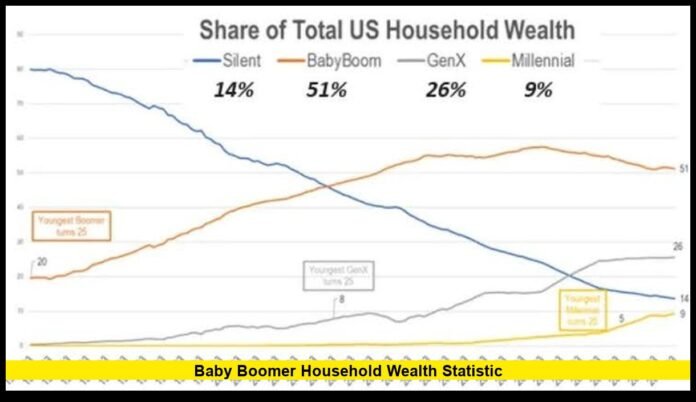

Baby boomer household wealth statistics remain a major focus of the U.S. economy as millions of Americans born between 1946 and 1964 move further into retirement and begin making decisions about housing, investments, spending and inheritance. The latest available data show that baby boomers continue to control an enormous share of American wealth, although the financial picture varies dramatically from one household to another.
The generation’s wealth has been built over several decades through homeownership, retirement accounts, business interests, stock-market investments and other assets. At the same time, wealth is heavily concentrated among the most affluent households, meaning that the financial experience of a wealthy boomer can look completely different from that of a retiree relying mainly on Social Security, a modest retirement account or home equity.
Key Points Summary
╔════════════════════════════════════════════════════════════════════╗
║ – Baby boomer households collectively held about $77 trillion in wealth in 2022. ║
║ – The median baby boomer household had about $432,200 in wealth in 2022, measured in 2024 dollars. ║
║ – The wealthiest 10% of boomer households controlled 71% of the generation’s total wealth. ║
║ – College-educated boomer households had substantially higher median wealth than those with less education. ║
║ – Federal Reserve data show household and nonprofit net worth reached $183.0 trillion in Q1 2026. ║
╚════════════════════════════════════════════════════════════════════╝
Baby Boomers Continue to Control a Huge Share of U.S. Wealth
The size of the baby boomer generation is only part of the explanation for its financial influence. Many members have spent 40 or more years accumulating assets, and that long period of saving and investing has allowed substantial wealth to build.
The Federal Reserve’s generation-based wealth data continue to place baby boomers at the top of the U.S. household wealth distribution. The generation is defined as people born from 1946 through 1964.
By the first quarter of 2026, baby boomers accounted for roughly half of U.S. household net worth under the Federal Reserve’s generation classification. That puts the generation well ahead of Gen X and younger generations in terms of total accumulated household wealth.
However, generation-wide figures should not be confused with the financial position of a typical individual.
A generation can control trillions of dollars while millions of households within that generation have comparatively modest savings.
What Is the Median Wealth of a Baby Boomer Household?
The median provides one of the most useful ways to understand the financial position of a typical household.
Federal Reserve data analyzed by Pew Research Center show that the median wealth of a baby boomer household was approximately $432,200 in 2022, expressed in 2024 dollars.
That number means half of comparable households had more wealth and half had less.
The distinction between median and average is particularly important when discussing wealth. Extremely wealthy households can cause an average to rise dramatically, making the average less representative of ordinary families.
For example, a household with several million dollars in investments and real estate can substantially affect an average calculation. The median is much less affected by those extreme values.
As a result, the $432,200 figure offers a more useful starting point for understanding the typical financial position of a boomer household.
Baby Boomers Collectively Held About $77 Trillion
The aggregate number is far larger.
In 2022, baby boomer households collectively owned approximately $77 trillion in wealth. That enormous pool of assets helps explain why the generation has become central to discussions about retirement markets, housing and the Great Wealth Transfer.
The figure includes the accumulated net worth of households across the generation rather than cash sitting in bank accounts.
Household wealth can include homes, retirement accounts, stocks, mutual funds, privately owned businesses and other assets, minus outstanding liabilities.
This distinction is important because someone can have a high net worth without having an equally large amount of readily available cash.
A homeowner, for example, may have substantial equity in a property while keeping relatively little money in a checking or savings account.
Wealth Is Extremely Unevenly Distributed
Perhaps the most important part of the data is the concentration of wealth within the generation.
The top 10% of baby boomer households controlled 71% of the generation’s wealth in 2022.
That means the remaining 90% of households shared less than 30% of the total.
This concentration explains why it can be misleading to describe baby boomers as uniformly wealthy.
Some households have substantial investment portfolios, multiple properties and significant retirement assets. Others may have limited savings and depend heavily on Social Security or other sources of retirement income.
The same generation can therefore contain both extremely wealthy households and financially vulnerable retirees.
Education Creates a Major Wealth Divide
Educational attainment is another major factor behind differences in wealth.
Baby boomer households headed by someone with a bachelor’s degree or higher had median wealth of approximately $1.08 million in 2022.
That was dramatically higher than the median for households whose heads had less education.
The figures illustrate how education, earnings and long-term access to investment opportunities can compound over an entire working life.
Higher education can lead to higher lifetime earnings, which can create greater opportunities to purchase homes, contribute to retirement accounts and invest in financial markets.
But education is not the only factor. Location, career choice, family circumstances, inheritance, debt and investment decisions can also have significant effects.
Housing Is One of the Biggest Sources of Boomer Wealth
Real estate has played a particularly important role in the financial story of baby boomers.
Millions of boomers purchased homes decades ago, often at prices that were substantially lower than today’s values. Over time, mortgage payments reduced outstanding debt while property appreciation increased equity for many homeowners.
For households that remained in the same property for decades, home equity can now represent a substantial portion of total net worth.
This has created an interesting financial situation.
A boomer may technically have hundreds of thousands of dollars in wealth tied to a home but may not feel wealthy in everyday life because that money is not immediately available for groceries, utilities or other expenses.
Turning housing wealth into spending money generally requires selling the property, downsizing, borrowing against the home or otherwise changing the way the asset is held.
Retirement Accounts Have Also Expanded Boomer Wealth
Retirement savings are another major component of the generation’s financial position.
Many baby boomers spent their working years contributing to employer-sponsored retirement plans such as 401(k)s, as well as individual retirement accounts and other investment accounts.
Some older workers also benefited from traditional pension plans that provide income during retirement.
Investment returns over several decades can make a major difference. Someone who consistently invested during their working years had substantially more time for compound growth than a person who started saving late in life.
At the same time, not every boomer accumulated a large retirement portfolio. Employment interruptions, lower wages, caregiving responsibilities, debt and limited access to employer-sponsored plans can all affect retirement savings.
The Federal Reserve’s Latest Wealth Picture
The broader U.S. household balance sheet remains enormous.
The Federal Reserve reported that household and nonprofit net worth reached $183.0 trillion in the first quarter of 2026.
That figure represents the value of assets minus liabilities for households and nonprofit organizations. It is broader than the wealth attributed specifically to baby boomers.
The latest data also demonstrate how quickly household wealth can change.
Stock-market movements can raise or reduce the value of retirement accounts and investment portfolios, while changes in real estate prices can affect homeowners’ equity.
Consequently, wealth statistics should always be viewed as snapshots rather than permanent measures of financial security.
Why the Wealth Gap Within the Generation Matters
The concentration of wealth has important implications for retirement.
A household with several million dollars in financial assets may have significant flexibility when markets fluctuate or unexpected expenses appear. A household with a paid-off home but little liquid savings may face a very different retirement experience.
The distinction also matters when discussing inheritance.
If most wealth is concentrated among the top 10%, the largest inheritances are likely to come from a relatively small group of families.
This does not mean ordinary families will receive nothing. Even a modest home, retirement account or investment portfolio can represent a meaningful transfer to children or grandchildren.
But the size of that transfer will vary enormously.
The Great Wealth Transfer Is Becoming More Important
Baby boomer wealth has become closely connected to the expected Great Wealth Transfer.
As boomers age, assets will increasingly move between generations through inheritances, gifts, property transfers and other forms of estate planning.
The process will not happen all at once.
Some boomers will use much of their wealth during retirement. Others may sell homes and downsize. Some will transfer assets while they are alive, while others will pass wealth through estates.
Healthcare costs, long-term care, inflation, taxes and longevity can all influence how much money remains available for heirs.
This is why the headline figure for boomer wealth should not be treated as a prediction of how much younger Americans will eventually inherit.
Why Younger Americans Are Watching Boomer Wealth
The financial position of baby boomers has become increasingly relevant to younger generations, particularly as housing affordability and retirement costs remain major concerns.
A large number of younger households are trying to build wealth while facing high home prices, substantial living expenses and different labor-market conditions from those experienced by earlier generations.
Meanwhile, many boomers own homes and financial assets that have appreciated significantly over their lifetimes.
The eventual transfer of those assets could provide financial assistance to younger Americans, but it may also reinforce existing inequalities if the largest inheritances flow primarily to families that are already financially secure.
Baby Boomers and the Housing Market
Boomer wealth also has implications for the housing market.
Older homeowners may remain in their properties for many years, especially when they have low mortgage balances or no mortgage at all.
Others may eventually sell, downsize or move closer to family.
When those properties enter the market, they can create opportunities for younger buyers. But housing supply, location, home prices and mortgage rates will determine whether those homes become genuinely affordable.
A major wave of downsizing is therefore not guaranteed to solve the country’s housing affordability problems.
Why Net Worth Does Not Equal Retirement Income
One of the biggest misunderstandings surrounding household wealth is the assumption that a high net worth automatically means high retirement income.
Net worth measures assets minus liabilities. It does not directly measure monthly cash flow.
A retired homeowner may have a valuable house but limited income. Another retiree may rent a home but have a large investment portfolio that generates income.
Social Security, pensions, investment withdrawals, rental income and part-time employment can all influence the amount of money available for everyday expenses.
This is why retirement security requires more than looking at a single wealth statistic.
How Baby Boomer Wealth Compares With Other Generations
Baby boomers remain well ahead of younger generations in accumulated wealth, largely because they have had much longer to build assets.
Gen X has gained significant wealth as its members move through their peak earning and asset-building years. Millennials and younger Americans are also accumulating wealth, but their shorter investment histories mean their total remains considerably smaller.
Generational comparisons should therefore be treated carefully.
Age itself is an important wealth-building factor. Older households have generally had more time to pay down mortgages, accumulate retirement savings and benefit from long-term investment growth.
The more meaningful question is often how each generation is performing at comparable stages of life rather than simply comparing total dollars today.
What These Numbers Mean for the U.S. Economy
The financial position of baby boomers can influence the broader economy in several ways.
Older households with substantial assets may have greater capacity to spend on travel, healthcare, housing improvements, entertainment and other services.
Investment decisions also matter. When older investors sell assets to fund retirement, those transactions can affect financial markets, although market outcomes depend on many factors.
Housing decisions are similarly important. If large numbers of older homeowners sell properties, move or downsize, the effects can spread through local housing markets.
The generation’s wealth therefore matters beyond retirement planning.
Baby Boomer Household Wealth Statistics Still Tell Only Part of the Story
The latest baby boomer household wealth statistics show a generation with an extraordinary accumulation of assets, but they also reveal a major divide between the wealthiest households and everyone else.
The approximately $77 trillion held by boomers in 2022 demonstrates the scale of their economic position. The $432,200 median household figure provides a more realistic view of the typical household. And the fact that the top 10% controlled 71% of the total shows just how unevenly that wealth is distributed.
Those numbers are likely to remain important as boomers move deeper into retirement.
Housing decisions, investment withdrawals, estate planning and inheritance will gradually reshape where the generation’s wealth goes next. Some assets will be spent, some will remain invested and some will eventually pass to younger generations.
For younger Americans, the impact could be significant, but the benefits will not necessarily be evenly distributed. Families with valuable homes, large retirement accounts and substantial investment portfolios are positioned to transfer more wealth than households with limited assets.
Ultimately, the story is not simply about how much money baby boomers have. It is about where that wealth is located, who controls it, how long it lasts and what happens to it as the generation ages.
How do you think the aging of the baby boomer generation will reshape America’s wealth landscape? Share your thoughts and stay tuned for the latest updates on household wealth and the economy.