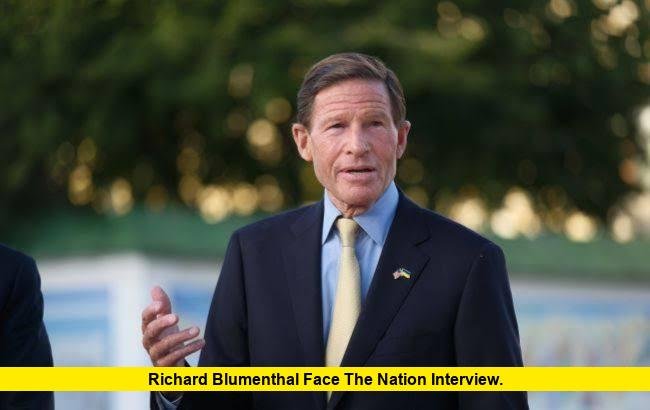

The richard blumenthal face the nation interview on Aug. 30, 2026, focused on the war in Ukraine, proposed Russia sanctions, U.S. military strength in Europe, immigration enforcement in Connecticut, and online safety for children. Democratic Sen. Richard Blumenthal of Connecticut spoke with moderator Margaret Brennan after returning from a trip to Ukraine.
The interview came as Congress faces renewed pressure over the Senate-passed Russia sanctions bill and as concerns grow about Russia’s military activity and the broader security of NATO’s eastern flank. Blumenthal also discussed recent Immigration and Customs Enforcement operations in Connecticut and renewed his call for passage of the Kids Online Safety Act.
Richard Blumenthal Returns From Ukraine
Blumenthal told Brennan that his recent trip to Ukraine gave him both encouragement and a closer view of the war’s human cost.
He traveled to Dnipro, a city near the front lines, where he visited a military hospital treating severely wounded Ukrainian troops. He also returned to Bucha, where he discussed the civilian killings and the continuing issue of Ukrainian children who were abducted during the war.
Blumenthal said Ukraine is making progress and described the country as turning the tide. At the same time, he emphasized the continuing destruction caused by Russian missile and drone attacks.
His comments came after a Russian drone attack west of Kyiv that Ukrainian officials said killed at least 38 people. The senator argued that the latest attack illustrated why Ukraine needs stronger air defenses and additional military capabilities.
During his meeting with Ukrainian President Volodymyr Zelenskyy, Blumenthal said he received what he described as a “homework assignment.” He identified three priorities: the Russia sanctions legislation, additional air defense for Ukraine, and Starlink capabilities.
The senator said those priorities were central to his discussions after returning to the United States.
Blumenthal Pushes House to Advance Russia Sanctions Bill
One of the most important parts of the interview involved the Russia sanctions legislation that has already passed the Senate.
Blumenthal urged the House to approve the measure. He argued that the legislation could put significant economic pressure on Russia and reduce the revenue available to support its war effort.
The Senate passed the bill by an 86-11 vote, giving the legislation substantial bipartisan support. Blumenthal emphasized that lawmakers from both parties participated in negotiations surrounding the measure.
The proposal includes stronger sanctions against Russian oligarchs and financial institutions. It also contains provisions aimed at Russia’s shadow fleet, which is used to transport oil and evade sanctions.
Another provision gives the president tariff authority involving major purchasers of Russian oil and gas. Blumenthal stressed during the interview that the authority is limited to the five largest purchasers. He also said European allies would not be subject to those tariffs under the measure.
The legislation nevertheless faces opposition among some House Democrats. Concerns have centered on the additional tariff authority that would be available to President Donald Trump.
Blumenthal rejected the idea that the legislation should be viewed primarily through that dispute. He argued that the bill was the product of extensive negotiations and that the immediate priority should be placing economic pressure on Russia.
Recent reporting has also highlighted Blumenthal’s expectation that the House could take up the legislation after Congress returns from its August recess. He has urged Zelenskyy to speak directly with House lawmakers, just as the Ukrainian president has addressed members of the Senate.
Why the Russia Sanctions Debate Is Important
Blumenthal described the current situation as an urgent moment in the war.
He argued that Russia is facing significant economic pressure and that additional sanctions could further restrict the money available to finance military operations.
During the interview, he cited a projected Russian deficit of $125 billion, equal to about 5% of GDP, along with a 14% interest rate on Russia’s national debt. Blumenthal presented those figures as evidence that economic pressure could have a meaningful impact on Moscow’s ability to sustain the war.
The senator’s position reflects the broader debate in Washington over how aggressively the United States should use economic tools against Russia.
The House must still decide whether to move forward with the Senate-passed legislation. Until that happens, the measure has not become law.
Blumenthal Warns Against Weakening U.S. Military Presence in Europe
The interview also turned to the U.S. military presence in Europe.
Brennan asked Blumenthal about reports involving a potential reduction in U.S. troop strength in Europe. The senator said he doubted Congress would approve a reduction at what he considers a particularly dangerous moment.
Blumenthal argued that Russia remains a serious threat and that reducing U.S. military strength in Europe could send the wrong message to Moscow and America’s European allies.
He also discussed a recent mission to Moscow by CIA Director John Ratcliffe. CBS reported during the program that Ratcliffe had warned Russia against attacking NATO member states.
Blumenthal questioned whether diplomatic warnings would be effective without stronger military backing. He argued that Russia responds to demonstrations of strength rather than words alone.
The senator called for more air-defense systems, including PAC-3 interceptors, as well as additional long-range artillery and other capabilities for Ukraine.
He also argued that Ukraine needs the ability to strike missile and drone launch sites and manufacturing facilities before attacks are launched.
Connecticut ICE Operations Become a Major Focus
The conversation then shifted from foreign policy to immigration enforcement in Connecticut.
Brennan asked Blumenthal about recent ICE operations in Danbury, Bridgeport and Stamford. She noted that local officials said the operations occurred without advance notification to the cities.
Blumenthal said he had not received detailed information from ICE. However, he said he understood that approximately 100 people had been detained or arrested.
He also claimed that only a small portion of those detained had criminal histories. He estimated that the number was roughly six or seven people.
Blumenthal strongly criticized the way he said the operations were being conducted.
He argued that the enforcement actions did not match the administration’s description of targeting people with serious criminal histories. He also said some people detained had legal status or had entered the country while seeking asylum.
Blumenthal described the enforcement approach as “repugnant and inhumane” and said he intended to investigate the situation further.
He told Brennan that he planned to walk through Danbury with the city’s mayor the following day. He also said the Senate Permanent Subcommittee on Investigations, on which he serves, had been conducting forums concerning alleged abuses involving ICE.
Blumenthal said he hoped to hold a similar forum in Danbury or elsewhere in Connecticut later in the week.
Online Safety and the Kids Online Safety Act
The final major topic in the interview was children’s online safety.
Brennan asked Blumenthal about a recently announced $17 billion settlement involving Meta and states that had sued the company over child-safety concerns. The discussion focused on measures involving social-media use and potentially harmful product features.
Blumenthal welcomed the settlement but said it did not eliminate the need for federal legislation.
He pointed to several limitations. The settlement covers Meta rather than the entire social-media industry. It also addresses only certain product-design features and has a 10-year duration.
Blumenthal argued that technology will continue changing during that period.
His conclusion was direct: he still believes Congress needs to pass the Kids Online Safety Act.
The legislation has been a major policy priority for Blumenthal. He said during the interview that he would continue working with Republican Sen. Marsha Blackburn of Tennessee, his bipartisan partner on the issue.
Blumenthal said he remains hopeful that the legislation can advance through both chambers of Congress.
What the Interview Revealed About Blumenthal’s Current Priorities
The latest interview showed Blumenthal concentrating on several issues that extend across foreign and domestic policy.
His immediate foreign-policy priority is pushing the House to act on the Russia sanctions bill. He also wants continued U.S. support for Ukraine’s air defenses and military capabilities.
At the same time, he is closely focused on the U.S. military presence in Europe. His comments indicate opposition to reducing American force levels while Russia remains a significant threat to NATO.
Immigration enforcement represents another major concern. Blumenthal intends to investigate recent ICE operations in Connecticut and seek additional information about those detained.
Online child safety remains a separate legislative priority. Despite the new Meta settlement, he continues to argue that federal legislation is necessary because individual corporate agreements cannot address every social-media platform or future technology.
Where the Russia Sanctions Bill Stands
The Senate’s 86-11 vote represents the most important legislative milestone discussed in the interview.
However, Senate approval alone does not make the bill law. The House must still consider the measure, and disagreements over presidential tariff authority could affect its path forward.
Blumenthal’s comments suggest that he intends to continue working across party lines to build support.
The senator’s appeal to Zelenskyy to speak with House members also underscores the importance Ukraine’s government places on congressional support.
For Blumenthal, the sanctions debate is directly connected to the broader question of how the United States can pressure Russia without weakening support among American allies.
Why the Aug. 30 Interview Matters
The latest interview was significant because it brought several current policy disputes together in one conversation.
Blumenthal had just returned from Ukraine, giving him a recent firsthand view of the war. He used that experience to reinforce his argument for sanctions, air defenses and continued American involvement in European security.
The discussion also provided a current look at his domestic priorities. His comments about ICE operations in Connecticut showed that immigration enforcement remains a major concern for him at home.
His final discussion about online safety demonstrated that he is continuing to pursue legislation aimed at protecting children from harmful social-media design and content.
The Aug. 30 appearance therefore offered a broad snapshot of the issues Blumenthal is emphasizing as Congress prepares for its next phase of legislative activity.
For readers searching for the latest richard blumenthal face the nation interview, the key takeaway is that the Connecticut senator used his appearance to press Congress on Russia sanctions, defend continued support for Ukraine, oppose a reduction in U.S. military strength in Europe, criticize recent ICE enforcement operations in Connecticut, and renew his push for federal online-safety legislation.
What do you think about Richard Blumenthal’s latest positions on Ukraine, immigration enforcement and online safety? Share your thoughts and stay tuned for confirmed updates.