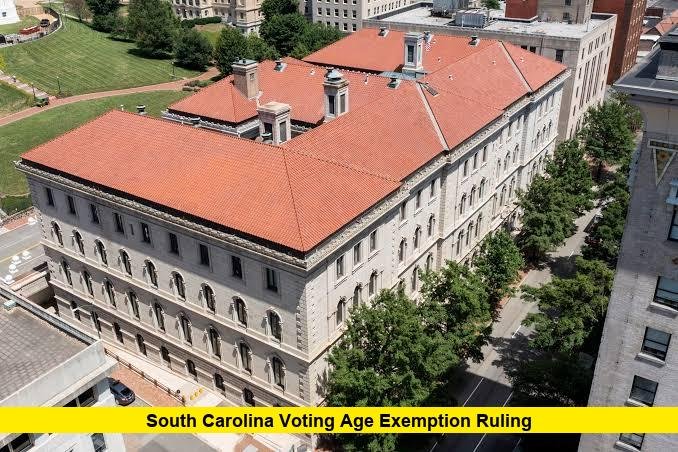

The South Carolina voting age exemption ruling has thrown out a decades-old rule that let voters 65 and older cast absentee ballots without restriction. On August 18, 2026, a three-judge panel of the U.S. Court of Appeals for the Fourth Circuit held that the state’s age-based carve-out violates the 26th Amendment.
What The Court Decided
The case, Grant v. Belangia, centered on a group of registered South Carolina voters, all under 65, who challenged the state’s absentee-by-mail system. Under the old law, voters 65 and older could vote by mail for any reason at all.
Younger voters faced a much narrower path. They needed to prove a specific excuse, such as a documented disability, active military service, hospitalization near Election Day, or a work conflict that kept them away from the polls.
Judge Roger Gregory wrote the panel’s opinion, joined by Judges Pamela Harris and Julius Richardson. The panel found that this two-tier system directly abridges younger citizens’ right to vote based on age, a result the 26th Amendment explicitly forbids.
Why The 26th Amendment Matters Here
Ratified in 1971, the 26th Amendment is best known for lowering the national voting age to 18. Its text also bars the denial or abridgment of voting rights “on account of age” for anyone 18 or older.
Legal analysts have called this ruling historically significant. Commentary tracking election law notes that this marks the first time since the early 1970s that a court has used the 26th Amendment to strike down a state law.
The panel rejected a separate argument that the law also violated the Equal Protection Clause of the 14th Amendment. Judges affirmed the lower court’s earlier dismissal of that claim, since age is not treated as a protected classification under equal protection analysis.
The Road To The Fourth Circuit
A group of Charleston-area voters originally filed this lawsuit in 2023 against the South Carolina State Election Commission. Stanford law professor Pamela Karlan worked on the case for the plaintiffs and argued that South Carolina stood apart from most states that allow broad absentee access without age-based restrictions.
The case first landed in the U.S. District Court for the District of South Carolina. Judge Bruce H. Hendricks ruled in favor of the state and dismissed both constitutional claims.
The plaintiffs appealed, and the Fourth Circuit reversed course on the 26th Amendment claim while leaving the equal protection dismissal in place.
What Changes For South Carolina Voters
The ruling does not force South Carolina to expand mail voting for everyone. Instead, it forces state officials to choose one of two paths going forward:
- Extend no-excuse absentee voting to all eligible voters, regardless of age
- Eliminate the automatic exemption and require every voter, including those 65 and older, to meet one of the existing excuse categories
Either option would end the current age-based distinction. State lawmakers and the South Carolina Election Commission will need to decide which route to pursue before the next statewide election cycle.
South Carolina’s Existing Absentee Categories
Before this ruling, only voters who fit into one of these groups could automatically request an absentee ballot without an excuse:
| Category | Requirement |
|---|---|
| Age 65+ | No excuse needed |
| Physically disabled | Documentation required |
| Armed Forces/Merchant Marines | Active service status |
| Hospitalized patients | Emergency admission near Election Day |
Voters outside these four groups needed to cite one of several additional excuses, including work conflicts, caregiving duties for a sick or disabled person, incarceration, or being out of the county during the voting window.
A Circuit Split That Could Reach The Supreme Court
Legal scholars tracking the decision say it creates a split among federal appeals courts on how the 26th Amendment applies to voting procedures. UC Davis law professor Vikram David Amar wrote that the bipartisan makeup of the panel strengthens the case for eventual Supreme Court review, possibly as soon as the Court’s October 2026 term.
South Carolina officials have signaled they intend to keep fighting the decision. State representatives have indicated plans to pursue further appeals, with the possibility of a Supreme Court petition.
The timing adds another layer of significance. This decision arrived the same week the Supreme Court sided with a separate push for tighter federal rules on mail-in ballots, keeping absentee voting policy squarely in the national spotlight.
Reactions From Legal Experts
Not every legal observer agrees with the outcome. Law professor Jonathan Turley, who has written extensively on the case, called the opinion well-reasoned but ultimately mistaken. He argued that South Carolina’s age-based accommodation reflected legitimate administrative efficiency rather than an abridgment of younger voters’ rights, since younger voters retain full access to in-person voting and several absentee excuse categories.
Supporters of the ruling counter that any law making it measurably harder for one age group to vote by mail than another falls squarely within what the 26th Amendment was written to prevent.
What Happens Next
The Fourth Circuit’s decision does not immediately rewrite South Carolina’s election code. The case now returns to the lower court, where officials must determine how to bring the state’s absentee voting rules into compliance with the appellate ruling.
South Carolina voters should watch for guidance from the State Election Commission in the coming months, particularly as the state weighs an appeal and works out its compliance strategy ahead of upcoming election cycles.
Given the possibility of Supreme Court review, this may not be the final word on how South Carolina — or other states with similar age-based exemptions — structure absentee voting access.
Have thoughts on how this ruling could reshape mail-in voting in South Carolina? Share your take in the comments and keep checking back for updates on this developing story.