
The Japan Tokyo earthquake today has become the top story across the country after a moderate but powerful tremor struck the greater Tokyo area early Sunday morning, injuring more than 30 people and disrupting daily life across the Kanto region. The Japan Meteorological Agency reported a preliminary magnitude of 5.9, while the United States Geological Survey recorded the event at a slightly lower magnitude of 5.8. The quake struck at around 2 a.m. local time, catching many residents off guard as they slept, and it was felt strongly throughout Tokyo, Saitama, Chiba, Kanagawa, and Ibaraki prefectures.
Officials confirmed that there was no tsunami danger from the quake, offering some reassurance to coastal communities. Even so, the shaking was intense enough to trigger emergency alerts on mobile phones across the region, waking residents and prompting an immediate response from local and national authorities.
Where the Earthquake Struck
According to the Japan Meteorological Agency, the epicenter of the quake was located in the southern part of Ibaraki Prefecture, an area northeast of Tokyo that is known for frequent seismic activity. The quake originated at a depth of roughly 68 to 70 kilometers, which is considered relatively deep for an earthquake of this magnitude. Deeper earthquakes often produce broader but somewhat gentler shaking at the surface compared to shallow quakes of similar strength, which may help explain why widespread destruction was avoided even though the tremor was felt across a wide swath of eastern Japan.
The Japan Meteorological Agency reported that shaking reached a lower 5 on Japan’s seven-level shindo intensity scale in parts of Tokyo’s Adachi Ward, as well as sections of Ibaraki, Saitama, and Chiba. Intensity level 4 was recorded in other parts of Tokyo and in Tochigi, Gunma, and Kanagawa prefectures. At lower 5 intensity, objects may fall from shelves, and people often need to hold onto something sturdy to keep their balance. In some areas, residents reported that the shaking lasted close to a minute, which added to the sense of alarm during the early morning hours.
Officials also noted that Tokyo’s 23 wards, along with Saitama and Chiba, experienced what is known as long-period ground motion at level 2. This type of slow, rolling shaking can cause high-rise buildings to sway noticeably, sometimes making it difficult for people on upper floors to stand steadily, even when the shaking at ground level feels moderate.
Injuries and Immediate Impact
Japan’s Fire and Disaster Management Agency reported that more than 30 people were injured across the affected prefectures, with authorities cautioning that the number could rise as further assessments continue. Most of the injuries were described as minor, with many people hurt after falling or bumping into furniture and doors while trying to get out of bed quickly in the middle of the night. Saitama and Kanagawa prefectures each reported roughly a similar number of injured residents, while additional injuries were confirmed in Chiba and Ibaraki.
One of the more serious cases involved an elderly woman in Yokohama who required medical attention, though officials have not released further details about the extent of her injuries. In Tokyo, several people became temporarily trapped in elevators when the shaking caused automatic safety stops, a common occurrence during moderate earthquakes in a city with thousands of high-rise buildings.
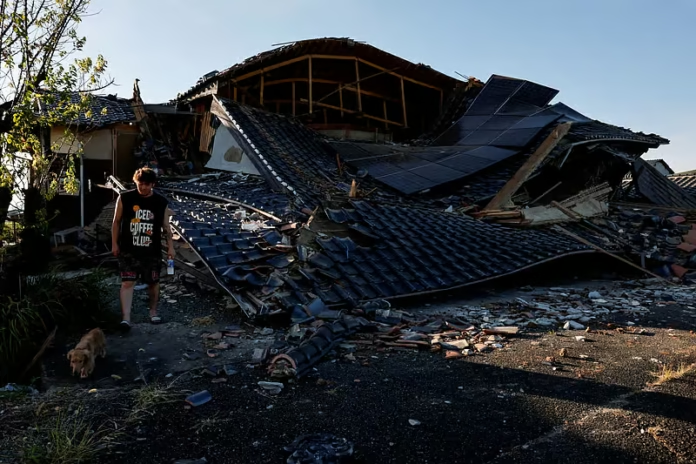
Property damage appears to have been limited overall, though isolated incidents were reported. In the city of Ushiku in Ibaraki Prefecture, part of a ceiling collapsed inside the city hall building. In Tokyo’s eastern Koto Ward, an underground water pipe ruptured, sending water flowing onto a nearby road. Repair crews were dispatched quickly, and the leak was brought under control within hours. Blackouts affected around 460 homes in Tokyo immediately after the quake, but power was restored to all affected households by later Sunday morning, according to TEPCO Power Grid.
Transportation and Public Services
The earthquake caused notable disruptions to rail service across the Kanto region during the early morning hours. Several JR East lines, including the Joban, Keihin-Tohoku, Shonan-Shinjuku, Musashino, Chuo-Sobu, and Sotobo lines, experienced delays as crews conducted safety inspections of tracks and infrastructure before resuming normal operations. Express trains serving Tokyo and Narita Airport were also affected. Shinkansen bullet train service, which is subject to strict safety protocols during seismic events, continued running normally after brief checks confirmed no damage to the high-speed rail infrastructure.
Japan’s Nuclear Regulation Authority stated that no abnormalities were detected at any of the roughly dozen nuclear power plants and facilities that handle nuclear materials in the region. This is a routine but important check following any earthquake of this magnitude, given Japan’s heightened attention to nuclear safety protocols.
Government and Official Response
Japanese authorities moved quickly to assess the situation following the quake. The government set up a task force to monitor damage reports and coordinate any necessary relief efforts, reflecting the standard emergency response procedure for earthquakes of this scale. Public broadcaster NHK aired continuous coverage in the hours following the event, showing largely normal traffic conditions in cities such as Mito and Saitama, suggesting that the broader transportation network outside of rail lines was not severely affected.
The Japan Meteorological Agency urged residents in areas that experienced strong shaking to remain alert for the possibility of another earthquake of similar magnitude occurring within the coming week. This kind of advisory is standard practice in Japan, where aftershock activity following a moderate quake can sometimes include tremors nearly as strong as the initial event. Residents in Ibaraki, Chiba, Saitama, and parts of Tokyo have been encouraged to secure heavy furniture, check emergency supplies, and review evacuation routes as a precaution.
Why This Earthquake Matters
Japan sits along the Pacific Ring of Fire, one of the most seismically active regions on the planet, and earthquakes of this size are not unusual. However, the fact that this particular quake struck so close to Tokyo, one of the most densely populated metropolitan areas in the world, has drawn significant public attention. Millions of residents felt the shaking directly, and the timing, in the early hours of Sunday morning, meant that many people experienced the quake while sleeping rather than during waking hours when they might have been more prepared to react.
The relatively limited damage and injury toll, especially when compared to Japan’s strict building codes and extensive earthquake preparedness infrastructure, highlights the effectiveness of the country’s long-standing investment in seismic-resistant construction and public education. Even so, officials continue to stress that residents should not become complacent, particularly with the possibility of aftershocks in the days ahead.
What Residents Should Know Going Forward
For those living in or near the Kanto region, staying informed through official channels such as the Japan Meteorological Agency and local government disaster prevention updates remains the best way to stay prepared. Authorities have not indicated any need for evacuations at this time, and transportation networks have largely returned to normal operation. Residents are advised to keep emergency kits accessible, ensure that heavy items in the home are secured, and remain aware of aftershock guidance issued by local officials in the coming days.
As assessments continue, the full scope of injuries and any additional infrastructure concerns may become clearer. At this time, there is no official confirmation of any deaths linked to the earthquake, and officials have indicated that the situation across the Kanto region remains stable.
Stay tuned for the latest updates on the Japan Tokyo earthquake today, and share your thoughts or experiences in the comments below.