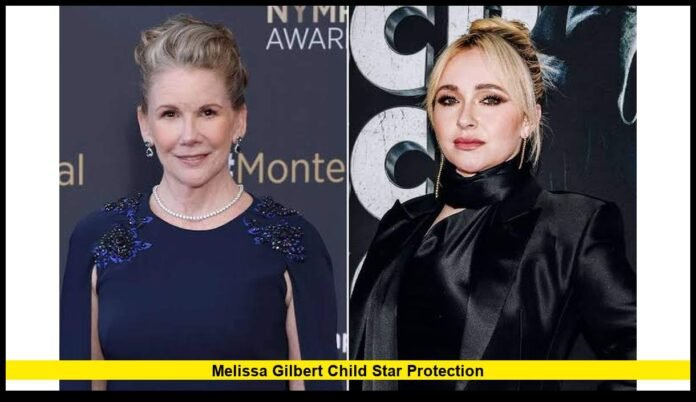

Melissa Gilbert child star protection has become a major topic after the Little House on the Prairie actress called for stronger safeguards for young performers following the deaths of Hayden Panettiere, Daveigh Chase and Michelle Trachtenberg. Gilbert has drawn on her own experience as a child actress while urging Hollywood to take greater responsibility for the well-being of children who work in entertainment.
Gilbert shared her latest thoughts in a Substack essay published Aug. 22, 2026. She described the recent deaths as deeply painful and questioned why former female child actors from her generation have faced such difficult outcomes. Her message focused on the need for meaningful industry changes rather than simply remembering young performers after tragedy strikes.
The actress has also supported fellow former child star Anna Paquin, who recently spoke publicly about the dangers she experienced growing up in Hollywood. Paquin said young performers were not adequately protected by systems that were supposed to safeguard them.
Gilbert’s response has helped bring renewed attention to the responsibilities of studios, networks, parents and other adults involved in the careers of child actors.
Melissa Gilbert draws from her own childhood in Hollywood
Gilbert knows the pressures of child stardom firsthand.
She began working in entertainment as a young child before becoming internationally recognized as Laura Ingalls Wilder on NBC’s Little House on the Prairie. The series ran from 1974 to 1983, and Gilbert grew up in front of television audiences.
That experience now shapes her perspective on the treatment of young performers.
Gilbert has emphasized that children who work in Hollywood remain children, regardless of how successful they become. Professional contracts, television ratings and financial opportunities do not change the need for adults to protect a child’s physical and emotional well-being.
Her recent comments reflect concerns that have followed her throughout her career. She wants young performers to have adults around them who can establish boundaries, recognize warning signs and make decisions based on the child’s interests.
Gilbert’s message also stresses that fame should not require a child to surrender ordinary childhood experiences.
The deaths that prompted Gilbert’s latest comments
Gilbert’s latest essay came after the deaths of three former female child performers: Michelle Trachtenberg, Daveigh Chase and Hayden Panettiere.
Trachtenberg died at 39 in February 2025. Chase died at 35 in June 2026. Panettiere died at 36 in August 2026.
Gilbert referenced all three women in her essay and described their deaths as painful losses for people who shared the experience of growing up as professional performers.
Her comments do not establish childhood acting as the cause of their deaths. Instead, Gilbert is asking Hollywood to examine whether young performers receive enough protection while they are working and during the difficult transition into adulthood.
That distinction is central to her argument.
Childhood fame does not automatically lead to adult problems. Many former child actors build successful and stable lives. Gilbert’s concern centers on the systems surrounding young performers and whether those systems do enough to protect vulnerable children.
Gilbert calls for stronger mental health support
One of Gilbert’s clearest recommendations involves mental health care.
She wants the entertainment industry to establish accessible mental health support for child actors, including assistance that continues as they move into young adulthood.
A child performer can experience intense pressure at an age when emotional development is still taking place. The demands of filming, publicity, school and public attention can create an unusual lifestyle.
Gilbert believes professional support should not disappear when a production ends.
A young actor may spend years surrounded by agents, producers, directors and other professionals. When a show ends or a career changes direction, that network can suddenly become much smaller.
The transition can be especially difficult for performers who have spent much of their childhood identifying themselves through their work.
Gilbert’s proposal would give young actors access to resources before problems become severe.
Her focus is therefore on prevention, support and continuity.
Why privacy has become another concern
Gilbert has also highlighted the effect of modern technology on young celebrities.
Smartphones and social media have changed celebrity culture dramatically. People can record and distribute images almost instantly, creating a level of public exposure that did not exist during Gilbert’s childhood.
She argues that young performers now face an environment in which privacy can be extremely difficult to maintain.
A child who becomes famous can attract attention both while working and during private moments. Social media can also turn ordinary incidents into widely shared content within minutes.
Gilbert believes Hollywood needs to recognize this change and provide stronger protection for young performers.
She wants children to have space away from their professional identities.
For a young actor, that means having opportunities to attend school, spend time with friends and develop a personality outside the entertainment business.
Gilbert says children need the ability to say no
Another important element of Gilbert’s message is the importance of boundaries.
She argues that child performers should be able to say no when they feel uncomfortable, overwhelmed or unsafe.
Production schedules can create enormous pressure. A television show or movie may involve dozens or hundreds of workers, making a young actor’s availability important to the entire production.
However, Gilbert believes that pressure should never override the needs of a child.
Young performers may not have the experience to challenge adults in positions of authority. They need trusted adults who can speak on their behalf.
That responsibility can involve parents, guardians, representatives and production personnel.
Gilbert’s broader point is that a successful child actor should never be treated like an adult simply because the child earns professional income.
The entertainment industry must recognize the difference between professional responsibility and childhood development.
The role of parents in child stardom
Gilbert has also spoken about parents and the role they play in protecting young performers.
Her comments following Daveigh Chase’s death included concerns about stage parenting. Gilbert had worked with Chase on a television pilot more than two decades ago and later reflected on what she remembered from that experience.
She stressed that responsible parenting can make a major difference in a young performer’s life.
Parents can help establish limits around work, publicity and finances. They can also recognize when a child needs time away from the industry.
Gilbert has made clear that child stardom itself does not guarantee dysfunction.
Instead, she believes the environment surrounding a young actor matters enormously.
A supportive family can help a child understand that acting is a job rather than the entire foundation of their identity.
That perspective can become particularly important when a child becomes successful at an early age.
Gilbert wants Hollywood to examine exploitation
Gilbert’s current advocacy goes beyond individual parenting decisions.
She is asking studios and networks to examine the broader culture surrounding young performers.
Her argument is that the industry should actively work to reduce exploitation rather than relying only on existing rules.
Young actors can hold significant financial value for productions. That can create situations where commercial priorities compete with a child’s needs.
Gilbert wants the entertainment business to recognize that young performers require additional protection because of their age.
She has encouraged industry leaders to have serious discussions about practical changes.
Those conversations could include mental health resources, privacy protections, working conditions and support during the transition into adulthood.
Her goal is not to prevent children from entering entertainment.
She wants children who do enter the industry to receive stronger support while they are there.
Anna Paquin adds another former child star’s voice
Gilbert’s latest comments followed a public statement from Anna Paquin.
Paquin became famous as a child and won an Academy Award for The Piano at age 11. On Aug. 21, she discussed the difficulties associated with growing up as a young actress.
Paquin argued that former child performers were not as protected as they should have been. She also offered support to other former child actors who may have struggled with their experiences.
Her comments received support from several actresses who also worked as young performers.
Gilbert responded positively and indicated that she would address the subject herself.
That led to her Aug. 22 essay, which broadened the conversation to systemic protection and the responsibilities of Hollywood.
The connection between the two actresses is important because both experienced professional success at a young age. Their comments come from personal experience rather than speculation about what child performers face.
Gilbert wants former child stars to work together
Gilbert has also encouraged former child performers to unite.
Former child actors understand aspects of the entertainment industry that may be difficult for outsiders to recognize. They know what it means to work while attending school, deal with public attention and move from childhood fame into adult life.
Gilbert believes that collective experience could help push Hollywood toward practical reforms.
Former child stars could share lessons with younger performers and advocate for policies that improve safety and support.
Such cooperation could also help reduce the isolation that some former child performers may feel.
The message from Gilbert is that people who experienced childhood fame should not have to deal with its consequences alone.
The transition from childhood fame to adulthood
Growing up is difficult for everyone, but former child actors can face additional challenges.
A young performer may become identified with one character for years. Fans can continue associating that person with a childhood role even after the actor reaches adulthood.
Career opportunities can also change quickly.
A performer who once worked regularly may suddenly face fewer offers. That shift can affect income, identity and relationships with the entertainment industry.
Gilbert wants Hollywood to recognize this transition as an important period rather than simply ending its responsibility when a child reaches adulthood.
Her call for continuing mental health support reflects that concern.
The industry invests heavily in discovering and developing young talent. Gilbert believes it should also invest in helping those performers develop healthy lives beyond their careers.
What Melissa Gilbert’s message means for young actors
The current discussion does not mean that Hollywood should stop hiring children.
Instead, Gilbert’s position calls for stronger safeguards around the process.
Young performers can continue acting while receiving greater protection from excessive pressure, invasive attention and exploitation.
The most important elements of Gilbert’s proposal include:
- Accessible mental health resources.
- Stronger privacy protections.
- Greater respect for children’s boundaries.
- Responsible parental involvement.
- Better support during the transition to adulthood.
- More industry accountability.
- Greater cooperation among former child performers.
These ideas place the child’s welfare at the center of the entertainment process.
That is the change Gilbert wants to see.
Why Gilbert’s advocacy is receiving attention now
The timing of Gilbert’s comments has made the issue especially prominent.
The deaths of several former child performers within a relatively short period have renewed public discussion about childhood fame.
At the same time, Paquin’s decision to discuss her own experiences has encouraged other former child actors to speak publicly.
Gilbert has now added her own voice to that discussion.
Her message is particularly notable because she has spent decades reflecting on her own experience as a child performer. She is not calling for the end of child acting. She is calling for a system that recognizes the special responsibilities involved when children become professional entertainers.
Her latest essay makes clear that she wants action rather than silence.
The current focus on Melissa Gilbert child star protection
As of Aug. 23, 2026, Gilbert’s recent advocacy centers on improving protections for young performers rather than announcing a specific new Hollywood policy.
She has called for systemic changes, accessible mental health support, greater privacy and stronger efforts to reduce exploitation.
Those proposals have not become universal industry rules.
They represent Gilbert’s public call for Hollywood leaders, former child stars and families to take the issue more seriously.
Her argument also places responsibility on adults.
Children entering entertainment cannot be expected to understand every professional or financial consequence of fame. Adults around them must provide protection, guidance and boundaries.
For Gilbert, the recent deaths have made that responsibility impossible to ignore.
Her experience as Laura Ingalls Wilder remains one of the defining parts of her career. Now, she is using that experience to raise questions about what should happen behind the scenes when the next generation of children enters Hollywood.
The discussion she has started focuses on a simple principle: young performers deserve the chance to work, succeed and grow up without sacrificing their safety, privacy or well-being.
Do you think Hollywood needs stronger protections for child actors? Share your thoughts and stay updated as Melissa Gilbert continues speaking out on the issue.