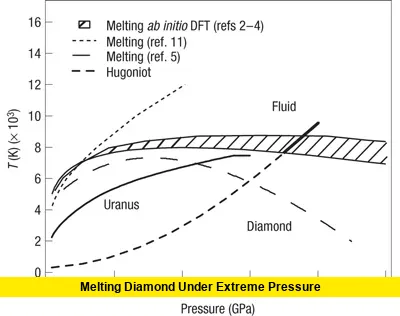

Diamond has always carried a reputation as the toughest material on Earth, the gem that resists scratches, heat, and nearly everything else thrown at it. But new research reveals that under conditions extreme enough, even diamond gives way to liquid form, and scientists have just closed a two-decade gap between theory and experiment on exactly how that happens.
On August 13, 2026, researchers at Lawrence Livermore National Laboratory (LLNL) published a study in Nature Physics documenting how diamond melts under pressures roughly three times greater than those found at the center of the Earth. The findings resolve two long-standing puzzles that had frustrated physicists since the early 2000s, and they carry direct implications for both nuclear fusion energy and the hidden interiors of distant planets.
Why Diamond Is So Hard to Melt in the First Place
Under everyday conditions, diamond simply does not melt. Heating it in open air causes it to react with oxygen and burn away into carbon dioxide gas at around 800 degrees Celsius. Heating it in a vacuum instead triggers graphitization, a phase change into solid graphite at roughly 1,500 degrees Celsius, again without ever passing through a liquid state.
Reaching genuine liquid diamond requires an entirely different approach: pressures exceeding 120,000 atmospheres combined with searing heat. That extreme resistance comes from diamond’s atomic structure, where every carbon atom bonds tightly to four neighboring carbon atoms in one of the strongest covalent networks in nature. Breaking that lattice apart takes an extraordinary amount of energy, which is exactly why diamond remains the gold standard for cutting and industrial tools.
Inside the New Experiment
To study diamond at the pressures found deep inside planets and fusion capsules, the LLNL team turned to the Omega Laser Facility at the University of Rochester’s Laboratory for Laser Energetics. Scientists vaporized the outer layer of a tiny diamond sample, sending a powerful shockwave racing through its interior. The resulting conditions briefly reached temperatures hotter than the surface of the sun and pressures higher than those found at the centers of Neptune and Uranus.
The tricky part was measurement. These extreme states lasted for only a billionth of a second, and the team needed to capture X-ray diffraction data revealing the atomic structure in that fleeting window. According to lead author and LLNL scientist Marius Millot, this marked the first time shock-compressed diamond had been probed with X-ray diffraction all the way through the melting process. Carbon’s light, small atoms scatter very few X-rays, making the signal exceptionally faint and difficult to isolate.
Solving a 1,000-Degree Discrepancy
LLNL scientists first observed unusual diamond-melting behavior roughly 20 years ago, when Jon Eggert and colleagues found that diamond actually becomes denser as it melts. That is unusual for most materials, but not unheard of: liquid water is denser than ice, which is why ice cubes float. The same logic applies to diamond, meaning solid diamond would float on top of liquid carbon at high pressure.
That early discovery, however, produced a stubborn 20 percent gap between the observed and predicted melting temperature, a discrepancy no simulation could close, no matter how advanced. Separately, researchers at Sandia National Laboratories using the Z machine’s extreme magnetic fields found hints that diamond might pass through an intermediate crystalline phase before fully melting, though no one could directly confirm it with atomic-level measurements.
The new LLNL experiments resolved both mysteries at once. The refined X-ray diffraction data produced a melting-temperature measurement that agreed almost perfectly with quantum mechanical simulations, revealing that the original measurements had been off by more than 1,000 degrees. And rather than passing through an intermediate phase, the diamond samples stayed in their familiar cubic crystal structure right up until melting, with solid diamond and liquid carbon simply coexisting until the transformation completed. Researchers believe this happens because a single shockwave does not give the sample enough time to reorganize into another structure, effectively trapping it in the diamond lattice until it melts outright.
What This Means for Fusion Energy
The findings have immediate relevance for inertial confinement fusion, the approach used at the National Ignition Facility, where powerful lasers compress a diamond capsule surrounding fusion fuel. Melting that capsule into a smooth, uniform fluid during the initial shock is critical, since any imperfections in the implosion can cause a fusion reaction to fail.
Because the new data shows diamond melts reliably even with a slightly gentler initial shock, scientists say future implosions could use slower first shocks while still fully melting the capsule. A softer shock keeps the fusion fuel more compressible, and models suggest this approach could potentially triple the energy yield achievable with the same amount of laser energy, assuming other technical challenges can be managed.
What This Means for Ice Giant Planets
The research also gives planetary scientists a new tool for understanding worlds that remain largely inaccessible. Neptune and Uranus are thought to contain layers where extreme pressure and heat compress carbon into diamond, which then sinks toward the planetary core in a process nicknamed “diamond rain.” Since the LLNL experiments reached pressures beyond what is estimated to exist inside these ice giants, the new melting data gives researchers a firmer foundation for modeling how these planets formed and evolved over billions of years.
What Comes Next
The LLNL team plans to use the National Ignition Facility to push diamond experiments toward even more extreme, previously unreachable conditions. Future work will focus on how diamond capsules respond during later stages of fusion implosions and how much stress a diamond structure can withstand under repeated shockwaves before its atomic order finally breaks down.
The study, “Diamond melting in shock compression experiments at 1 TPa pressures,” appears in Nature Physics and was supported by LLNL’s Laboratory Directed Research and Development program, with contributions from Federica Coppari, Amy Lazicki, Yong-Jae Kim, Otto Landen, Vladimir Smalyuk, Peter Celliers, and others.
What do you think diamond’s hidden liquid phase means for the future of fusion energy? Drop your thoughts in the comments and stay tuned for more breakthroughs from the frontier of extreme-pressure physics.