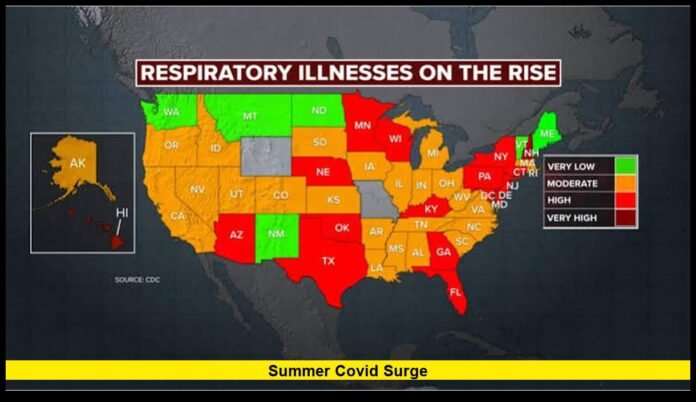

The summer covid surge is becoming a broader U.S. trend, with federal estimates showing COVID-19 infections growing or likely growing in all 50 states as of August 12, 2026. The latest national respiratory virus data also show COVID-19 activity increasing in parts of the country, particularly the West and South, even though overall respiratory illness remains very low.
The latest numbers do not indicate a return to the enormous COVID-19 waves seen earlier in the pandemic. Instead, they point to a renewed increase in transmission during a period when many Americans expected respiratory virus activity to remain relatively quiet.
That makes the current trend important to understand.
COVID-19 continues to circulate throughout the year, and summer transmission can rise even when influenza and RSV activity remain low. The latest surveillance picture shows why Americans should pay attention to local conditions rather than relying only on national headlines.
COVID-19 Infections Are Increasing in Every State
One of the most notable developments in the latest federal data is the direction of COVID-19 transmission.
As of August 12, federal estimates indicated that infections were growing or likely growing in all 50 states. No state was classified as having infections that were clearly declining or remaining unchanged.
That finding does not mean every state has a high level of COVID-19 activity.
The estimate measures the direction of transmission. A state can have relatively low overall infection levels while still experiencing an increase compared with previous weeks.
This distinction is especially important when interpreting reports about the current summer increase.
National transmission can rise without creating the same level of illness in every community. Local conditions can vary based on population density, travel, previous infections, vaccination levels and the particular variants circulating in an area.
The latest federal respiratory virus assessment, updated August 14, also shows that acute respiratory illness remains very low nationally. That means the increase in COVID-19 transmission has not translated into a broad national respiratory healthcare crisis.
The West and South Are Seeing Stronger Activity
Although transmission is increasing nationally, the West and South remain especially important areas to watch.
Federal respiratory surveillance shows COVID-19 activity increasing in these regions. That regional pattern has been developing during the summer and remains one of the clearest signs of where transmission is gaining momentum.
States can experience different trends even when they belong to the same broad region.
One metropolitan area may see a noticeable increase while another community nearby has much lower activity. This is one reason local wastewater information, testing trends and healthcare data can provide useful additional context.
The West and South also include major travel destinations.
Millions of Americans travel through states such as California, Florida, Texas, Arizona, Nevada and other heavily visited areas during summer. Large numbers of visitors can connect communities with different levels of virus circulation.
That does not mean travel itself causes COVID-19 increases. It does mean that movement between communities can help respiratory viruses spread.
Why COVID-19 Can Rise During Summer
COVID-19 has never behaved like a virus that disappears when temperatures rise.
SARS-CoV-2 can circulate during every season. Summer increases have occurred in the United States even when other respiratory viruses were at relatively low levels.
Several factors can contribute to summer transmission.
Travel is one obvious factor. Airports, hotels, restaurants, attractions and other crowded locations bring people from different regions together.
Large gatherings can also increase opportunities for exposure. Concerts, festivals, sporting events, weddings and family celebrations may involve people who would otherwise have little contact with one another.
Indoor environments remain relevant as well.
During periods of extreme heat, people spend more time inside homes, businesses, schools, entertainment venues and other air-conditioned spaces. Respiratory particles can accumulate more easily in poorly ventilated indoor environments.
Summer vacation schedules can add another layer.
Children may attend camps, teenagers may participate in activities and families may travel frequently. College students also begin returning to campuses toward the end of summer.
None of these factors guarantees infection.
Together, however, they create more opportunities for a virus that continues to circulate year-round.
The Current Increase Is Not the Same as Earlier COVID Waves
The latest numbers should be placed in context.
During the worst stages of the pandemic, COVID-19 produced extraordinary levels of hospitalization, intensive care use and death across the United States.
The current situation is not comparable to those periods.
Overall acute respiratory illness remains very low nationally. Current surveillance does not indicate the type of nationwide healthcare pressure associated with the largest pandemic waves.
Several factors have changed since 2020.
Population immunity is broader. Vaccines and antiviral medicines are available. Doctors have substantially more experience recognizing and treating COVID-19. Public health agencies also have more surveillance tools for monitoring transmission.
As a result, an increase in infections today does not necessarily produce the same number of severe outcomes that occurred during earlier pandemic waves.
That does not mean the virus has become insignificant.
COVID-19 can still cause serious illness, hospitalization and death, particularly among people with a higher risk of complications.
Older Americans Remain at Higher Risk
Age continues to be one of the strongest predictors of severe COVID-19 outcomes.
Adults 65 and older face a substantially greater risk of hospitalization and serious complications than younger adults. The risk becomes even higher among people in their 70s and 80s.
Underlying health conditions can add to that risk.
Certain heart and lung conditions, diabetes, kidney disease, obesity and other medical conditions have been associated with a higher risk of severe COVID-19.
People with weakened immune systems can also face greater danger from infection.
Residents of long-term care facilities may be particularly vulnerable because many are older and have multiple health conditions.
For these groups, a rise in community transmission can be more significant than the national respiratory illness level might suggest.
A relatively mild increase in infections can still result in serious cases among people who are more medically vulnerable.
Wastewater Is Helping Track the Increase
Wastewater surveillance has become one of the most useful tools for monitoring COVID-19 activity.
The system measures SARS-CoV-2 material found in wastewater collected from communities. It can provide an indication of virus circulation without requiring people to visit doctors or report their infections.
That matters because traditional case reporting has changed dramatically.
Many Americans now test at home. Others never test when symptoms are mild. Some people may not seek medical care at all.
Those infections can therefore remain outside traditional clinical reporting systems.
Wastewater can capture a broader community signal.
Federal wastewater data use categories ranging from very low to very high. The measurements are intended to help estimate infection risk within a community.
However, wastewater data should not be interpreted as an exact count of infected people.
Sampling coverage differs between communities. Results can also change as additional data become available.
The strongest interpretation comes from comparing wastewater trends with other indicators.
Hospitalizations Tell a Different Story
Infection levels and severe disease are not the same measurement.
A person can become infected without requiring medical attention. Another person can develop symptoms severe enough to require emergency care or hospitalization.
That is why hospitalization data remain essential.
If COVID-19 transmission increases but hospitalizations remain relatively stable, it can suggest that the rise is not producing a comparable increase in severe illness.
If hospitalizations begin rising sharply afterward, that would provide a different signal.
The latest national respiratory illness picture remains far below the most severe periods of the pandemic.
That is one of the key reasons the current increase should be described carefully.
There is evidence of increasing transmission. There is not evidence of a return to the healthcare crisis seen during the largest U.S. COVID-19 waves.
Read more – Covid Symptoms 2025: What You Need to Know Now
Variants Continue to Shape the COVID-19 Picture
SARS-CoV-2 continues to evolve as it spreads.
New lineages can emerge, compete with existing variants and become more or less common over time.
Federal genomic surveillance tracks these changes.
The goal is to identify whether circulating viruses have characteristics that could affect transmission, immune protection, testing or treatment.
JN.1-related lineages have continued to play an important role in the evolution of SARS-CoV-2.
BA.3.2 has also received attention because of its genetic differences from earlier lineages and its ability to evade some antibody responses in laboratory studies.
However, genetic differences alone do not establish that a variant causes more severe disease.
Scientists need real-world epidemiological and clinical information to determine whether a lineage produces different health outcomes.
The same principle applies to transmission.
A variant becoming more common does not automatically mean that it is inherently more dangerous. It may have an advantage in spreading among a population that already has substantial immunity.
That is why variant trends need to be interpreted alongside hospitalization and other severity indicators.
Symptoms Can Still Look Like Other Respiratory Illnesses
COVID-19 symptoms have changed somewhat across different stages of the pandemic, but many current infections still resemble ordinary respiratory illnesses.
Common symptoms can include:
- Cough
- Sore throat
- Runny nose
- Nasal congestion
- Fever
- Chills
- Fatigue
- Headache
- Muscle or body aches
- Shortness of breath
- Loss of taste or smell in some cases
Some people develop only mild symptoms.
Others can experience more significant respiratory problems.
Symptoms alone cannot reliably distinguish COVID-19 from influenza, RSV or other respiratory infections.
Testing is therefore useful when knowing the cause of an illness matters.
People who are at increased risk of severe disease should pay particular attention to the timing of symptoms because treatment options are most useful when started early.
Why Testing Still Matters
Home testing remains an important way to identify COVID-19 infections.
Rapid antigen tests can provide results quickly, but an early negative result does not always rule out infection.
If symptoms continue after an initial negative result, repeating the test can provide additional information.
A healthcare professional may also recommend a molecular test in certain situations.
Testing can be especially useful for people who live with older relatives or others at high risk.
Knowing that an infection is present can help someone make decisions about contact with vulnerable family members, workplaces and social activities.
It can also help high-risk patients seek treatment within the appropriate window.
Treatment Is Available for High-Risk Patients
Antiviral treatment remains an important part of modern COVID-19 care.
Paxlovid, which contains nirmatrelvir and ritonavir, is an oral treatment used for eligible people who have an increased risk of severe disease. It generally needs to be started within five days of symptom onset.
Remdesivir is another treatment option for eligible patients. It is administered intravenously and generally needs to begin within seven days of symptoms.
Molnupiravir can be considered in certain circumstances when other preferred treatments cannot be used.
Not everyone with COVID-19 needs antiviral treatment.
Eligibility depends on factors such as age, medical history and the risk of progressing to severe disease.
Medication interactions also matter. Paxlovid can interact with some commonly used medicines, so healthcare professionals may need to review a patient’s medications before prescribing it.
People at higher risk should contact a healthcare professional quickly if they develop symptoms and test positive.
Vaccination Guidance Has Become More Individualized
COVID-19 vaccination policy in the United States has changed as the virus has become a long-term respiratory threat.
Current guidance for the 2025–2026 vaccine uses individual-based decision-making for people ages 6 months and older. The potential benefit is considered more favorable for people at increased risk of severe disease.
Adults 65 and older are also included under individual-based decision-making.
The number and timing of doses can depend on age, previous vaccination and immune status.
People who are moderately or severely immunocompromised can have different vaccination needs.
Because recommendations can change as new vaccine formulations and public health information become available, people should check current guidance with their healthcare provider rather than relying on an older vaccination schedule.
What the Current Numbers Really Mean
The most important point is that increasing transmission does not automatically equal a severe nationwide outbreak.
The federal estimate that infections are growing or likely growing in all 50 states measures direction, not overall disease burden.
A state can have increasing transmission while still having a relatively low number of infections.
Likewise, rising infections do not automatically mean hospitals will become overwhelmed.
Several steps usually occur between transmission and severe outcomes.
People first become infected. Some develop symptoms. A smaller proportion develop severe disease, and an even smaller proportion require hospitalization.
The risk varies substantially by age, health status and immune protection.
That is why public health experts examine several measurements together.
The Indicators to Watch Next
The direction of the current trend will become clearer as new data arrive.
Wastewater levels will be important because they can reveal changes in community virus circulation.
Emergency department visits can show whether more people are seeking care for COVID-19-related illness.
Hospitalizations can provide insight into the severity of infections.
Laboratory testing can help identify changes in positivity.
Genomic surveillance can reveal whether one variant is becoming dominant.
Transmission models can help estimate whether infections are still increasing.
No single measure provides the complete picture.
When multiple indicators move upward together, the evidence for a meaningful increase becomes stronger. If transmission indicators peak and begin falling while hospitalizations remain low, the situation may prove to be a limited seasonal increase.
Why Local Conditions Matter More Than Ever
National numbers provide useful context, but local conditions can be more relevant to individuals.
Someone living in a community with increasing wastewater levels may face a different exposure risk than someone living in an area where levels remain low.
Travel can also change that risk quickly.
A person may spend one week in a low-activity community and the next week at a crowded destination with higher transmission.
That is why checking local information can be more useful than assuming conditions are identical across the country.
Schools, workplaces, nursing homes and healthcare facilities may also experience different patterns depending on their populations and environments.
For people at higher risk, local transmission information can help guide decisions about gatherings, testing and contact with vulnerable relatives.
What to Expect as Summer Comes to an End
The next stage of the current increase will depend on whether transmission continues to climb or begins to stabilize.
Late August and early September bring another potential change in social patterns.
Students return to schools and colleges. Families resume normal work and school schedules. Indoor gatherings become more common in many parts of the country.
Those changes can influence respiratory virus transmission.
COVID-19 may therefore remain an important respiratory virus to monitor as summer transitions into fall.
The latest data do not establish how high transmission will eventually rise.
They do show that infections are currently moving upward, making continued surveillance important.
The Bottom Line for Americans
The latest U.S. data show a clear increase in COVID-19 transmission during August 2026, with federal estimates indicating growing or likely growing infections in every state.
At the same time, overall acute respiratory illness remains very low nationally.
The West and South are showing some of the clearest increases, while wastewater monitoring, emergency department activity, laboratory results and hospitalizations provide additional ways to track what happens next.
The current trend should be taken seriously without being confused with the enormous COVID-19 waves of the early pandemic.
For most Americans, the most useful steps are straightforward: know the symptoms, test when appropriate, pay attention to local conditions and seek medical advice promptly if you are at higher risk of severe disease.
People considering vaccination should use the latest age- and risk-based guidance when discussing their options with a healthcare professional.
COVID-19 remains capable of changing quickly, which makes current surveillance more useful than relying on comparisons with previous years.
Are you noticing a rise in COVID-19 cases or symptoms in your community? Share what you are seeing and stay informed as the latest U.S. trends develop.