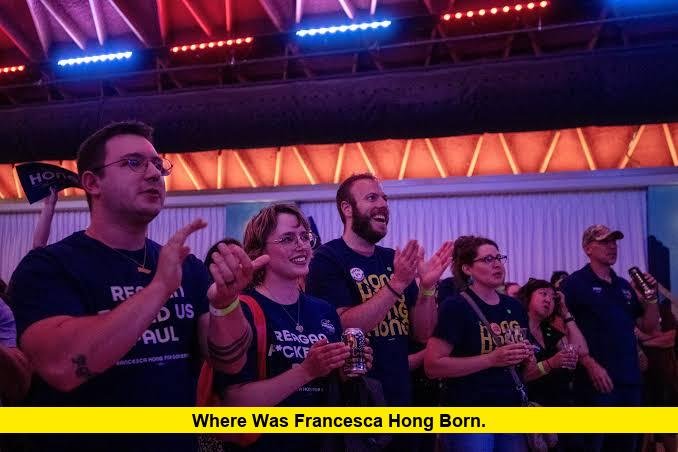

Francesca Hong, the Democratic Socialist state lawmaker turned frontrunner in Wisconsin’s 2026 gubernatorial race, was born on November 4, 1988, in Madison, Wisconsin. Her birthplace is more than a biographical footnote — it has become central to her political identity, shaping how she talks about the state, its working families, and the community that raised her. As Hong’s name spreads well beyond Wisconsin’s borders during a closely watched primary season, many people searching for information about her are asking the same basic question: where was Francesca Hong born, and how did that upbringing shape the candidate now competing to lead the state?
Madison Roots and a Family Built on Immigration
Hong was born and raised in Madison, the same city she now represents in the Wisconsin State Assembly. Her parents, Jinkuk and Youngjoo Hong, immigrated from South Korea in the 1980s so that her father could pursue a doctoral degree in sociology at the University of Wisconsin–Madison. The family settled near campus in the Eagle Heights community, a neighborhood historically home to many international graduate students and their families. It was there that Francesca and her younger sister grew up while their mother cared for the household and later pursued her own degree in education.
That immigrant story has become a defining piece of Hong’s public narrative. Her parents eventually became U.S. citizens, and her mother went on to teach public school music for more than a decade before completing a master’s degree in vocal performance. Hong has often credited her parents’ determination and sacrifice for shaping her own work ethic and political values, telling supporters at campaign events that her family “chose Wisconsin” because they believed in the opportunities the state could offer.
Growing up in Madison, Hong attended local public schools and graduated from Madison West High School in 2007, where she co-captained the varsity soccer team and worked part-time as a restaurant server. That early exposure to the service industry would end up steering the entire trajectory of her adult career, long before politics entered the picture.
From the Kitchen to the Capitol
After high school, Hong enrolled at the University of Wisconsin–Madison, where she studied journalism and Spanish. She eventually left school to pursue a full-time career as a chef, starting out washing dishes before working her way through a series of kitchen jobs across Madison. By age 23, she had become executive chef at 43 North, a well-regarded American bistro in the city. In 2016, Hong and her then-husband, Matt Morris, opened their own restaurant, Morris Ramen, which quickly became a local favorite.
Hong’s culinary career took an unexpected turn during the COVID-19 pandemic, when the shutdown forced her restaurant to close temporarily. In response, she co-founded Cook It Forward, a nonprofit that provided meals to Madison residents struggling during the crisis. That experience, she has said, exposed deep gaps in how the state supported workers and small businesses, and it pushed her toward public service. Her frustration with what she saw as inadequate government response became the catalyst for her first campaign.
In 2020, Hong ran for and won the seat representing Wisconsin’s 76th Assembly District, which covers downtown Madison, the city’s east side, and Maple Bluff. She took office in January 2021, becoming the first Asian American lawmaker in Wisconsin’s history — a milestone that remains one of the most frequently cited facts about her career. She was reelected without opposition in both 2022 and 2024, and during her time in the Assembly she has pushed for policies including raising the tipped minimum wage and, more recently, co-drafting legislation aimed at placing a statewide moratorium on new data center development.
Public Interest in Hong’s Background Grows With Her Campaign
Interest in where Francesca Hong was born and how she grew up has surged alongside her political rise. She entered the crowded Democratic primary for Wisconsin governor as a relative unknown but steadily built momentum as a self-described democratic socialist candidate, earning endorsements from Wisconsin-based chapters of the Democratic Socialists of America. Her campaign gained further traction after two of her better-known rivals stumbled: former Lt. Gov. Sara Rodriguez exited amid a campaign finance controversy, and former Lt. Gov. Mandela Barnes dropped out of the race in early August.
Polling throughout the summer consistently showed Hong with a commanding lead over the rest of the Democratic field. A Marquette University Law School poll put her at 38 percent support, well ahead of her closest rivals, while later internal and independent surveys showed her lead widening into double digits heading into primary day. Her rise has drawn national attention as a test of whether a democratic socialist can win statewide office in a perennial presidential battleground like Wisconsin — a question that has made her one of the most closely watched candidates of the 2026 election cycle nationally, not just within the state.
Hong’s identity as a Madison-born, second-generation Korean American has featured prominently in that coverage. She has spoken publicly about balancing pride in her Korean heritage with her identity as a lifelong Wisconsinite, and she has used her personal story — chef, small business owner, mother, and community organizer — to connect with voters frustrated by establishment politics. Some Democratic leaders, including outgoing Gov. Tony Evers, have publicly questioned whether Hong’s progressive positioning could hurt Democrats in a general election matchup, particularly against Republican U.S. Rep. Tom Tiffany, who is running with the backing of President Donald Trump. Hong has pushed back on those concerns, arguing that voters are looking for candidates who prioritize working-class issues over establishment caution.
Latest Updates on the 2026 Wisconsin Governor’s Race
Wisconsin’s Democratic gubernatorial primary took place on August 11, 2026, pitting Hong against Milwaukee County Executive David Crowley and several other candidates for the right to face Tiffany in November. Heading into election day, Hong maintained a substantial polling advantage, with multiple surveys showing her lead expanding rather than narrowing in the campaign’s final stretch. As of this writing, there is no official confirmation of the final certified results, and readers following the race closely should check official Wisconsin Elections Commission sources or established news outlets for the most up-to-date tally as votes are counted.
If Hong secures the nomination, she would go on to face Tiffany in what is expected to be one of the most competitive and closely watched gubernatorial contests in the country this fall. A general election victory would make her the first woman and the first Asian American to serve as Wisconsin’s governor, as well as the first self-identified democratic socialist ever elected governor of any U.S. state — a distinction that has amplified interest in her Madison upbringing and personal story well beyond Wisconsin’s borders.
Final Thoughts
Francesca Hong’s birthplace of Madison, Wisconsin, is inseparable from the political identity she has built throughout her career. From a childhood shaped by her parents’ immigrant journey to a career in Madison’s restaurant industry and eventually a seat in the state legislature, Hong’s story reflects a deep, lifelong connection to the city and state she now hopes to lead. As the 2026 governor’s race continues to unfold, her Madison roots remain a central part of the narrative driving national attention toward her candidacy.
Stay tuned for the latest updates on Wisconsin’s 2026 governor’s race, and share your thoughts on Francesca Hong’s candidacy in the comments below.