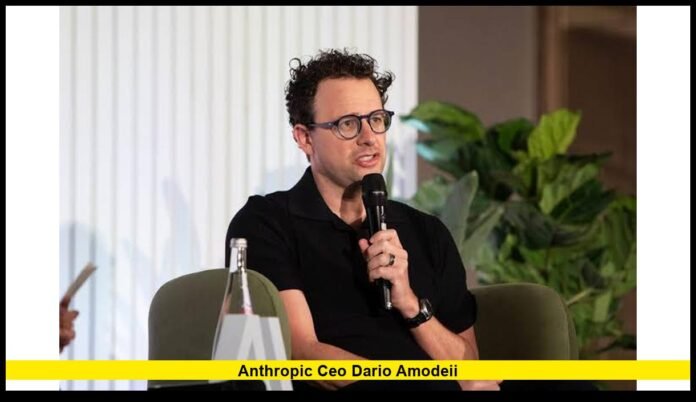

Artificial intelligence continues to reshape industries worldwide, and anthropic ceo dario amodei remains one of the most influential figures driving that transformation. As the co-founder and CEO of Anthropic, Amodei has built a company focused on creating powerful AI systems while emphasizing safety, transparency, and responsible development. Throughout 2026, he has remained at the center of discussions about AI regulation, talent competition, national security, and the future of work.
Key Points Summary
╔════════════════════════════════════════════════════════════════════╗
║ – Dario Amodei is the co-founder and CEO of Anthropic.            ║
║ – He previously led AI research at OpenAI before founding         ║
║   Anthropic in 2021 with former OpenAI colleagues.                ║
║ – Anthropic is known for developing the Claude family of AI       ║
║   models with a strong focus on AI safety and reliability.        ║
║ – In 2026, Amodei has continued advocating responsible AI         ║
║   development while expanding enterprise AI products.             ║
║ – He has recently commented on AI hiring, open-weight models,     ║
║   national security, and the future impact of AI on jobs.         ║
╚════════════════════════════════════════════════════════════════════╝
Who Is Dario Amodei?
Dario Amodei is an American artificial intelligence researcher, entrepreneur, and technology executive best known as the co-founder and chief executive officer of Anthropic, the company responsible for developing Claude AI. His work focuses on building advanced AI systems while improving their reliability, interpretability, and safety. As AI technology becomes increasingly important to businesses, governments, and consumers, Amodei has emerged as a prominent figure in discussions about the future of artificial intelligence.
Before establishing Anthropic, Amodei served as vice president of research at OpenAI, where he helped direct research into large language models, including GPT-2 and GPT-3. He also contributed to research on reinforcement learning from human feedback, commonly known as RLHF, a technique that helps train AI systems to produce responses that better reflect human preferences.
Amodei earned a doctorate in biophysics from Princeton University and subsequently worked as a postdoctoral researcher at Stanford University School of Medicine. Before joining OpenAI, he worked at Google Brain as a senior research scientist.
His academic background and experience in AI research have shaped his approach to developing advanced models. Today, Amodei oversees Anthropic’s research direction and long-term strategy as the company expands its AI products and enterprise services.
Founding Anthropic
Dario Amodei co-founded Anthropic in 2021 alongside his sister, Daniela Amodei, and several former OpenAI colleagues. The founders established the company with the goal of developing powerful artificial intelligence systems while placing considerable emphasis on safety, reliability, and responsible deployment.
Anthropic was created during a period of rapid progress in machine learning, when researchers were increasingly concerned about the potential risks associated with more capable AI systems. The company’s founders believed that AI development required not only improvements in performance but also research into how models behave, how their decisions can be understood, and how their capabilities can remain subject to appropriate human oversight.
Anthropic subsequently attracted substantial investment from major technology companies and other investors. Its development has been supported by partnerships and infrastructure agreements that help it train and operate increasingly capable models.
The company also adopted a public benefit corporation structure, allowing it to consider its stated public-benefit mission alongside commercial interests. This structure reflects its intention to address the opportunities and risks associated with advanced AI.
Under Amodei’s leadership, Anthropic has expanded from a research-focused startup into a major AI developer. Its work now encompasses foundational model research, business applications, developer tools, and AI safety evaluations.
Claude AI and Anthropic’s Growth
Anthropic is best known for developing Claude, a family of artificial intelligence models and assistants designed for writing, reasoning, coding, research, and other knowledge-based tasks. Claude has become a central part of the company’s business strategy, serving individual users, software developers, and organizations that want to integrate AI into their operations.
Claude is designed to assist with activities such as summarizing documents, analyzing information, generating computer code, answering questions, and helping users work through complex problems. Anthropic also provides developer interfaces that allow businesses to incorporate Claude’s capabilities into their own applications and workflows.
The company has placed particular emphasis on coding and enterprise applications. AI-assisted software development is an important area of competition because companies increasingly use models to help write, review, explain, and troubleshoot code. Claude’s capabilities in this area have contributed to its visibility among developers and technology businesses.
Anthropic also develops tools intended to help organizations deploy AI systems within existing business environments. These applications can support customer service, document processing, research, and internal productivity, although performance and suitability depend on the task and implementation.
As competition intensifies across the AI industry, Anthropic must continue improving model capabilities, reliability, security, and cost efficiency. Claude’s development therefore remains closely connected to Amodei’s broader strategy of combining advanced AI research with commercial products.
Leadership Style
Dario Amodei is widely associated with an approach to AI development that emphasizes technical progress alongside safety research. His public writing and interviews have frequently addressed the potential benefits of advanced AI, the possibility of serious risks, and the need for institutions to prepare for technological changes that may occur rapidly.
At Anthropic, this approach is reflected in research into model interpretability, alignment, evaluations, and methods for making AI systems more predictable. Interpretability research seeks to improve understanding of the internal processes behind model behavior, while alignment research examines how AI systems can be trained to follow appropriate objectives and constraints.
Amodei has also discussed the importance of government engagement and public policy. As AI capabilities advance, questions about cybersecurity, economic disruption, national security, and the concentration of technological power have become increasingly relevant to policymakers.
However, balancing safety with commercial competition presents a practical challenge. AI companies need to improve their products, attract skilled employees, secure computing resources, and meet customer demand while evaluating emerging risks.
Amodei’s leadership involves managing these competing priorities. Anthropic’s decisions about model releases, safety testing, infrastructure spending, and business expansion provide a practical measure of how the company implements its stated principles. Its approach continues to attract attention from researchers, investors, customers, and policymakers who are evaluating the responsibilities of frontier AI developers.
Latest News About Dario Amodei in 2026
Dario Amodei and Anthropic have remained in the spotlight as the company expands its commercial operations and addresses questions about the risks associated with increasingly capable AI systems. One of the most significant recent developments is Anthropic’s preparation for a potential public-market debut.
The company’s public offering plans have brought renewed attention to its financial performance, corporate governance, long-term strategy, and approach to AI safety. A public listing could provide additional capital for research, computing infrastructure, product development, and other business priorities, while also introducing new expectations from investors and public-market regulators.
Another important development concerns the security of advanced AI models. In disclosures associated with its public offering preparations, Anthropic described security incidents and testing failures involving AI models in controlled evaluation environments. These disclosures highlight the operational challenges involved in ensuring that powerful systems remain within intended boundaries.
Amodei has also continued to contribute to discussions about AI’s possible effects on employment, economic productivity, and national security. These subjects are increasingly important as organizations introduce AI tools into professional workflows.
Together, these developments illustrate the issues confronting Anthropic’s leadership: scaling a competitive AI business, maintaining public confidence, strengthening security, and addressing the wider consequences of advanced artificial intelligence.
AI Hiring Competition
Competition for experienced artificial intelligence researchers and engineers has become an important issue for companies developing advanced models. Anthropic competes with other AI laboratories and major technology businesses for employees with expertise in machine learning, infrastructure, model training, security, and related fields.
Dario Amodei’s leadership decisions take place within this competitive environment. Building advanced AI systems requires specialized talent, substantial computing resources, and teams capable of conducting research while turning technical advances into reliable products. Recruiting and retaining these employees can therefore influence a company’s research progress and commercial performance.
Reports and public discussion about compensation in the AI industry have raised questions about whether unusually large pay packages are sustainable and how compensation affects company culture. However, claims about Amodei’s precise position on particular salary offers should be attributed to a verified interview or statement rather than treated as established fact without supporting evidence.
Anthropic must balance competitive compensation with financial discipline, employee retention, and its long-term research objectives. Compensation packages can also include equity and other incentives, making comparisons between technology executives and researchers more complicated than salary figures alone suggest.
For Amodei, the broader challenge is building teams that can deliver technical progress while maintaining consistent research standards. The outcome of the AI hiring competition could affect Anthropic’s ability to develop new models, improve existing products, and respond to rivals.
Position on Open-Weight AI Models
Open-weight artificial intelligence models are systems whose trained parameters are made available for others to download, examine, or adapt, subject to the applicable license. They differ from closed models, whose weights are generally controlled by their developers and accessed through hosted products or authorized interfaces.
The debate over open-weight AI has become increasingly important because these systems can give developers greater flexibility, support local deployment, and reduce dependence on a single provider. They can also create challenges when highly capable models are distributed without effective safeguards or when their capabilities are used for malicious purposes.
Dario Amodei has participated in broader discussions about AI security, export controls, and the risks associated with advanced model capabilities. His concerns about powerful AI systems should not automatically be interpreted as support for banning every open-weight model. Specific claims about his policy position should be tied to his documented public statements.
The central policy question is how to distinguish between models that can be distributed with manageable risks and systems whose capabilities could enable serious harm. Possible approaches include capability-based evaluations, security requirements, targeted restrictions, and stronger protections for sensitive computing infrastructure.
For Anthropic, this debate has implications for competition and regulation. The company’s commercial models generally operate under controlled access arrangements, while the wider AI ecosystem includes developers pursuing more open distribution strategies. The policy challenge is to weigh innovation and accessibility against demonstrable security risks.
AI and Future Employment
The effect of artificial intelligence on employment is one of the major economic questions associated with Dario Amodei’s work. Advanced AI systems can already assist with writing, software development, research, data analysis, and other tasks that traditionally required substantial human effort. Further improvements could change how businesses organize work and how employees spend their time.
The consequences will not necessarily be the same across every occupation. Some jobs may change as AI automates individual tasks, while other roles could experience reduced demand or new requirements for technical skills. AI may also create new business opportunities and increase productivity, potentially supporting employment in some areas even as it reduces the need for certain activities elsewhere.
Amodei has publicly discussed the possibility that advanced AI could produce substantial economic changes, including disruptions to white-collar work. These concerns have encouraged broader debate about workforce preparation, education, labor-market monitoring, and the distribution of productivity gains.
Understanding the impact requires reliable evidence rather than assumptions about how quickly particular jobs will disappear. Employers’ adoption decisions, model capabilities, operating costs, regulation, and customer demand will all influence the outcome.
For Anthropic, employment research is relevant to both its business strategy and its wider public-benefit mission. Policymakers and businesses will need to assess actual changes in hiring, wages, productivity, and working conditions as AI adoption expands. The long-term effects remain uncertain, making continued measurement and research essential.
Relationship With AI Regulation
Dario Amodei has become a prominent participant in discussions about how governments should respond to increasingly capable artificial intelligence. His public work has addressed AI safety, security, interpretability, and the possibility that advanced systems could create risks beyond those associated with ordinary software.
AI regulation covers several distinct areas, including consumer protection, privacy, cybersecurity, discrimination, transparency, and the testing of high-capability models. Policymakers must also consider national security and the possibility that AI tools could be misused to support cyberattacks or other harmful activities.
Amodei’s emphasis on safety reflects the view that technological progress should be accompanied by methods for identifying and reducing significant risks. Potential measures discussed across the industry include structured safety evaluations, incident reporting, stronger cybersecurity practices, and oversight proportionate to a system’s capabilities.
However, designing effective regulation involves difficult trade-offs. Requirements that are too weak may fail to address genuine risks, while poorly designed rules could impose unnecessary costs on smaller developers or restrict beneficial research. Regulations also need to remain adaptable as technology changes.
Anthropic’s experience developing and deploying frontier models places it directly within these debates. Its research, product decisions, and public disclosures can inform discussions about appropriate safeguards, although the company’s own policy preferences are not a substitute for independent evaluation. The continuing challenge is to establish practical rules that protect the public while allowing beneficial innovation.
Anthropic’s Position in the AI Industry
Anthropic has developed into a major participant in the artificial intelligence industry through its Claude models, enterprise products, developer services, and safety-focused research. Under Dario Amodei’s leadership, the company has pursued a strategy that combines advanced model development with commercial deployment.
Its position reflects several factors, including model performance, access to computing infrastructure, business relationships, research expertise, and the ability to attract customers. Organizations evaluating AI providers often consider not only the quality of model responses but also security, privacy, reliability, integration costs, and administrative controls.
Claude competes in a market that includes products from OpenAI, Google, and other AI developers. Competition takes place across coding, general-purpose assistance, enterprise automation, research, and access to developer APIs. Different products can perform differently depending on the task, pricing arrangement, and implementation, so industry leadership cannot be measured by a single capability.
Anthropic’s safety research is an important part of its public identity. Its work on model behavior, interpretability, and evaluations seeks to address questions about how advanced systems operate and how their risks can be managed. At the same time, the company must maintain commercial growth and deliver products that customers find useful.
As the industry develops, Anthropic’s competitive position will depend on its ability to improve its technology, manage infrastructure costs, meet customer needs, and respond to regulatory and security challenges. Amodei’s leadership remains central to these strategic decisions.
Career Timeline
Early Academic Career
Dario Amodei studied physics and pursued advanced research into biological systems and neural activity. He earned a doctorate in biophysics from Princeton University, where his research included statistical approaches to understanding neural circuits. He later completed postdoctoral research at Stanford University School of Medicine, applying scientific methods to complex biological problems.
Google Brain
Before joining OpenAI, Amodei worked as a senior research scientist at Google Brain. His work in deep learning placed him within a research environment focused on advancing neural networks and machine learning. This experience helped establish the technical foundation for his later work on large-scale AI models.
OpenAI
Amodei subsequently joined OpenAI and became its vice president of research. During his time there, he helped lead research associated with large language models, including GPT-2 and GPT-3. He also worked on safety research and techniques for training models to better reflect human preferences.
Anthropic
In 2021, Amodei co-founded Anthropic with Daniela Amodei and former OpenAI colleagues. The company developed Claude and expanded into enterprise AI, developer tools, and advanced AI research. Amodei became its chief executive officer and has continued to guide its research direction and strategic vision.
Current Leadership in 2026
In 2026, Amodei remains Anthropic’s CEO as the company prepares for a potential IPO and addresses the business, governance, and safety challenges associated with frontier AI development. His career reflects a transition from academic research to leadership at a major AI company.
Why Dario Amodei Matters
Dario Amodei matters because he occupies a leadership position at a company developing some of the world’s most capable commercially available AI systems. Decisions made by Anthropic can influence how businesses adopt AI, how developers build applications, and how researchers approach the safety and reliability of advanced models.
His background combines scientific research with experience directing large AI development programs. At OpenAI, he helped lead work on language models and human-feedback-based training methods. At Anthropic, he has overseen the development of Claude and supported research into interpretability, alignment, and safer deployment.
Amodei’s influence also extends into economic and policy discussions. AI companies are increasingly involved in debates about employment, education, cybersecurity, privacy, national security, and the concentration of technological power. His public statements contribute to these conversations, particularly where the potential benefits of AI must be considered alongside risks.
His role also illustrates the pressures facing executives in the frontier AI sector. Companies must compete for customers, talent, investment, and computing capacity while demonstrating that their products can be deployed responsibly. These priorities can sometimes conflict, making governance and accountability important parts of company strategy.
As Anthropic expands, Amodei’s decisions will remain relevant to investors, customers, employees, policymakers, and researchers. His significance ultimately comes from the intersection of his technical background, executive authority, and participation in discussions about how increasingly powerful AI should be developed and used.
Looking Ahead
Anthropic’s future will depend on its ability to advance Claude, expand its customer base, maintain reliable products, and manage the substantial infrastructure required to develop frontier AI systems. Dario Amodei will continue to play a central role in setting the company’s research priorities and guiding its overall strategy.
One important development is Anthropic’s preparation for a potential initial public offering. The company’s October 2026 filing marks a significant step toward a possible public-market debut, although filing registration documents does not itself mean that shares have begun trading. The timing, valuation, and final terms of any offering remain subject to the relevant process and market conditions.
The filing also brings attention to the relationship between AI safety and commercial growth. Anthropic must demonstrate that it can build competitive products while protecting its models, evaluating risks, and maintaining effective oversight. Security incidents and testing failures disclosed during the IPO process underline why these responsibilities remain important even for companies that emphasize safety.
Beyond financial performance, Amodei will face questions about AI’s effect on employment, the governance of powerful models, and the role of regulation. These issues are likely to remain central as AI becomes more widely integrated into business and public life.
For now, Anthropic’s direction will be shaped by technical progress, customer demand, competition, infrastructure investment, and the company’s ability to address the risks associated with increasingly capable AI. Amodei’s leadership will be an important factor in how those priorities develop.
What are your thoughts on Dario Amodei’s vision for the future of AI? Share your opinion in the comments and stay tuned for more AI industry updates.