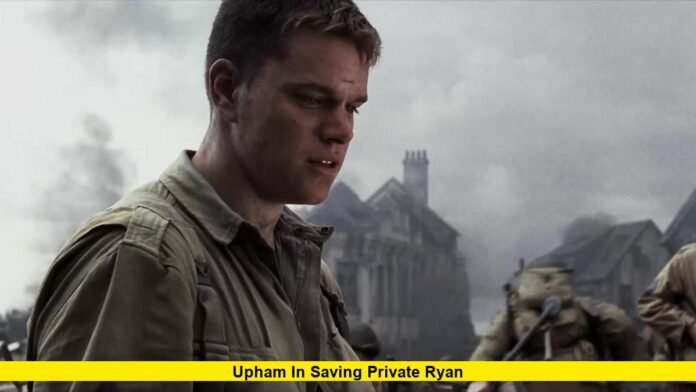

Few supporting characters in war cinema spark as much debate as Upham in Saving Private Ryan. Played by actor Jeremy Davies, Corporal Timothy E. Upham is the reluctant intellectual thrust into the chaos of World War II combat, and his arc remains one of the most discussed elements of Steven Spielberg’s 1998 masterpiece. Nearly three decades after the film’s release, viewers continue to search for insight into this character, his purpose in the story, and the powerful moral questions his presence raises about courage, fear, and survival in wartime.
Who Is Upham in Saving Private Ryan
Corporal Upham is a U.S. Army soldier assigned to Captain John Miller’s squad as a translator and cartographer during the D-Day invasion and the subsequent mission to find and retrieve Private James Francis Ryan. Unlike the seasoned infantrymen around him, Upham has never seen combat. He is a typist and a linguist, fluent in French and German, pulled from a desk job because his language skills are needed for the mission. This background immediately sets him apart from the rest of the squad, establishing him as an outsider among battle-hardened soldiers.
From his introduction, Upham is portrayed as intelligent, articulate, and somewhat naive about the realities of war. He carries a typewriter instead of combat instincts, and his idealism about soldiering and human decency clashes sharply with the brutal environment he is thrown into. This contrast becomes the foundation for one of the film’s most important character studies.
Upham’s Role in the Story
Upham’s primary function within Captain Miller’s unit is practical: he speaks German and French, which proves useful when the squad encounters civilians and enemy soldiers. However, his real narrative purpose goes far deeper. Through Upham, the film explores what happens to an ordinary, non-violent person when placed in an extraordinary and violent situation.
Throughout the mission, Upham struggles visibly with the horrors he witnesses. He questions the morality of decisions made by his fellow soldiers, particularly around the treatment of prisoners of war. In one pivotal scene, Upham argues for showing mercy to a captured German soldier, appealing to the rules of engagement and basic human compassion. This moment becomes crucial later in the film, as that same soldier reappears during the climactic battle, creating one of the most debated plot threads in the movie.
As the mission progresses, Upham is present for increasingly intense combat, yet he remains largely unable to act. His fear is portrayed honestly and without judgment, reflecting the reality that not every soldier sent into battle is prepared, physically or psychologically, for what awaits them.
The Pivotal Scene: Upham’s Hesitation
The most talked-about moment involving Upham occurs during the final battle for the bridge in the fictional town of Ramelle. As his fellow soldiers fight and die around him, Upham freezes on a staircase while a comrade is being killed in close combat just below him. He can hear the struggle, understands the danger, and yet cannot bring himself to intervene.
This scene has generated extensive discussion among viewers and critics alike. Some interpret Upham’s paralysis as a realistic depiction of how untrained soldiers might genuinely respond to extreme trauma and fear. Others view it as a critique of intellectualism and detachment when action is desperately needed. Spielberg does not offer an easy answer, and that ambiguity is precisely what makes the character so enduring in conversations about the film.
Upham’s Final Act
Later in the same battle, Upham experiences a transformation that reshapes how audiences understand his arc. After the fighting subsides and he encounters the previously spared German soldier again, Upham makes a decisive and violent choice, one that stands in stark contrast to his earlier pleas for mercy. This final act has become central to interpretations of the character, with many viewers seeing it as a commentary on how war strips away idealism and reshapes even the most principled individuals.
This ending sequence is often cited as the emotional and thematic crux of Upham’s entire journey. It raises lasting questions about morality in combat, the psychological toll of war, and whether compassion can survive in an environment built on survival and violence.
Jeremy Davies and His Performance
Jeremy Davies, the actor behind Upham, delivered a performance that required him to convey vulnerability, intelligence, and internal conflict without relying on typical action-hero heroics. Davies has spoken in past interviews about the physical and emotional demands of the role, noting that Spielberg wanted a portrayal that felt authentic rather than stylized. Davies reportedly trained alongside the rest of the cast during the film’s rigorous military boot camp, which helped the ensemble develop the camaraderie and tension visible on screen.
While Upham remains one of Davies’ most recognized roles, his career has spanned television and film for decades, including notable work in other acclaimed productions. Still, it is his portrayal of the frightened, conflicted corporal in Saving Private Ryan that continues to define his legacy for many moviegoers.
Why Upham Remains a Point of Public Interest
Interest in Upham has persisted well beyond the film’s original theatrical run for several reasons. First, the character serves as an audience surrogate. Many viewers, lacking military combat experience themselves, may see their own uncertainty and fear reflected in Upham’s reactions. He is not portrayed as a coward in a simplistic sense, but as a complex representation of how trauma and unfamiliarity with violence can paralyze even well-intentioned people.
Second, Upham’s arc invites ongoing ethical debate. Discussions about his hesitation on the staircase and his subsequent actions frequently appear in film analysis communities, academic discussions on war cinema, and retrospective reviews of Saving Private Ryan. The character offers a rare cinematic example of moral ambiguity that resists a clean, heroic resolution.
Finally, Upham’s presence highlights the film’s broader themes about the human cost of war. Saving Private Ryan is often praised for its unflinching depiction of combat, particularly the opening Normandy landing sequence, but Upham’s storyline adds a quieter, more introspective layer to the film’s exploration of duty, fear, and survival.
The Broader Context of Saving Private Ryan
Released in 1998 and directed by Steven Spielberg, Saving Private Ryan follows Captain John Miller and his squad as they are ordered to locate a paratrooper, Private James Ryan, whose three brothers have all been killed in action. The mission, set against the backdrop of the Normandy invasion, became one of the most acclaimed war films of its era, earning multiple Academy Awards and widespread critical praise for its realism and emotional weight.
Upham is one of several fictional squad members created to represent different facets of the American soldier experience during World War II. While characters like Miller and Sergeant Horvath embody hardened leadership and battlefield competence, Upham represents the everyman thrust into an unimaginable situation, making his journey especially relatable to audiences unfamiliar with combat.
Latest Discussions and Continued Relevance
Even decades after its release, Saving Private Ryan continues to be revisited in film retrospectives, anniversary screenings, and discussions about war filmmaking. Upham’s character regularly resurfaces in these conversations, particularly in analyses examining the psychological realism Spielberg brought to the film. There is no official confirmation of any new interviews, extended cuts, or reinterpretations of the character beyond what has already been documented in the years following the film’s release, and fans should treat any claims of new revelations with caution unless confirmed by verified sources.
The character also continues to circulate in online discussions, video essays, and educational contexts examining trauma, ethics, and leadership under pressure, cementing his place as one of cinema’s most thought-provoking supporting roles.
Final Thoughts
Upham in Saving Private Ryan endures as one of the most nuanced and debated characters in modern war cinema. Rather than offering a simple portrait of heroism or cowardice, the character embodies the unpredictable and deeply human ways people respond to fear, morality, and violence. Jeremy Davies’ portrayal gave the role a lasting emotional resonance, ensuring that Upham’s story continues to prompt reflection and discussion long after the credits roll. For audiences revisiting Saving Private Ryan or discovering it for the first time, Upham stands as a reminder that not every act of courage looks the same, and not every soldier’s war is fought purely on the battlefield.
Share your thoughts on Upham’s arc in the comments below, and check back for more in-depth film analysis and updates.