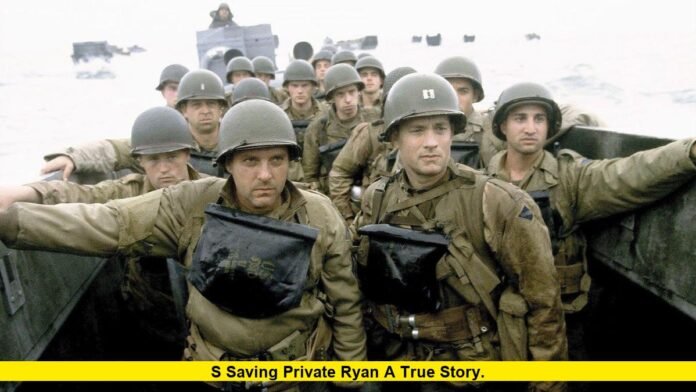

Few war films have left as lasting an impact on audiences as Steven Spielberg’s 1998 masterpiece. Many viewers who watch the film’s harrowing opening sequence on Omaha Beach come away asking is Saving Private Ryan a true story, and the answer is more nuanced than a simple yes or no. While the character of Private James Francis Ryan never actually existed, the emotional core of the film is loosely inspired by a real family’s wartime tragedy, and the military policy at the heart of the plot was very much real. Understanding where fact ends and fiction begins helps explain why the movie has resonated so deeply with audiences for more than two decades.
The Film’s Premise and Historical Setting
Saving Private Ryan follows Captain John H. Miller, played by Tom Hanks, as he leads a small squad of soldiers on a dangerous mission behind enemy lines during the invasion of Normandy in June 1944. Their orders are to locate Private James Ryan, a paratrooper whose three brothers have all been killed in action within a short span of time, and bring him home safely so his grieving mother does not lose her final surviving son. The film opens with an unflinching, technically ambitious recreation of the D-Day landings at Omaha Beach, a sequence that is widely regarded as one of the most realistic combat scenes ever put on film. From there, the story shifts into a fictional rescue mission that carries the emotional weight of the entire picture.
Although the specific mission depicted in the movie was invented for dramatic purposes, the broader setting, military units, weapons, and battlefield conditions were researched extensively to reflect the realities of World War II combat in France during the summer of 1944.
The Real Family Behind the Story
The true story of Saving Private Ryan traces back to the Niland brothers, four siblings from Tonawanda, New York, a small town near Buffalo. Edward, Preston, Robert, and Frederick “Fritz” Niland all served in the United States military during World War II, each assigned to a different unit. Robert and Fritz served as paratroopers with the 82nd and 101st Airborne Divisions respectively, Preston served as an infantry officer with the 4th Infantry Division, and Edward flew missions in the Pacific theater with the Army Air Forces.
Within a matter of days in the spring of 1944, tragedy struck the family repeatedly. In May 1944, the Nilands learned that Edward’s aircraft had gone down over Burma and that he was presumed dead. Then, on D-Day itself, Robert was killed while manning a machine gun to cover his unit’s retreat from a German counterattack near the village of Neuville-au-Plain. The very next day, Preston was killed by enemy fire while attempting to help capture a German artillery battery near Utah Beach. In the span of little more than a week, the family had received word that three of their four sons were gone.
It was against this backdrop that Fritz, the last remaining brother believed to be alive, was located by an Army chaplain and ordered home under a wartime directive meant to protect families from losing every son in a single conflict. This is the true story of Saving Private Ryan that inspired the film’s central premise, even though the details of the film’s rescue mission were dramatized for the screen.
The Sole Survivor Policy
The military regulation that drives the plot of Saving Private Ryan is grounded in fact. Sometimes called the Sole Survivor Policy, this directive was developed after the U.S. War Department became aware of families who had lost multiple sons in combat, most famously the five Sullivan brothers, who all died together when their ship was sunk during the Battle of Guadalcanal in November 1942. That loss prompted policymakers to reconsider how surviving family members were treated when siblings died in service.
The policy was formalized into law by Congress in 1948 and was later expanded in 1964 to more clearly protect the last surviving son of a family in which a parent or sibling had died as a result of military service. It remains part of U.S. military policy in modified form today, continuing to influence how the armed forces handle situations involving surviving family members. The Niland family’s experience predates the formal 1948 law, but their case is frequently cited as one of the real-world examples that helped shape the policy’s development and public awareness of the issue.
Where the Film Differs From Reality
While Saving Private Ryan draws its emotional foundation from the Niland family’s story, the filmmakers took clear creative liberties, and it is important to separate the dramatized elements from what actually happened. In the movie, all three of Ryan’s brothers are killed and a special eight-man squad is dispatched deep behind enemy lines to physically extract him from combat. In reality, Fritz Niland was not rescued through an armed mission; he was found already serving with his unit in Normandy and was simply reassigned home through standard military channels after a chaplain, Father Francis Sampson, made the arrangements.
There is also a significant difference in the outcome for the family. In the film, every one of Ryan’s brothers dies, leaving him as the sole survivor. In real life, Edward Niland, initially presumed dead after his aircraft went down over Burma, was later discovered alive in a Japanese prisoner-of-war camp and was liberated in 1945. That meant two of the four Niland brothers, not just one, ultimately survived the war and lived for decades afterward back in New York. This is a detail that many people are unaware of, and it gives the true story a somewhat less tragic ending than the film portrays.
The character of Captain Miller and his entire squad, along with the specific dangers they face while searching for Ryan, are also fictional constructs created for the film. No official record ties a real combat mission to the exact events shown on screen.
Public Fascination and Ongoing Interest
Interest in the true story behind Saving Private Ryan has remained strong since the film’s release, and it continues to surface regularly in documentaries, historical retrospectives, and anniversary coverage of D-Day. The Niland family has been honored at memorial ceremonies at the Normandy American Cemetery in France, where Robert and Preston Niland are buried side by side. Relatives of the family have participated in commemorative events and interviews describing how closely the emotional tone of certain scenes, including dialogue about staying with fellow soldiers, mirrored things Fritz Niland actually said when he was ordered home.
The broader public has also shown sustained curiosity about the difference between the Niland brothers and the Sullivan brothers, since both families are sometimes mentioned in connection with the film. The Sullivans’ loss is widely credited with helping prompt the military to examine sibling service policies in the first place, while the Nilands’ experience is the more direct narrative inspiration for the specific plot of Ryan being sent home. Historians and authors, including Stephen Ambrose, have written detailed accounts exploring both families and how their experiences intersect with the policies later formalized by the military.
Why the True Story Still Matters
Part of what makes Saving Private Ryan endure as a piece of filmmaking is that its fictional narrative is anchored in something real: the genuine anguish faced by American families during World War II and the military’s attempt to address that anguish through policy. The film does not claim to be a documentary, and Spielberg and screenwriter Robert Rodat were open about the fact that the specific mission was invented. Yet by rooting the story in the emotional truth of the Niland family’s ordeal, the film manages to honor the sacrifices of countless real families who lost multiple sons in the war, even those whose stories were never turned into a major motion picture.
For viewers who want to understand the difference between cinematic drama and documented history, learning about the Niland brothers offers a fuller picture of the sacrifice, uncertainty, and occasional mercy that shaped so many families during the war. The mission to find Private Ryan may be fictional, but the grief, duty, and relief experienced by real families like the Nilands were entirely genuine.
Final Thoughts
So, is Saving Private Ryan a true story? Not literally, but it is deeply rooted in real history. The film blends a fictional rescue mission with the very real experience of the Niland brothers and the wartime policy designed to prevent families from losing every son to combat. Knowing this history adds another layer of meaning to a film already celebrated for its realism, and it serves as a reminder that some of the most powerful stories in cinema begin with events that actually happened.
Have thoughts on the true story behind Saving Private Ryan? Share your perspective in the comments and check back for more deep dives into the real history behind your favorite films.