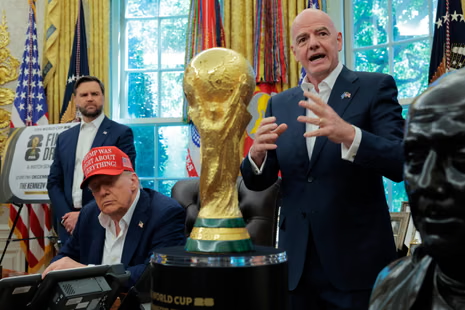

Football fans around the globe are already looking ahead to the next decade, and one of the most searched questions in international soccer circles right now is which nation will land the World Cup 2038 host country title. While the 2026, 2030, and 2034 editions of the tournament are already locked in, the race to host the 2038 FIFA World Cup remains wide open, with no official decision made by FIFA as of mid-2026. Several countries have publicly expressed interest, but the governing body has not opened a formal bidding process, and there is no official confirmation of a winner at this stage.
This article breaks down everything currently known about the 2038 World Cup host decision, including FIFA’s confederation rotation rules, the countries that have shown interest, and the factors that could shape the final outcome.
Why the 2038 World Cup Host Decision Matters
Hosting a FIFA World Cup is one of the biggest prizes in global sports. It brings billions of dollars in tourism revenue, massive infrastructure investment, and years of international spotlight. With the 2026 World Cup shared by the United States, Mexico, and Canada, the 2030 tournament spread across Spain, Portugal, Morocco, and three South American nations, and the 2034 edition awarded to Saudi Arabia, attention has quickly turned to who could host next. The World Cup 2038 host country decision will shape football’s global calendar for years and is already generating debate among fans, football federations, and sports economists.
Understanding FIFA’s Rotation Policy
To understand why certain countries are considered frontrunners for 2038, it helps to understand FIFA’s confederation rotation policy. Under this informal but consistently applied rule, a confederation that has hosted either of the two previous World Cups is generally excluded from bidding on the next tournament. This is designed to spread hosting duties across different continents rather than concentrating them in Europe or the Americas.
Applying this policy to the 2038 cycle produces a fairly narrow field of eligible confederations. Since the 2030 World Cup will be jointly hosted across UEFA (Europe), CAF (Africa), and CONMEBOL (South America) nations, and the 2034 tournament goes to Saudi Arabia under the AFC (Asian Football Confederation), those three confederations plus Asia would theoretically be ruled out of contention for 2038. That leaves only two confederations eligible under the current rotation model:
- CONCACAF, which covers North America, Central America, and the Caribbean
- OFC, the Oceania Football Confederation
This is why so much of the 2038 host country conversation centers on the United States, along with smaller Pacific nations like New Zealand and Fiji, rather than traditional European or South American football powers.
Countries That Have Expressed Interest
Even though FIFA has not opened a formal bidding window, multiple national federations have publicly signaled interest in hosting the 2038 tournament. It is important to note that expressing interest is very different from submitting an official bid, and none of the following should be treated as confirmed hosts.
The United States has been floated repeatedly as the most likely candidate, largely because it falls within the eligible CONCACAF confederation and already possesses the stadium infrastructure, transportation networks, and hospitality capacity needed for a modern, expanded 48-team World Cup. Reports have suggested the U.S. could pursue a joint bid involving Pacific nations such as New Zealand and Fiji, which would allow Oceania to technically co-host while leaning on American infrastructure for the bulk of matches. New Zealand’s football federation has acknowledged it could not realistically host a tournament of this scale alone, given stadium capacity requirements, and has looked into creative joint-hosting arrangements as a result.
England has also entered the conversation, with a FIFA vice president publicly voicing support for either a solo English bid or a renewed United Kingdom joint bid, pointing to the country’s existing stadium infrastructure and its recent successful bids for UEFA Euro 2028 and the 2035 FIFA Women’s World Cup. However, under the current rotation rules, a UEFA-based bid would face significant eligibility hurdles given Europe’s role in hosting the 2030 tournament.
Germany, Italy, and France have all had their respective football federations publicly state interest in hosting either the 2038 or a later edition of the World Cup, though these federations also face the same rotation policy challenges affecting other European nations. Germany’s federation specifically mentioned openness to bidding for 2038 or 2042, leaving its exact target somewhat undecided.
A joint Baltic-Nordic and Lublin Triangle bid, potentially modeled on the multi-country hosting approach used for UEFA Euro 2020, has also been floated by regional government officials, though this remains an early-stage idea rather than a formal proposal.
The Case for a United States Return
If FIFA maintains its current rotation approach without exception, the United States stands out as the nation best positioned to meet the practical demands of hosting. The 2026 World Cup, shared with Mexico and Canada, will have already demonstrated the country’s ability to manage large crowds, high-capacity stadiums, and complex logistics for an expanded 48-team format. Analysts point out that no other CONCACAF or OFC nation currently has comparable stadium infrastructure, hotel capacity, or transportation networks to independently support a tournament of this size.
That said, hosting the World Cup for a third time within a relatively short historical window would be unusual. The United States previously hosted in 1994 and will co-host again in 2026, and a 2038 hosting would mark a rapid return by historical standards. Critics of this scenario argue that other nations, including some that have never hosted a men’s World Cup, deserve consideration, even though the rotation policy currently narrows the realistic field.
Public Interest and Ongoing Debate
The World Cup 2038 host country question has become a popular talking point among soccer analysts, prediction markets, and fan communities, even though the tournament remains more than a decade away. Some commentators and betting markets have suggested that a United States-Pacific joint bid is the most probable outcome given the rotation constraints, though no market or analyst prediction should be mistaken for an official FIFA decision. It’s worth noting that as of mid-2026, prediction markets tracking this outcome have shown minimal trading activity, reflecting just how far off and uncertain the final decision remains.
There is also active discussion about whether FIFA might adjust or bend its own rotation policy, as it has faced criticism in the past for how flexibly the rule has been applied to past bidding cycles. Because the policy is not a strict, codified FIFA statute but rather a customary practice, some observers believe FIFA retains the ability to make exceptions if a compelling bid emerges from an otherwise ineligible confederation.
What Happens Next in the Bidding Process
FIFA typically opens the formal bidding process for a World Cup several years before the tournament itself, often allowing member federations to submit letters of intent followed by detailed technical bids. Based on timelines used for previous tournaments, the official bidding window for the 2038 World Cup is expected to open sometime between 2031 and 2032, though FIFA has not confirmed a specific date. Once bidding opens, interested federations will need to submit detailed proposals covering stadium readiness, transportation infrastructure, accommodation capacity, and financial guarantees before a final vote takes place at a FIFA Congress.
Until that process begins, all reports of interest from the United States, England, Germany, Italy, France, New Zealand, Fiji, and the Baltic-Nordic region remain preliminary. No federation has submitted a formal bid, and FIFA has made no official statement naming a favorite or a confirmed timeline for its decision.
Final Thoughts
The race to determine the World Cup 2038 host country is still in its earliest stages, shaped more by FIFA’s confederation rotation policy than by any formal bidding competition. With Europe, Africa, South America, and Asia effectively excluded under the current rules, attention has understandably shifted toward the United States and potential Oceania partners like New Zealand and Fiji, even as European federations continue to voice long-term interest for this cycle or the one that follows. Fans should treat all current reports as early speculation rather than settled fact, since FIFA has not opened bidding, named a favorite, or set a firm timeline for a final decision. As the 2026, 2030, and 2034 tournaments unfold, the picture for 2038 will likely become clearer, but for now, the host remains officially undecided.
Stay tuned and drop your predictions in the comments below as more updates emerge on the race to host the 2038 World Cup.