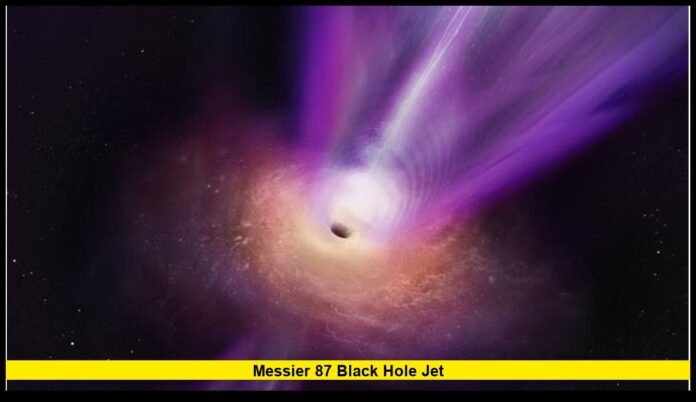

The messier 87 black hole jet is once again at the center of major astronomical discoveries in 2026, as scientists have released new observations that reveal the most detailed views yet of the powerful stream of particles erupting from the supermassive black hole known as M87*. Recent findings from the Event Horizon Telescope (EHT) and NASA’s Chandra X-ray Observatory have helped researchers trace the jet closer to its origin and examine how it changes over time, offering fresh insights into one of the most extraordinary phenomena in the universe.
Why the Messier 87 Black Hole Jet Matters
The giant elliptical galaxy Messier 87, commonly called M87, sits approximately 55 million light-years from Earth in the Virgo Cluster. At its center lies M87*, a supermassive black hole with a mass estimated at about 6.5 billion times that of the Sun.
M87* became world-famous in 2019 when astronomers released the first direct image of a black hole. Since then, scientists have continued studying the black hole and its enormous jet, which extends thousands of light-years into space.
Unlike many black holes that remain hidden behind surrounding gas and dust, M87 offers a rare opportunity to observe both the black hole and the giant jet powered by it.
The jet serves as a natural laboratory for studying:
- Extreme gravity
- Magnetic fields
- Relativistic particles
- Black hole feeding processes
- Galaxy evolution
Researchers believe these jets play a major role in regulating star formation and shaping the development of galaxies across the universe.
Latest 2026 Findings Bring Scientists Closer to the Jet’s Origin
One of the biggest developments of 2026 came from researchers working with the Event Horizon Telescope.
Using observations collected in 2021 and analyzed with improved techniques, astronomers identified what appears to be the most likely location of the jet’s base. This marks a major step toward understanding exactly where the outflow begins near the black hole.
Scientists discovered evidence for a compact emission region located extremely close to M87*. The location aligns with structures previously observed in radio studies of the jet.
The finding helps bridge a long-standing gap between:
| Observation Type | What It Shows |
|---|---|
| Black hole shadow images | Material close to the event horizon |
| Large-scale jet images | Particle streams extending thousands of light-years |
| New 2026 results | Potential connection between the two |
Researchers have spent years trying to connect the black hole’s bright ring structure to the beginning of the jet. The latest observations provide the strongest evidence yet that this connection is becoming visible.
How Scientists Studied the Jet
The Event Horizon Telescope is not a single instrument.
Instead, it combines radio telescopes around the world into a virtual Earth-sized observatory using a technique called Very Long Baseline Interferometry.
This approach delivers extraordinary resolution.
The telescope network can observe details near the black hole that would otherwise remain invisible.
For the latest research, scientists analyzed radio emissions at 230 GHz. They compared signals captured across different telescope baselines and found additional emission that could not be explained solely by the black hole’s ring.
The most likely explanation was a compact structure associated with the jet’s launching region.
This discovery gives astronomers a stronger foundation for testing theories about how black holes generate such powerful outflows.
New Chandra Images Reveal Remarkable Jet Evolution
Another major breakthrough arrived in June 2026 through observations from NASA’s Chandra X-ray Observatory.
Researchers released the most detailed X-ray views ever obtained of the M87 jet.
The new images combine observations collected over more than a decade, allowing scientists to track subtle changes in the jet’s structure.
These observations revealed:
- Previously unresolved knots of energetic material
- Improved views of jet motion
- Better alignment with optical and infrared observations
- More detailed measurements of particle acceleration regions
Scientists applied advanced image-processing methods to enhance the clarity of the data.
As a result, structures that once appeared blurred now show significant detail.
The updated images allow astronomers to monitor how material moves outward from the black hole and evolves over time.
A Jet Traveling at Near-Light Speed
The M87 jet ranks among the most powerful known cosmic structures.
Material inside the jet travels at speeds approaching the speed of light.
Because of these extreme velocities and the jet’s orientation relative to Earth, astronomers observe a phenomenon known as apparent superluminal motion.
This effect can make parts of the jet appear to move faster than light.
However, the illusion results from geometry and relativistic effects rather than an actual violation of Einstein’s theory of relativity.
The jet stretches roughly 3,000 light-years in visible observations, though some measurements indicate energetic activity extending even farther.
Its immense size demonstrates how efficiently black holes can transfer energy into surrounding space.
The Role of Magnetic Fields
Magnetic fields remain central to understanding the messier 87 black hole jet.
Observations over recent years have shown that M87* contains highly organized magnetic structures near the event horizon.
These magnetic fields likely play a key role in:
- Extracting energy from the black hole
- Accelerating particles
- Collimating the jet into a narrow beam
- Maintaining jet stability over vast distances
Researchers have observed significant changes in magnetic field orientation around the black hole between observation campaigns.
Those changes suggest the environment surrounding M87* remains highly dynamic despite the black hole’s enormous size.
The latest jet studies continue supporting models in which magnetic fields drive the outflow.
What Makes M87 Different From Other Black Holes
Thousands of black holes have been identified throughout the universe.
Yet M87 remains unique for several reasons.
First Black Hole Ever Imaged
The 2019 Event Horizon Telescope image transformed astronomy.
For the first time, scientists directly observed a black hole’s shadow against surrounding glowing material.
Visible Giant Jet
Many supermassive black holes generate jets.
Few are as large, bright, and accessible to observation as M87’s.
Relatively Nearby
At approximately 55 million light-years away, M87 is close enough for detailed study by modern instruments.
Massive Size
Its enormous mass allows changes near the event horizon to occur more slowly than around smaller black holes.
This makes long-term monitoring easier.
These characteristics make M87 one of the most valuable objects for testing theories about black hole physics.
James Webb Space Telescope Contributions
The James Webb Space Telescope has also helped scientists better understand the M87 jet.
Recent infrared observations revealed details that had never been seen with such clarity.
Researchers identified:
- Fine structures within the jet
- Regions where particles accelerate
- A faint counter-jet extending in the opposite direction
- New information about jet composition
Infrared observations complement radio, optical, and X-ray studies.
Together, these datasets provide a more complete picture of how the jet behaves across different energy ranges.
Understanding How Black Holes Launch Jets
One of the biggest unanswered questions in astrophysics involves jet formation.
Scientists know black holes themselves cannot eject material from inside the event horizon.
Instead, the process occurs in the surrounding environment.
Current leading theories suggest:
- Gas falls toward the black hole.
- The material forms a rotating accretion disk.
- Powerful magnetic fields develop.
- Energy from the disk or black hole rotation accelerates particles outward.
- The particles form highly focused jets.
The latest M87 observations help researchers test these ideas.
By identifying structures near the likely jet base, astronomers can compare real observations against theoretical models.
Each new dataset narrows the list of possible explanations.
How the Jet Influences the Entire Galaxy
The M87 jet does more than produce impressive images.
It significantly affects the galaxy around it.
Jets inject enormous amounts of energy into interstellar and intergalactic gas.
This energy can:
- Heat surrounding material
- Prevent gas from cooling
- Slow star formation
- Redistribute matter across large distances
- Influence galaxy growth
Many astronomers believe supermassive black holes and their jets play a major role in shaping galaxy evolution throughout cosmic history.
The M87 system provides one of the clearest examples of this process.
Future Event Horizon Telescope Observations
Scientists are already preparing for the next generation of observations.
New telescope stations have expanded the Event Horizon Telescope network, improving sensitivity and image quality.
Researchers expect future campaigns to provide:
- Sharper black hole images
- Better views of the jet-launching region
- Improved measurements of magnetic fields
- More detailed observations of particle acceleration
Some teams are even working toward creating time-resolved movies showing how matter moves around M87*.
Because M87’s immense mass causes changes to occur relatively slowly, it represents one of the best candidates for such a project.
Key Facts About M87 and Its Jet
| Feature | Details |
|---|---|
| Galaxy | Messier 87 (M87) |
| Distance from Earth | About 55 million light-years |
| Black Hole Name | M87* |
| Estimated Mass | About 6.5 billion solar masses |
| First Black Hole Image | 2019 |
| Jet Length | About 3,000 light-years visible |
| Observation Methods | Radio, X-ray, optical, infrared |
| Major 2026 Development | Evidence identifying the likely jet base |
| Recent X-ray Advance | Most detailed jet images ever obtained |
Why 2026 Could Be a Turning Point
The combination of Event Horizon Telescope results and new Chandra observations has made 2026 one of the most important years yet for M87 research.
For decades, scientists could observe the black hole and the jet separately.
Now, evidence increasingly points toward a direct observational connection between the two.
Researchers are beginning to map the region where the jet originates with greater precision than ever before.
As new observations continue arriving from radio, infrared, optical, and X-ray observatories, the picture of M87’s central engine is becoming clearer.
The work not only advances black hole science but also deepens our understanding of how galaxies evolve across billions of years.
What do you think about these new discoveries surrounding the M87 jet? Share your thoughts and keep checking back for the latest space science updates.