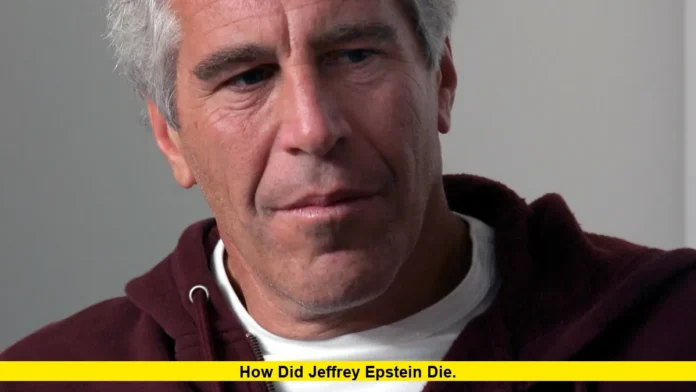

Few deaths in modern American history have generated as much suspicion, controversy, and ongoing investigation as that of Jeffrey Epstein. The disgraced financier and convicted sex offender died inside a federal jail cell in Manhattan on August 10, 2019, while awaiting trial on sex trafficking charges. Officially, his death was ruled a suicide by hanging. Yet more than six years later, the question “how did Jeffrey Epstein die” remains one of the most searched and most contested topics online, fueled by newly released files, congressional hearings, and a steady stream of unanswered questions about what really happened inside the Metropolitan Correctional Center that night.
This article walks through every major phase of the case: his arrest and indictment, the final weeks of his life, the night he died, the autopsy and the criticism it drew, his burial, the public reaction, the investigations that followed, and the homicide theories that continue to dominate headlines in 2026.
Apprehension and Indictment
Jeffrey Epstein was arrested on July 6, 2019, after his private jet landed at Teterboro Airport in New Jersey following a trip from Paris. Federal agents from the FBI and the New York Police Department took him into custody on charges of sex trafficking of minors and conspiracy to commit sex trafficking. The arrest followed a renewed investigation by federal prosecutors in the Southern District of New York, who had reopened scrutiny of Epstein after a 2018 Miami Herald investigative series exposed how lightly he had been treated in an earlier 2008 Florida case, where he served just 13 months in a work-release program after pleading guilty to state prostitution charges.
The new federal indictment, unsealed on July 8, 2019, accused Epstein of operating a network that recruited and abused dozens of underage girls at his Manhattan townhouse and his private island in the U.S. Virgin Islands between 2002 and 2005, with some accusers describing abuse continuing well beyond that period. Prosecutors argued Epstein posed a significant flight risk and a danger to potential witnesses, citing his vast wealth, multiple properties around the world, and access to a private aircraft. A federal judge denied him bail on July 18, 2019, ordering him held at the Metropolitan Correctional Center (MCC) in lower Manhattan until trial, which was scheduled for the following year.
Initial Incident and Final Weeks
Epstein’s time at MCC was marked by red flags almost from the start. On July 23, 2019, just over two weeks after his arrival, he was found unresponsive in his cell with marks on his neck. Jail officials initially described the episode as a possible suicide attempt, though Epstein’s legal team disputed that characterization, suggesting instead that a violent cellmate may have assaulted him. That cellmate was Nicholas Tartaglione, a former police officer awaiting trial on murder charges, who later said he discovered Epstein on the floor of their shared cell and alerted guards. A handwritten note that Tartaglione claimed to have found near Epstein after the incident was eventually released by a federal judge years later, although it never appeared in the government’s official reports on Epstein’s death.
Following this incident, Epstein was placed on suicide watch and then moved to the jail’s psychiatric unit for observation. He was assigned a cellmate specifically as a safeguard. However, just before his death, jail officials made the consequential decision to move Epstein out of suicide watch and back into a special housing unit cell by himself, removing the cellmate who had been assigned to monitor him. This decision is now widely viewed as one of the most critical institutional failures in the case, since standard protocol calls for inmates on suicide watch to be checked far more frequently and never housed entirely alone.
Death
In the early morning hours of August 10, 2019, Epstein was found dead in his cell at MCC. According to jail logs and later government reports, two correctional officers were assigned to check on inmates in the Special Housing Unit, including Epstein, every 30 minutes overnight. Investigations later revealed that the guards on duty, Tova Noel and Michael Thomas, failed to conduct those mandatory checks for several hours, instead browsing the internet, shopping online, and moving around the unit while sitting at their desks. At approximately 6:30 a.m., officers making belated rounds discovered Epstein unresponsive, hanging from a bedsheet that had been tied to the top of his bunk bed. He was 66 years old.
Surveillance footage and digital logs reviewed years later as part of the broader Epstein files disclosures showed an orange-colored shape moving toward the isolated jail tier the night before his death was discovered, raising further questions about who, if anyone, accessed that area during the hours the mandated checks were skipped. Members of Congress have since sought direct testimony from the guards involved to clarify exactly what happened during that window.
Discovery
Officer Michael Thomas was the one who found Epstein. According to later accounts, when guards knocked on his cell door calling “come to the door” and received no response, Thomas entered and discovered Epstein alone in a cell that was unusually cluttered with extra blankets and linens. Epstein was found hanging by a strip of orange-colored cloth, reportedly torn from a bedsheet, tied to the top bunk of his cell. Emergency responders attempted resuscitation, and Epstein was rushed to NewYork-Presbyterian Lower Manhattan Hospital, where he was pronounced dead shortly after arrival.
The Federal Bureau of Prisons announced his death publicly that Saturday morning, describing it as an apparent suicide. The announcement triggered immediate, intense scrutiny, in part because Epstein had been on suicide watch only weeks earlier and was, by virtue of his case, one of the most closely guarded and high-profile inmates in the entire federal prison system.
Controversy
The circumstances surrounding Epstein’s death sparked controversy almost instantly, for several overlapping reasons. First, the missed overnight checks meant there was effectively no continuous monitoring of Epstein for hours before his body was discovered. Second, it was later revealed that the camera footage covering the area outside Epstein’s cell had technical problems, and the recording that did exist from a nearby hallway camera was not from the camera directly facing his cell door, fueling speculation about gaps in surveillance. Third, Attorney General William Barr publicly stated he found the circumstances of Epstein’s death “deeply troubling” and ordered both the FBI and the Department of Justice’s Inspector General to investigate.
Adding to the controversy, it emerged that Epstein had been moved out of a shared cell shortly before his death despite being on a heightened-risk status, and that jail short-staffing meant one of the two guards on duty that night was working overtime as a non-corrections staff member temporarily reassigned to cover the shift, a practice known as “augmentation” that critics said was common at MCC due to chronic understaffing.
Possible Motivations
If Epstein’s death was indeed a suicide, several factors are commonly cited as possible motivations. He faced a near-certain conviction at trial on federal sex trafficking charges, carrying a potential sentence of up to 45 years in prison, which for a man in his late 60s would have amounted to a life sentence. Beyond the criminal exposure, Epstein was the subject of numerous civil lawsuits from accusers and faced the prospect of his vast fortune being dismantled through fines, settlements, and restitution. Friends and former associates also described him as someone who valued his freedom, status, and control over his public image above almost everything else, suggesting that the prospect of decades behind bars, combined with public disgrace, could have been a powerful motive for self-harm.
At the same time, those who question the suicide ruling have pointed to opposing motivations: Epstein’s apparent optimism about his legal strategy, reports that he was actively working with his attorneys on a defense and discussing bail alternatives, and accounts from people who interacted with him in his final days describing him as engaged rather than despondent. These conflicting accounts are part of why the question of his mental state heading into that final night remains disputed.
Autopsy
New York City’s chief medical examiner, Dr. Barbara Sampson, performed the official autopsy and ruled Epstein’s death a suicide by hanging. The examination reportedly found a fractured hyoid bone in Epstein’s neck, among other injuries consistent with hanging. The Bureau of Prisons and the Department of Justice both stood behind this determination, and the finding was further reviewed and supported in a lengthy 2023 Department of Justice Office of the Inspector General report examining the systemic failures that allowed the death to occur.
Epstein’s family also hired their own forensic expert, Dr. Michael Baden, a well-known forensic pathologist and former New York City medical examiner, to observe the official autopsy on their behalf. Baden’s presence added an additional layer of independent review to the proceedings, though his subsequent public comments would go on to fuel rather than settle the controversy.
Autopsy Report and Criticism
This is where the case became most contentious. Dr. Baden publicly stated that the combination of injuries he observed, particularly multiple fractures in the neck area including the hyoid bone, was, in his professional opinion, more consistent with strangulation by another person than with self-inflicted hanging. He noted that such fractures are statistically more common in homicidal strangulation cases than in suicidal hangings, especially in younger individuals, though he acknowledged that hanging deaths in older individuals can sometimes produce similar fracture patterns due to more brittle bone structure.
The official medical examiner’s office pushed back firmly, with Dr. Sampson stating unequivocally that her determination of suicide was made after a careful, thorough examination of all available evidence, including the autopsy findings, the circumstances of the death, and a review of Epstein’s prison and medical history. Other forensic pathologists not connected to either side of the case noted publicly that hyoid bone fractures, while less common in hangings than in strangulations, are not unheard of, particularly in cases involving older individuals or specific hanging mechanics. The full, unredacted autopsy report has never been publicly released in its entirety, and this lack of complete transparency has remained a persistent point of criticism from journalists, members of Congress, and the public alike.
Burial
Jeffrey Epstein was cremated, and there has been no widely reported public memorial service or burial site disclosed to the media. Some reports at the time indicated his remains were ultimately interred at a Jewish cemetery, though his estate and family largely avoided public commentary on funeral arrangements, a notable departure from the high-profile nature of his life and the intense media attention surrounding his death. The secrecy surrounding his final arrangements mirrored the broader pattern of opacity that has characterized much of the Epstein case from start to finish.
Reaction
Reaction to Epstein’s death was swift, intense, and deeply skeptical from multiple corners of American society. Survivors and their attorneys expressed outrage that Epstein would never face a public trial, robbing his victims of the opportunity to see him held accountable in open court and to potentially expose other powerful individuals who may have participated in or facilitated his abuse. Many accusers said his death felt like one final act of control, denying them the justice and full public reckoning they had fought for.
Politicians across the spectrum, including then-President Donald Trump, publicly questioned the official suicide narrative within hours of the announcement. Attorney General William Barr ordered immediate investigations and later testified before Congress about the systemic failures at the jail. The Bureau of Prisons came under blistering criticism for staffing shortages, lax oversight, and a pattern of failures that several officials admitted should never have allowed a high-profile, suicide-watch inmate to die unsupervised. Public trust in the official account was further eroded by years of slow-moving disclosures, redacted documents, and what many viewed as an inadequate explanation for how such a closely monitored prisoner could die without detection for hours.
Investigations
Multiple official investigations followed Epstein’s death. The FBI opened an immediate inquiry into the circumstances surrounding it. The Department of Justice’s Office of the Inspector General launched its own multi-year investigation into the failures at MCC, ultimately publishing a lengthy report in 2023 that detailed how staffing shortages, skipped checks, malfunctioning cameras, and procedural breakdowns combined to create conditions in which Epstein’s death went unnoticed for hours. The two correctional officers on duty that night, Tova Noel and Michael Thomas, were initially charged with falsifying federal records related to the rounds they were supposed to have completed, though those charges were later resolved through a deferred prosecution arrangement requiring community service rather than jail time.
The investigation entered a dramatic new phase starting in 2025, when Congress passed the Epstein Files Transparency Act with overwhelming bipartisan support, compelling the Department of Justice to release the bulk of its unclassified Epstein-related records. The Department of Justice published an initial batch of roughly 3.5 million pages of files in December 2025, with additional rolling releases continuing into 2026 and totaling several million pages overall. These disclosures included internal memoranda, surveillance video logs, correspondence, and photographs, and they renewed congressional interest in exactly what happened during Epstein’s final hours.
In early 2026, newly released video logs appeared to show an orange-colored shape moving toward Epstein’s isolated jail tier roughly an hour before his death is believed to have occurred, details that did not neatly match earlier official summaries of that night. The House Oversight Committee subsequently sought, and in some cases obtained, direct testimony from former guard Tova Noel and other jail personnel regarding the final hours of Epstein’s life. Noel testified that her life had been upended by years of threats and conspiracy accusations, while continuing to deny any role in facilitating or covering up Epstein’s death, attributing many of the institutional failures to what she described as a dysfunctional culture at MCC. As of mid-2026, congressional committees continue to review records and seek additional testimony, and the Department of Justice has indicated further document releases are still pending.
Subsequent Criminal Trials and Developments
Although Epstein’s own criminal case ended with his death, the broader legal fallout has continued for years. His longtime associate, Ghislaine Maxwell, was arrested in 2020 and convicted in December 2021 on multiple federal charges, including sex trafficking of minors and conspiracy, for her role in recruiting and grooming victims on Epstein’s behalf. She was sentenced to 20 years in federal prison in 2022, and her subsequent appeals to overturn the conviction have been unsuccessful at the appellate level, though additional legal challenges have continued.
Civil litigation also proceeded extensively after Epstein’s death. His estate established a victims’ compensation fund that paid out settlements to dozens of accusers, while separate lawsuits targeted financial institutions, including JPMorgan Chase and Deutsche Bank, accused of facilitating Epstein’s trafficking operation by failing to flag suspicious transactions despite red flags spanning years. Both banks reached substantial settlements with victims rather than proceeding to trial. Additional civil suits and investigations have examined the roles played by other Epstein associates, with the 2025-2026 document releases reigniting scrutiny of numerous high-profile individuals named or referenced in the files, prompting fresh political pressure for further accountability measures.
Homicide Suspicions and Conspiracy Theories
No aspect of the Epstein case has generated more public fascination than the theory that he was murdered rather than having taken his own life. Skeptics point to a constellation of factors: the timing of his death just weeks before a trial that threatened to expose powerful associates; the failure of two guards to conduct mandatory checks for hours; malfunctioning or improperly positioned surveillance cameras; Dr. Baden’s forensic opinion regarding the neck fractures; the unusual decision to remove Epstein’s cellmate shortly before his death; and the broader historical pattern of secrecy and slow disclosure that has defined the case.
Proponents of the official suicide finding counter that suicide watch failures, chronic prison understaffing, and self-inflicted hanging deaths with hyoid fractures, while less common, are documented and plausible, especially given Epstein’s prior apparent suicide attempt weeks earlier and the extreme stress of facing a likely life sentence. They also note that multiple independent reviews, including the lengthy 2023 Inspector General investigation, found no forensic or video evidence of anyone entering Epstein’s cell to harm him, only evidence of negligence in monitoring him.
Even so, public skepticism has remained remarkably persistent and has only intensified with each new document release. The discrepancy between a press release dated a day before Epstein’s officially reported death date, surfaced within the 2025-2026 file disclosures, has become a particular flashpoint for renewed conspiracy theorizing, even though officials have characterized it as an administrative or clerical inconsistency rather than evidence of foul play. Congressional hearings throughout 2026 have continued to probe surveillance gaps, guard testimony, and the broader question of institutional accountability, ensuring that “how did Jeffrey Epstein die” remains an actively investigated and hotly debated question rather than a fully settled matter.
Frequently Asked Questions
Was Jeffrey Epstein’s death officially ruled a suicide? Yes. The New York City chief medical examiner ruled Epstein’s death a suicide by hanging, a finding upheld by the Department of Justice and its Office of the Inspector General following multi-year reviews.
Did anyone go to prison for failing to supervise Epstein? The two correctional officers on duty, Tova Noel and Michael Thomas, were initially charged with falsifying federal records for failing to complete required overnight checks. Both ultimately avoided jail time through a deferred prosecution agreement involving community service.
What did Epstein’s family’s forensic expert conclude? Dr. Michael Baden, hired by Epstein’s brother to observe the autopsy, publicly stated the injury pattern, particularly fractures in the neck region, appeared in his opinion more consistent with strangulation than self-inflicted hanging, a conclusion disputed by the official medical examiner.
Has the full, unredacted autopsy report ever been released? No complete, unredacted version of the autopsy report has been made public, which remains a significant point of ongoing criticism from journalists, lawmakers, and the public.
Are investigations into Epstein’s death still ongoing in 2026? Yes. Congressional committees continue to review newly released Epstein files, seek testimony from former jail personnel, and examine surveillance footage and document discrepancies related to his final hours.
What happened to Ghislaine Maxwell? Epstein’s longtime associate was convicted in December 2021 on federal sex trafficking and conspiracy charges and sentenced to 20 years in prison. Her appeals have so far been unsuccessful.
What do you think really happened inside that Manhattan jail cell? Share your thoughts in the comments below, and follow our site for the latest updates as new Epstein files and congressional findings continue to come to light.
Sources
- NBC News – Unanswered questions about Epstein’s final hours
- CBS News – Newly released video logs on Epstein jail cell death
- CNN Politics – Epstein files and prison officials the night he died
- ABC News – Former Epstein prison guard testimony
- PBS NewsHour – Judge releases cellmate note from Epstein’s suspected suicide attempt
- U.S. Department of Justice – DOJ Disclosures, Epstein Files
- Congress.gov – H.R.4405 Epstein Files Transparency Act
- CBS News – Live updates on Epstein files release
- USA Today Fact Check – Jeffrey Epstein death verification
- U.S. Department of Justice Office of the Inspector General – 2023 Report on Epstein’s Death