
The 2026 FIFA World Cup is officially underway — and it is already delivering drama, upsets, and unforgettable moments. With a record-breaking 48 teams competing across 12 groups in the United States, Canada, and Mexico, keeping up with the World Cup group table 2026 has never been more important — or more exciting. Whether you are tracking your favourite nation’s qualification chances or just want to know who is topping the table, this guide covers everything you need to know.
What Makes the 2026 FIFA World Cup Group Stage Different?
For the first time in World Cup history, 48 nations are competing instead of the traditional 32. This means 12 groups of four teams each — replacing the 8-group format used since France 1998. The expanded format brings more football, more nations, and more chances for upsets.
Key rules for the 2026 group stage:
- The top two teams from each group automatically advance to the Round of 32
- The eight best third-place finishers across all 12 groups also qualify, making 32 total teams advancing
- The group stage runs from June 11 to June 27, 2026
- Final matchdays (June 26–27) are played simultaneously within each group to prevent any strategic advantage
- Tiebreakers are decided by: head-to-head points → head-to-head goal difference → overall goal difference → goals scored → team conduct score → FIFA ranking
2026 FIFA World Cup: All 12 Groups at a Glance
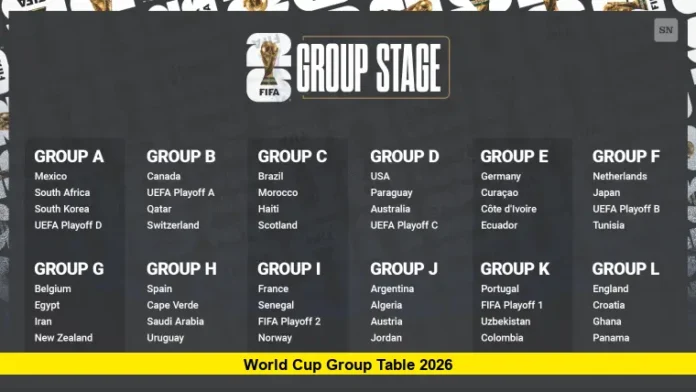
Here is the complete breakdown of all 12 groups (A through L) confirmed for the 2026 FIFA World Cup:
Group A: Mexico (host), South Africa, Korea Republic, Czechia
Group B: Canada (host), Bosnia and Herzegovina, Qatar, Switzerland
Group C: Brazil, Morocco, Scotland, Haiti
Group D: United States (host), Paraguay, Australia, Türkiye
Group E: Germany, Curaçao, Côte d’Ivoire, Ecuador
Group F: Netherlands, Japan, Tunisia, Sweden
Group G: Belgium, Iran, Egypt, New Zealand
Group H: Spain, Uruguay, Saudi Arabia, Cape Verde
Group I: France, Senegal, Norway, Iraq
Group J: Argentina, Algeria, Austria, Jordan
Group K: Portugal, Colombia, Uzbekistan, DR Congo
Group L: England, Croatia, Ghana, Panama
Latest Results: What Has Happened So Far (as of June 15, 2026)
Group A — Mexico, South Africa, Korea Republic, Czechia
The tournament kicked off on June 11 at the iconic Estadio Azteca in Mexico City, with host nation Mexico defeating South Africa 2–0 in a result that echoed the famous 2010 World Cup opener at the same fixture. On the same day, South Korea came from behind to beat Czechia 2–1, putting two teams on three points immediately.
Group B — Canada, Bosnia and Herzegovina, Qatar, Switzerland
June 12 saw Canada earn a hard-fought 1–1 draw against Bosnia and Herzegovina at BMO Field in Toronto. Switzerland and Qatar played out a dramatic 1–1 draw, with Qatar’s Boualem Khoukhi scoring a stunning 94th-minute equalizer — earning the Gulf nation its first-ever FIFA World Cup point.
Group C — Brazil, Morocco, Scotland, Haiti
One of the most anticipated groups delivered on June 13. Brazil and Morocco played out a closely contested 1–1 draw in East Rutherford, New Jersey, in a match that lived up to the pre-tournament hype. Meanwhile, Scotland ended a 28-year World Cup absence with a 1–0 victory over Haiti, with John McGinn scoring the winner in the 28th minute — Scotland’s first World Cup goal since 1998. McGinn’s effort was deflected in off a defender but counted, and it was fully deserved.
Group D — USA, Paraguay, Australia, Türkiye
The United States delivered a statement performance on June 12, hammering Paraguay 4–1 in one of the early tournament’s most one-sided results. Australia provided the biggest shock of the opening weekend on June 13, defeating Türkiye 2–0 with goals from Nestory Irankunda (27′) and Connor Metcalfe (75′). After the first round of matches, both the USA and Australia sit on three points at the top of Group D.
Group E — Germany, Curaçao, Côte d’Ivoire, Ecuador
June 14 brought Group E’s opening matches. Germany showed their class with a dominant 7–1 victory over Curaçao, who briefly had their moment in World Cup history before the floodgates opened. In the other match, Côte d’Ivoire edged Ecuador 1–0 thanks to a stunning 90th-minute goal from Amad Diallo, making it a dramatic late winner.
Group F — Netherlands, Japan, Tunisia, Sweden
Also on June 14, Netherlands and Japan produced the match of the tournament so far — a 2–2 thriller. Three goals arrived in a 13-minute spell in the second half, with Japan’s Daichi Kamada equalising in the 88th minute to deny the Dutch a winning start. The result earned both teams a point and left the group wide open.
Groups G, H, I, J, K, L — Matches Beginning June 15–17
Several groups are yet to begin their campaigns at the time of writing:
- Group G (Belgium, Iran, Egypt, New Zealand) opens on June 15
- Group H (Spain, Uruguay, Saudi Arabia, Cape Verde) also begins June 15
- Group I (France, Senegal, Norway, Iraq) kicks off June 16
- Group J (Argentina, Algeria, Austria, Jordan) begins June 16–17
- Group K (Portugal, Colombia, Uzbekistan, DR Congo) opens June 17, with Cristiano Ronaldo making his sixth and final World Cup appearance at age 41
- Group L (England, Croatia, Ghana, Panama) begins around June 17–18
Group-by-Group Analysis and Tournament Predictions
Group A: Mexico’s Home Advantage
Mexico enter as heavy favourites in their home group. Their 2–0 opening win over South Africa demonstrated their quality on familiar territory. Korea Republic’s strong start against Czechia makes this group competitive, but most analysts expect Mexico and South Korea to advance.
Group B: Canada’s Cautious Start
Despite dominating Bosnia and Herzegovina, Canada were held to a 1–1 draw — a reminder that nothing is guaranteed. Switzerland are experienced at World Cups and will be difficult to overcome. With Qatar’s surprise point already banked, Group B is more competitive than many expected.
Group C: The Group of Death?
Many football analysts have pointed to Group C as the most difficult in the tournament. Brazil are World Cup royalty but appeared vulnerable in their draw with Morocco. Scotland’s emotional return after 28 years has given the group an extra romantic storyline. Haiti, making just their second World Cup appearance, face an uphill battle but demonstrated spirit in their opener.
Group D: USA and Australia Flying
The host United States look like genuine knockout-round contenders after their 4–1 demolition of Paraguay. Australia’s shock win over Türkiye has added intrigue to a group that was always expected to be competitive. Türkiye and Paraguay both need results quickly.
Group E: Germany Back with a Bang
Germany’s 7–1 win was a statement to the rest of the tournament. While the opposition (Curaçao) was always going to be weaker on paper, the margin and manner of the victory was impressive. Ivory Coast’s late winner over Ecuador means the race for second place behind Germany will be tight.
Group F: Netherlands vs Japan Sets the Tone
The 2–2 draw between Netherlands and Japan in their Group F opener suggests this could be one of the most entertaining groups to watch over the next two weeks. Both Sweden and Tunisia will be eager to capitalise.
Group I: The Most Competitive Group
Group I — featuring France, Senegal, Norway, and Iraq — is widely considered the most competitive group at the 2026 World Cup, with three teams capable of reaching the quarter-finals or beyond. Kylian Mbappé’s France are favourites, but Senegal are formidable and Erling Haaland’s Norway are a genuine dark horse.
Group K: Ronaldo’s Last Dance
Portugal in Group K offers one of the tournament’s most compelling storylines. Cristiano Ronaldo, at 41, makes his sixth and final World Cup appearance. Portugal open against DR Congo on June 17. Colombia, ranked 13th in the world, will push Portugal hard for the group top spot.
How the Third-Place Qualification Works
One of the most complex and exciting elements of the new-format World Cup group table 2026 is the third-place qualification system. Eight of the 12 third-placed teams advance to the knockout stages. They are ranked by:
- Points accumulated in the group stage
- Goal difference
- Goals scored
- Team conduct score (yellow and red cards)
- FIFA ranking
This means a third-place finish is not the end of the road — it could still lead all the way to the Round of 32. Teams with 4–6 points from a third-place finish have a strong chance of qualifying, though 3 points remains risky depending on the competition across other groups.
Key Dates: World Cup Group Stage Schedule 2026
June 11 — Tournament opens (Mexico vs South Africa, Estadio Azteca)
June 11–27 — Group stage matches across all 12 groups
June 26–27 — Final simultaneous group stage matchdays
June 28 onwards — Round of 32 knockout stage begins
July 19, 2026 — World Cup Final at MetLife Stadium (New York/New Jersey)
Where to Watch the World Cup Group Stage 2026
In the United States, matches are broadcast on Fox and FS1 (English) and Telemundo (Spanish). In the United Kingdom, BBC and ITV share broadcasting rights. Streaming options vary by region, with many broadcasters offering online viewing platforms. The first-ever World Cup halftime show is also planned for the July 19 final.
Why the 2026 World Cup Group Stage Matters More Than Ever
With 48 teams and 12 groups, the World Cup group table 2026 is more dynamic than any previous edition. More nations means more diversity — debuts for Cape Verde, Curaçao, Jordan, and Uzbekistan add fresh stories to the world’s biggest sporting event. Legendary players like Lionel Messi (Argentina) and Cristiano Ronaldo (Portugal) are making what are expected to be their final World Cup appearances, adding layers of emotion to every group match they feature in. Every result matters, every goal difference counts, and the path from group stage to World Cup glory has never felt more electric.
Which group do you think will produce the biggest shock of the tournament? Drop your predictions in the comments below and keep checking back — the World Cup group table 2026 updates every matchday!