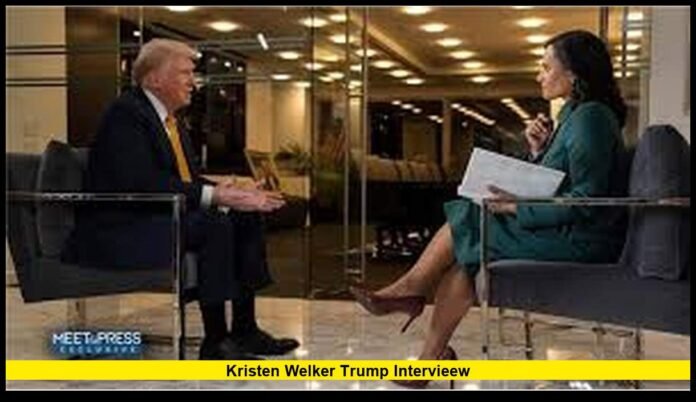

The kristen welker trump interview quickly became one of the most discussed political events of the weekend as President Donald Trump and NBC moderator Kristen Welker engaged in a sharp and often tense conversation covering foreign policy, election issues, media relations, and the direction of the country. The high-profile appearance on Meet the Press generated widespread attention across the political spectrum and reignited debates about journalism, presidential accountability, and the challenges facing the United States in 2026.
The interview unfolded during a period of intense political scrutiny as the administration continues to navigate major international and domestic issues. While the discussion began with policy questions and current events, it eventually developed into a confrontational exchange that highlighted the increasingly strained relationship between political leaders and members of the national press.
For viewers across the country, the conversation offered a revealing glimpse into how Trump approaches difficult questions, how major policy decisions are being explained to the public, and why political interviews remain a powerful part of the American democratic process.
A High-Stakes Television Appearance
Sunday political programs have long served as important platforms for national leaders to communicate directly with voters. Presidents often use these interviews to explain policies, respond to criticism, and clarify their administration’s priorities.
Trump’s latest appearance carried added significance because it came at a time when several major issues dominate public discussion. International tensions remain a concern, debates about election procedures continue to attract attention, and economic questions remain central to conversations among lawmakers and voters alike.
Welker approached the interview with a series of questions designed to address those issues directly. The result was a lengthy discussion that covered multiple subjects and produced several headline-making moments.
Throughout the interview, Trump defended his administration’s positions while pushing back against questions he viewed as unfair or misleading. The back-and-forth created an atmosphere that was both substantive and confrontational, keeping viewers engaged from beginning to end.
Foreign Policy Takes Center Stage
Trump discussed negotiations involving Iran and outlined his administration’s approach toward reducing regional instability while maintaining pressure on adversaries. He emphasized the importance of American strength on the global stage and argued that his administration remains committed to protecting U.S. interests abroad.
The president described ongoing discussions aimed at reaching a broader agreement that could help reduce tensions while addressing long-standing security concerns.
Foreign policy has become an increasingly important issue for the White House in recent months. Events overseas have created new challenges for policymakers, forcing leaders to balance military readiness, diplomatic engagement, and economic considerations.
During the interview, Trump portrayed his administration’s strategy as one focused on achieving stability while avoiding unnecessary escalation. He stressed that negotiations remain a critical tool but maintained that strong leverage remains essential to securing favorable outcomes.
The discussion provided viewers with one of the administration’s most detailed public explanations of its current foreign policy thinking.
Debate Over Campaign Messaging
Another major topic involved Trump’s long-standing political message regarding military conflicts and America’s role overseas.
Welker questioned whether current events align with themes that were emphasized during previous campaigns. Trump responded by explaining that circumstances often require presidents to adapt to changing global realities.
He argued that protecting American interests remains his highest priority and said leadership decisions must be based on current threats rather than campaign slogans.
The exchange reflected a broader challenge faced by every administration. Candidates often present broad goals during election campaigns, but governing frequently requires responding to events that cannot be predicted years in advance.
Political analysts noted that the conversation highlighted the complexities of translating campaign promises into policy decisions once in office.
For supporters, Trump’s answers demonstrated flexibility and pragmatism. Critics argued that voters deserve clear explanations when policies appear to differ from earlier rhetoric.
Regardless of political affiliation, many viewers viewed the exchange as one of the interview’s most important moments.
Election Issues Create Tension
The conversation became more intense when attention turned to election-related concerns.
Trump has continued to discuss election procedures and voting systems, subjects that have remained politically significant for several years. Welker challenged the president on several aspects of those claims and sought detailed responses regarding the evidence supporting his concerns.
As the questioning continued, tensions between interviewer and interviewee became increasingly visible.
Trump defended his views while criticizing what he described as media resistance to discussing election integrity concerns. He argued that many Americans share questions about voting procedures and deserve answers from public officials.
Welker pressed for specifics, leading to one of the most contentious segments of the interview.
The exchange highlighted a broader national divide regarding election administration and public confidence in democratic institutions. Supporters of additional scrutiny argue that transparency strengthens public trust. Others contend that repeated allegations can undermine confidence when not supported by official findings.
The interview did not resolve those disagreements, but it clearly demonstrated how central the issue remains in American politics.
Trump’s Ongoing Battle With the Media
The relationship between Donald Trump and major news organizations has been a defining feature of his political career.
That dynamic was evident throughout the interview.
At multiple points, Trump accused national media outlets of treating him unfairly and presenting issues through a partisan lens. He argued that coverage of his administration often focuses disproportionately on controversy while overlooking policy achievements.
Media criticism has remained a recurring theme of Trump’s public appearances for years. His supporters frequently echo those concerns, believing that many journalists approach political stories with preconceived narratives.
Journalists, meanwhile, maintain that rigorous questioning is necessary to hold public officials accountable and provide voters with information needed to evaluate leaders and policies.
The interview became another example of this continuing clash between political power and the press.
Rather than avoiding confrontation, both Trump and Welker engaged directly with each other’s arguments, creating moments that immediately attracted public attention.
Why the Exchange Resonated With Viewers
Political interviews occur regularly, but only a handful become major national stories.
Several factors contributed to the widespread interest in this appearance.
First, the discussion involved issues that affect millions of Americans, including foreign policy, national security, election administration, and media accountability.
Second, the interview featured two nationally recognized figures with strong public profiles.
Third, the conversation unfolded in an unscripted format that allowed viewers to observe real-time reactions rather than prepared statements.
Modern audiences increasingly value authenticity, even when it produces uncomfortable moments. The interview delivered exactly that kind of unscripted interaction.
Many viewers saw a president defending his positions under intense questioning. Others saw a journalist attempting to obtain direct answers on matters of public importance.
Those contrasting interpretations fueled extensive discussion across television, social media, and political circles.
The Role of Meet the Press in American Politics
For generations, Meet the Press has served as one of the nation’s most influential political programs.
The show has hosted presidents, foreign leaders, lawmakers, and policy experts while providing a forum for serious discussions about public affairs.
Because of its history and reputation, appearances on the program often generate significant attention.
Political leaders understand that statements made during these interviews can shape public perceptions and influence future debates.
The latest interview reinforced the program’s enduring role in the political landscape. It demonstrated how traditional broadcast journalism continues to matter even in an era dominated by digital media and social networking platforms.
Long-form interviews remain one of the few opportunities for voters to see leaders respond to sustained questioning on a wide range of topics.
Public Reaction Across the Political Spectrum
Reaction to the interview was swift and highly divided.
Supporters of the president praised his willingness to challenge the interviewer and defend his administration’s policies. Many argued that he successfully communicated his positions despite facing aggressive questioning.
Others viewed the interview differently, saying it raised important questions that deserved clearer answers.
Political commentators from various ideological backgrounds spent much of the following day analyzing key moments from the discussion.
Some focused on foreign policy implications. Others examined election-related exchanges. Still others concentrated on the broader relationship between politicians and journalists.
The range of reactions illustrated how differently Americans can interpret the same event depending on their political perspectives and priorities.
Yet despite those differences, there was widespread agreement on one point: the interview mattered.
It generated discussion because it addressed issues that continue to shape national debate.
What the Interview Reveals About the Current Political Climate
The kristen welker trump interview reflected more than a disagreement between a president and a journalist.
It served as a snapshot of the broader political environment in the United States.
Americans remain deeply engaged in discussions about foreign policy, election procedures, media credibility, and government accountability. Those debates influence public opinion, legislative priorities, and future political campaigns.
The interview brought many of those conversations together in a single televised event.
It highlighted the challenges facing political leaders who must explain complex policies to a diverse audience. It also demonstrated the pressures journalists face when attempting to obtain clear answers on controversial subjects.
As the country moves through another consequential political year, similar exchanges are likely to remain common.
Voters continue to seek information, leaders continue to defend their decisions, and journalists continue to ask difficult questions.
That dynamic remains a fundamental part of democratic governance.
Looking Ahead
The issues discussed during the interview are unlikely to disappear anytime soon.
International developments will continue to shape foreign policy decisions. Election-related debates will remain part of the political conversation. Questions regarding media trust and political accountability are also expected to persist.
Future interviews involving the president will likely attract significant attention as Americans look for answers about the challenges facing the country.
For now, this appearance stands out as one of the most memorable political television moments of the year.
Its combination of policy discussion, sharp exchanges, and national significance ensured that it became a major topic of conversation far beyond the program itself.
As Washington continues to grapple with critical issues at home and abroad, interviews like this one will remain essential opportunities for voters to hear directly from the people making decisions that affect the nation’s future.