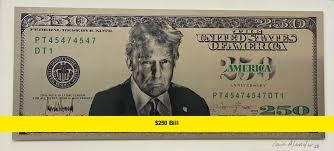

A proposal involving a new $250 bill has triggered nationwide discussion after reports emerged that officials aligned with President Donald Trump explored the possibility of placing his image on a high-denomination banknote tied to America’s 250th anniversary celebrations. The idea has quickly evolved from a political talking point into a broader debate about currency laws, presidential symbolism, and the future of cash in the United States.
The discussions reportedly took place as federal agencies prepared commemorative initiatives for the country’s semiquincentennial events in 2026. While no official authorization has been issued, the concept has already generated intense reactions from lawmakers, economists, historians, and the public.
A New Denomination Draws National Attention
The United States has not introduced a new circulating paper currency denomination in generations. Current American banknotes range from $1 to $100, with the $100 bill remaining the largest denomination widely used in public circulation.
The idea of creating a $250 note would represent a major shift in modern currency policy. Supporters of the proposal argue that the denomination could serve as both a commemorative tribute and a symbol connected to the nation’s 250-year milestone.
Critics, however, say the plan raises legal and constitutional questions that would likely face significant scrutiny in Congress and federal courts.
Federal Restrictions Could Block the Plan
One of the most significant barriers involves longstanding federal policy regarding portraits on U.S. currency. Existing law traditionally prevents living individuals from appearing on official American banknotes and coins.
Because Donald Trump is currently serving as president, experts say any attempt to feature his portrait on a circulating note would likely require legislative changes approved by Congress.
Legal scholars note that the restriction was originally created in the nineteenth century to prevent political favoritism and preserve the neutrality of national symbols. For decades, U.S. currency design has focused primarily on historical figures who are no longer living.
The proposal has therefore become more than a conversation about money. It has evolved into a larger dispute over presidential legacy and political branding.
Why the Proposal Surfaced in 2026
America’s 250th anniversary has become a central theme for multiple federal initiatives scheduled throughout the year. Agencies have prepared historical programs, patriotic events, educational campaigns, and commemorative products tied to the anniversary of the Declaration of Independence.
Within that broader celebration, some Trump allies reportedly viewed a new banknote as a high-profile tribute connected to the milestone year.
The timing also reflects Trump’s continued influence within Republican politics and his administration’s emphasis on national symbolism and economic messaging.
While supporters describe the concept as patriotic, opponents argue that linking a sitting president to a commemorative currency project risks politicizing national institutions.
Currency Experts Question Practical Demand
Financial analysts remain divided over whether a $250 denomination would serve a practical purpose in the modern economy.
The rise of digital banking, mobile payments, and electronic transfers has steadily reduced reliance on physical cash for large transactions. Credit cards, online payment systems, and banking apps now dominate many areas of consumer spending.
Because of that shift, some economists believe a high-value bill would have limited everyday use.
Others argue that larger denominations could create additional concerns involving counterfeiting, illegal transactions, and money laundering investigations. Financial institutions already monitor substantial cash movements under existing federal reporting rules.
Some analysts predict that if a $250 note were ever issued, it would likely become more of a collector’s item than a commonly circulated banknote.
Historical Background of High-Denomination Bills
Although many Americans have never seen one, the United States previously issued several large-denomination banknotes.
Older currency included $500, $1,000, $5,000, and even $10,000 bills during earlier periods of American banking history. Those notes were eventually discontinued as electronic financial systems became more common and security concerns increased.
Today, surviving examples of those historic notes are mostly found in museums, auctions, and private collections.
A modern high-denomination note would therefore represent one of the most dramatic changes to U.S. paper currency in decades.
Political Reactions Intensify Online
Public response to the proposal has been deeply divided.
Supporters across conservative media and social platforms have praised the concept as a celebration of Trump’s political influence and leadership during a historic anniversary year. Some have argued that commemorative currency designs are common worldwide and should not automatically be viewed as controversial.
Critics have taken the opposite position, accusing supporters of attempting to personalize federal institutions around a sitting president.
The debate has fueled viral discussions online, where mock-up images and unofficial concept designs circulated rapidly after reports about the proposal emerged.
Several commentators also questioned whether introducing a new denomination aligns with the country’s increasingly cashless economy.
Treasury and Printing Challenges Remain Significant
Even if lawmakers approved the idea, introducing a new bill would require years of technical planning and production work.
Modern U.S. currency includes sophisticated anti-counterfeit protections such as microprinting, embedded security threads, color-shifting ink, and watermark technology. Developing and testing those features is a lengthy process involving multiple federal agencies.
The Bureau of Engraving and Printing would also need to coordinate with the Federal Reserve and banking institutions nationwide before any new denomination could enter circulation.
Production costs could become another major issue during congressional budget negotiations.
Collectors Already Showing Interest
Despite the uncertainty surrounding the proposal, currency collectors and memorabilia enthusiasts have already shown strong interest in the concept.
Rare and unusual American banknotes often attract substantial attention in collector markets, especially when tied to political history or major national anniversaries.
Some analysts believe that even a limited commemorative version could generate strong demand among collectors, similar to special-edition coins released during past national celebrations.
At the same time, experts caution that no official commemorative Trump banknote has been approved or announced by federal authorities.
What Comes Next
At present, the proposal remains unofficial and faces considerable legal, political, and logistical hurdles. Congress would likely need to approve any major changes involving a new denomination or the placement of a living president on U.S. currency.
Still, the controversy surrounding the idea has already placed the topic at the center of national conversation during one of the country’s most symbolic anniversary years.
Whether the proposal advances or quietly disappears, it has highlighted how currency design can become intertwined with politics, identity, and public debate in modern America.