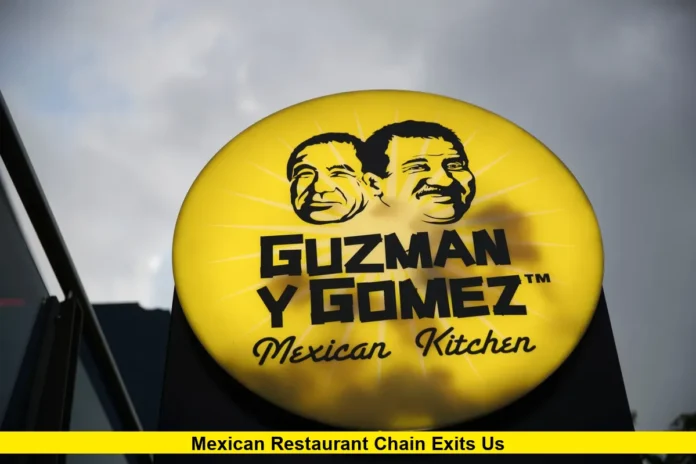

In a stunning reversal that has sent shockwaves through the fast-casual dining industry, a Mexican restaurant chain has officially exited the US market — shutting every one of its American locations practically overnight. Guzman y Gomez (GYG), the Australian-based fast-casual Mexican chain that once dreamed of rivaling Chipotle on American soil, abruptly closed all eight of its US restaurants in the Chicago area on May 22, 2026. The sudden exit marks the end of a six-year, $115 million bet on the US market — and raises serious questions about the viability of international restaurant expansion in today’s challenging economic climate.
Who Is Guzman y Gomez?
Founded in Sydney, Australia in 2006 by Steven Marks and Robert Hazan, Guzman y Gomez built its reputation as a premium fast-casual competitor to Chipotle, offering fresh ingredients, customizable bowls, burritos, and tacos with no artificial flavors, preservatives, or colors. Over two decades, the brand expanded successfully across Australia, Japan, and Singapore, eventually growing to more than 200 global locations.
Flush with international success and listed on the Australian Securities Exchange, GYG set its sights on the United States — the world’s most competitive restaurant market. The company launched its US operations in 2020, planting its flag in Chicago, a city with deep Mexican cuisine roots and an appetite for fast-casual dining. Founder Steven Marks, a New York native, even relocated to Chicago personally to oversee the expansion — a clear signal of how seriously the company took its American ambitions.
At its peak, the company openly spoke of opening “hundreds, if not thousands” of locations across the country, drawing comparisons to McDonald’s and Chipotle.
The Abrupt Exit: What Happened?
As recently as February 2026, GYG reaffirmed its commitment to the US market, insisting it would stick with a country of 350 million potential customers. That makes the May 22 closure all the more jarring.
GYG CEO Steven Marks told Business News Australia that the company ultimately determined its US operations were not generating strong enough returns to justify continued investment — prompting an immediate exit and the permanent closure of all eight Chicago-area restaurants.
The financial damage is significant. GYG expects to recognize a one-off profit and loss impact of between $30 million and $40 million in its 2026 full-year results as a direct consequence of the US exit. The cash component of these exit costs — covering lease liabilities, employee costs, and contractual commitments — is not expected to exceed $15 million.
For context, the total US investment over six years amounted to approximately $115 million with no path to profitability in sight.
Why Did the Mexican Restaurant Chain Exit the US?
Several compounding factors drove the decision:
Fierce Market Competition
The US fast-casual Mexican segment is dominated by entrenched giants. Chipotle alone operates roughly 4,000 US locations and commands extraordinary brand loyalty. Taco Bell, with its massive scale and marketing firepower, and newer regional players all make for an extraordinarily crowded landscape. GYG, despite its clean-ingredient positioning, struggled to differentiate itself enough to draw customers away from established favorites.
Soaring Food and Labor Costs
The restaurant industry has faced relentless cost pressure since inflation surged across the US economy. Reports indicate that food-away-from-home prices climbed nearly 40% between 2019 and 2026. For a brand built around premium, fresh ingredients, those input costs were particularly punishing.
Changing Consumer Behavior
American consumers have increasingly pulled back on discretionary restaurant spending. Industry analysts note that even higher-income consumers have become cautious, citing rising costs, an unpredictable job market, and broader economic uncertainty. Rich Shank, senior principal and vice president of innovation at Technomic, noted that the environment caused US restaurant visits to decline for two straight years, with only modest growth projected for 2026.
Brand Awareness Gap
Breaking into the US market requires enormous advertising budgets and operational scale to build the kind of customer loyalty GYG had earned over decades in Australia. Starting in a single metro area — even a large one like Chicago — limited the brand’s ability to achieve the name recognition needed to compete with national giants.
RBC Capital Markets analyst Michael Toner put it bluntly: “The US business had very low prospects of being successful, and the losses of the business were weighing down the earnings of the group so the sooner exit than anticipated is positive.”
What This Means for GYG’s Global Plans
Crucially, GYG insists the US exit does not signal broader brand trouble. The company’s board maintains strong conviction in the global appeal of the GYG brand and says it will continue expanding in a “disciplined and deliberate manner.” Its master franchise partners in other markets — particularly Singapore and Japan — continue to deliver strong sales growth and healthy unit economics.
The company also confirmed that the US departure will not affect its dividend for FY26, and international expansion efforts outside the US remain firmly on track.
A Broader Pattern: Mexican Chains Struggling Across the US
GYG’s exit is not an isolated story. The Mexican restaurant sector has faced a prolonged period of stress that stretches well beyond one Australian import.
In 2025 alone, several casual Mexican dining chains closed locations or filed for bankruptcy:
- On The Border Mexican Grill & Cantina — which operated around 120 locations at the start of 2025 — closed 40 underperforming stores in February 2025 due to rent and financial performance issues, then filed for Chapter 11 bankruptcy on March 4, 2025.
- Abuelo’s declined from 40 locations across 15 states to just 16 locations before filing for Chapter 11 in September 2025.
- Taco Cabana, which had operated 146 restaurants across New Mexico and Texas, closed five locations in September 2025.
- Torchy’s Tacos, the popular Austin-based fast-casual chain, announced in February 2026 that it would close four locations across two states after a portfolio performance review.
- Session Taco, based in St. Louis, closed multiple locations after once operating nine across the Missouri area.
The broader market tells a more nuanced story, however. Despite these closures, the Mexican restaurant sector’s total market size is projected to rise from $76.2 billion in 2025 to $80.2 billion in 2026, according to Business Research Insights — suggesting that while weaker players are being squeezed out, the category itself is not disappearing.
What Happens to Employees?
The sudden nature of GYG’s US closure has raised serious concerns about workers. All eight Chicago-area locations shut on May 22, 2026, with staff receiving little advance notice. Exit costs covered by the company include employee-related payments, though the abruptness of the closure has drawn criticism. Employment law experts have noted the closures could trigger obligations under the federal WARN Act, which requires covered employers to provide 60 days’ notice before mass layoffs.
Key Takeaways for the Restaurant Industry
GYG’s retreat from the US offers a stark lesson for any international brand eyeing the American market:
- Scale matters from day one. A handful of locations in one city cannot build the brand awareness needed to compete with national chains operating thousands of restaurants.
- Economic timing is everything. Entering the US in 2020 — just as pandemic disruptions, inflation, and behavioral shifts were reshaping consumer habits — proved catastrophic for margin assumptions.
- Differentiation must be crystal clear. “Fresh ingredients” is not a sufficient point of difference in a market where Chipotle has already claimed that positioning for 30 years.
- Exit early before losses compound. GYG’s decision to cut losses rather than throw more capital at a struggling operation may ultimately protect shareholder value, as analysts have noted.
The Bottom Line
The story of a Mexican restaurant chain exiting the US is, at its core, a story about the brutal realities of America’s dining landscape. GYG came in with ambition, capital, and a proven international playbook — and still couldn’t make it work. As inflation squeezes diners, competition intensifies, and consumer loyalty proves harder than ever to earn, even well-funded brands are discovering that the US is a market that demands far more than a good menu.
Have you eaten at a Guzman y Gomez location, or do you think another international Mexican chain could succeed where GYG failed? Drop your thoughts in the comments — we’d love to hear from you!