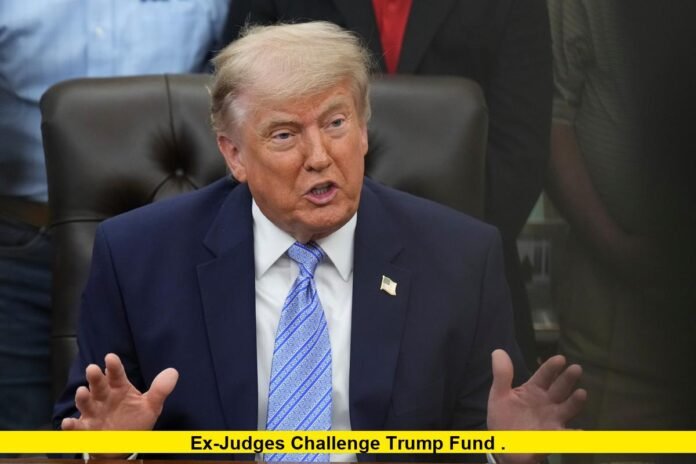

In a stunning legal development, a coalition of 35 former federal judges has formally asked a federal court to reopen a settled lawsuit between President Donald Trump and the U.S. government — calling the controversial $1.776 billion “Anti-Weaponization Fund” a potential fraud on the judicial system. The move marks one of the most significant legal challenges yet to an arrangement that has drawn swift and bipartisan condemnation across Washington.
What Is the Anti-Weaponization Fund?
The Anti-Weaponization Fund is a controversial program created as part of a settlement announced by the U.S. Department of Justice on May 18, 2026. The fund emerged from a lawsuit filed by President Donald Trump against the Internal Revenue Service (IRS) following the unauthorized disclosure of his tax returns by former IRS contractor Charles Littlejohn.
Littlejohn admitted to leaking confidential tax information belonging to Trump and thousands of other wealthy Americans and later pleaded guilty to federal charges. To resolve the lawsuit, the Justice Department agreed to establish the Anti-Weaponization Fund, a $1.776 billion compensation pool financed through the U.S. Treasury’s Judgment Fund. The amount was reportedly selected as a symbolic reference to 1776, the year the United States declared its independence.
According to the settlement, the fund is intended to provide compensation to individuals, organizations, or entities that claim they were unfairly targeted or harmed by what is described as government “weaponization.” Supporters argue that the fund offers a mechanism for addressing alleged abuses of federal authority, while critics question both its legal basis and the scope of its intended use.
A particularly controversial aspect of the agreement involves protections granted to Trump and his affiliated entities. The settlement reportedly provides broad immunity from future IRS civil enforcement actions related to matters connected to the tax returns at issue in the lawsuit. Legal scholars and former government officials have described this provision as highly unusual, noting that federal agencies rarely agree to limit future enforcement authority in this manner.
The creation of the Anti-Weaponization Fund has sparked significant political and legal debate. Critics argue that it could set a precedent for using taxpayer-funded settlements in unprecedented ways, while supporters maintain that it addresses concerns about government misconduct. As court challenges and public scrutiny continue, the fund remains at the center of a broader discussion about executive power, government accountability, and the limits of federal legal settlements.
Why Are Ex-Judges Calling It a “Fraud on the Court”?
A group of 35 former federal judges has sharply criticized the settlement that created the Anti-Weaponization Fund, arguing that the circumstances surrounding the agreement raise serious legal concerns. On May 27, 2026, they filed a motion under Rule 60 of the Federal Rules of Civil Procedure, asking U.S. District Judge Kathleen Williams to reopen the case and determine whether the settlement amounted to a “fraud on the court.”
Their argument centers on the sequence of events leading to the settlement. According to the filing, President Trump’s legal team submitted a Notice of Voluntary Dismissal, formally ending the lawsuit against the IRS. The judges contend that this filing made no mention of any settlement agreement. Only after the case was dismissed did the Justice Department publicly announce the creation of the $1.776 billion Anti-Weaponization Fund.
The former judges argue that this raises questions about whether the court was fully informed about the existence and terms of the agreement before the case was closed. In their motion, they stated that the lawsuit itself “is a fraud on the court” and asserted that the settlement “was not, and never will be, legally justified.”
A key issue involves the legal authority cited for establishing the fund. The judges argue that the statutes relied upon by Acting Attorney General Todd Blanche require a genuine legal dispute between opposing parties. They claim the case may not have met that standard if it was “collusive, feigned, or fraudulent,” as alleged in their filing.
The motion also asks Judge Williams to investigate whether the court was misled about important aspects of the case, including whether a legitimate controversy existed and whether any settlement negotiations were conducted at arm’s length. The former judges maintain that these questions must be answered before the settlement can be considered valid.
As a result, the dispute has evolved beyond the original tax-return leak case and now focuses on whether the settlement process itself complied with fundamental legal and constitutional requirements.
Who Are the Judges Behind the Challenge?
The legal challenge to the Anti-Weaponization Fund is being led by a coalition of 35 former federal judges whose backgrounds span both major political parties. Their involvement has drawn attention because the group includes respected former trial and appellate judges appointed by Republican and Democratic presidents alike, giving the challenge a bipartisan character.
Among the most prominent members is Ursula Mancusi Ungaro, a former federal judge appointed by President George H.W. Bush. Her participation is notable because she previously served on the same federal court as Judge Kathleen Williams, who is now being asked to review the settlement.
Another key figure is John Tinder, a retired federal appeals court judge from the Seventh Circuit. After his retirement, his seat was eventually filled by Amy Coney Barrett before her elevation to the U.S. Supreme Court. His inclusion adds appellate-level experience and credibility to the coalition.
The group also includes J. Michael Luttig, a highly influential conservative jurist appointed by President George H.W. Bush. Luttig has become one of the most prominent legal critics of certain actions taken by President Trump and is widely respected across the legal community for his constitutional expertise.
Supporters of the challenge argue that the coalition’s bipartisan makeup strengthens its credibility because the judges are not united by political affiliation but by concerns about legal process and judicial integrity. Their motion contends that the court should examine whether the settlement was properly disclosed, whether a genuine legal dispute existed, and whether the agreement was negotiated in a lawful manner.
For that reason, the challenge has attracted attention beyond partisan politics. The participation of former judges from different ideological backgrounds signals that the dispute is being framed as a question of constitutional governance, judicial oversight, and the proper use of federal legal settlement authority rather than simply a political disagreement.
The Conflict of Interest at the Core of the Case
One of the most controversial aspects of the legal battle surrounding the Anti-Weaponization Fund is the potential conflict of interest embedded in the structure of the original lawsuit. Critics argue that the case presents an unusual and potentially problematic situation because President Donald Trump was both the plaintiff bringing the lawsuit and the head of the Executive Branch responsible for overseeing the agencies involved in the dispute.
The lawsuit targeted the Internal Revenue Service (IRS) over the unauthorized disclosure of Trump’s tax records. However, the IRS operates within the federal government, and the Department of Justice (DOJ), which ultimately negotiated the settlement, is also part of the Executive Branch led by the president. This arrangement prompted legal scholars and former judges to question whether the case involved genuinely adverse parties or whether both sides were effectively under the same chain of authority.
The unusual nature of the litigation became a focal point of public discussion after Trump reportedly remarked, “I’m supposed to work out a settlement with myself.” While supporters viewed the comment as an acknowledgment of the unique circumstances, critics saw it as highlighting the central concern that the lawsuit lacked the independence typically expected in federal court proceedings.
The coalition of 35 former federal judges cited this issue extensively in its filing challenging the settlement. According to their argument, the lawsuit may have been “collusive,” meaning that the parties were not truly acting as opponents in a legitimate legal dispute. They contend that the litigation provided a mechanism through which the administration and the DOJ could create legal justification for establishing the $1.776 billion Anti-Weaponization Fund without undergoing the level of judicial scrutiny normally associated with such a significant government action.
The judges further argue that federal courts can only hear cases involving a genuine “case or controversy” between adverse parties. If that requirement was not met, they claim, the foundation of both the lawsuit and the resulting settlement could be called into question.
As a result, the alleged conflict of interest has become one of the central legal issues in the broader dispute. The question is no longer limited to the tax-return leak itself but now extends to whether the lawsuit was structured in a manner consistent with constitutional requirements and longstanding principles of judicial independence.
Bipartisan Backlash in Congress
The Anti-Weaponization Fund has generated fierce opposition not just in the courts, but also on Capitol Hill — and notably, even among Republicans. Senior GOP senators have publicly criticized the deal:
- Sen. Thom Tillis (R-NC) called it “absurd” that the fund could “potentially compensate someone who assaulted a police officer.”
- Sen. Mitch McConnell (R-KY) described a “slush fund to pay people who assault cops” as “utterly stupid” and “morally wrong.”
Democrats have been equally vocal. Just before Trump dropped his original lawsuit, 93 House Democrats filed their own brief accusing the president of “undermining the Constitution by bringing this collusive suit.” Congressional Democrats have repeatedly referred to the fund as a “slush fund” capable of channeling money to Trump’s political allies.
Acting Attorney General Todd Blanche, when grilled by senators, refused to rule out the possibility that Capitol rioters who assaulted police officers on January 6, 2021, could be eligible to receive payouts from the fund.
Multiple Lawsuits Now Targeting the Fund
The former judges’ challenge is far from the only legal action taken against the fund. A growing wave of litigation is building:
- Two Capitol Police officers who fought against the January 6 rioters filed suit to block the fund, warning it could result in the “public financing of paramilitary organizations.”
- A fired federal prosecutor and a California university professor — represented by the legal advocacy group Democracy Forward — filed suit in federal courts in both Washington, D.C. and Virginia, arguing the fund violates the Administrative Procedure Act and was created with “no congressional authorization, no basis in law, and no accountability.”
- The city of New Haven, Connecticut, joined as a plaintiff in one of those suits.
- Watchdog groups and outside lawyers have also filed briefs challenging the arrangement as a conflict of interest.
The DOJ’s Defense
The Justice Department has pushed back against the mounting criticism. Spokesperson Natalie Baldassarre issued a statement Wednesday saying it is “a routine move for plaintiffs to dismiss cases without referencing any settlement,” and called the judges’ motion “frivolous,” insisting “there is nothing improper about this agreement.”
President Trump, meanwhile, framed the fund as an act of justice for those wronged by political persecution, posting that he was “helping others, who were so badly abused by an evil, corrupt, and weaponized Biden Administration, receive, at long last, JUSTICE!”
What Happens Next?
The ball is now in U.S. District Judge Kathleen Williams’ court — literally. Williams, an Obama appointee, had already signaled last month that she was considering whether to look into the circumstances surrounding the lawsuit’s dismissal. The former judges’ motion gives her a formal vehicle to reopen the case and conduct that inquiry under Rule 60.
If she grants the motion, the court could scrutinize whether there was ever a genuine legal dispute between Trump and his own government, and whether the settlement process sidestepped judicial oversight in a manner that corrupts the integrity of the court. The outcome could have major implications not just for the $1.776 billion fund, but for the broader question of how far a sitting president can use the levers of government — including the DOJ — to benefit himself and his allies.
This legal battle is just getting started — follow along as it unfolds and share your thoughts below: do you think the courts will succeed in scrutinizing the Anti-Weaponization Fund, or is this the new normal in American politics?